Boeing 757-200 Airliner
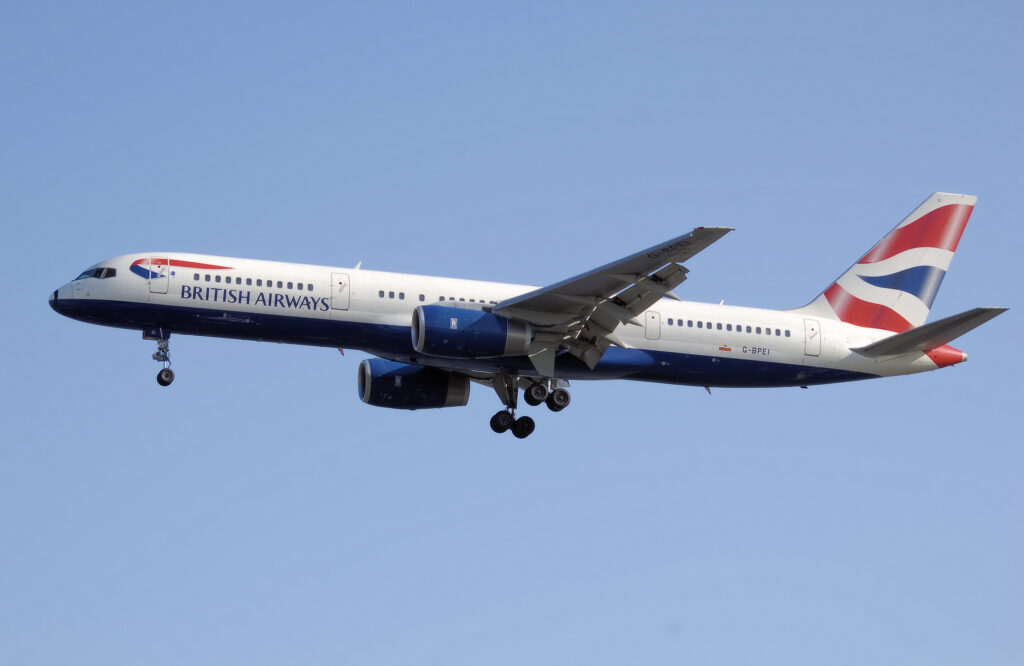
The Boeing 757-200 is a powerful single-aisle airliner that first flew in 1982. Boeing built 913 of the 1,050 757s as this version before production ended in 2004, and many still fly transatlantic, high-altitude and cargo routes.
| General Characteristics | |
| Type | Narrow-body airliner, Civil and Commercial Aircraft |
|---|---|
| National Origin | United States |
| Manufacturer | Boeing |
| Variants | 757-200, 757-200PF, 757-200M, 757-200SF/PCF conversions, C-32 (military) |
| Status | In service (production ended 2004) |
| First Flight | 19 February 1982 |
| Introduction | 1 January 1983 with Eastern Air Lines |
| Primary Users | Delta Air Lines, United Airlines, FedEx Express, DHL |
| Number Built | 913 757-200s (1,050 757s in total) |
| Capacity & Dimensions | |
| Cockpit Crew | Two |
| Typical Seating | 200 (two-class) |
| Max Seating | 239 (exit limit) |
| Overall Length | 47.32 m (155 ft 3 in) |
| Wing Span | 38.05 m (124 ft 10 in) |
| Wing Sweep | 25° |
| Wing Area | 185.25 m² (1,994 sq ft) |
| Overall Height | 13.56 m (44 ft 6 in) |
| Weights, Powerplant & Performance | |
| MTOW | 115,660 kg (255,000 lb) |
| OEW | 58,440 kg (128,840 lb) |
| Fuel Capacity | 43,490 L (11,489 US gal) |
| Engines | 2 × Rolls-Royce RB211-535 or Pratt & Whitney PW2000 |
| Max. Thrust | 163–193 kN (36,600–43,500 lbf) each |
| Typical Cruise Speed | Mach 0.80 |
| Max. Speed | Mach 0.86 |
| Range | 7,250 km (3,915 nmi) |
| Service Ceiling | 13,000 m (42,000 ft) |
The Boeing 757-200 is a single-aisle airliner known for its long, thin fuselage, tall landing gear and unusually powerful engines. It first flew on 19 February 1982 and entered service with Eastern Air Lines on 1 January 1983. Boeing built 1,050 757s before the line closed in 2004, and 913 of them were 757-200s. Two decades later, airlines still have no exact replacement for it.
Origins
In the late 1970s, Boeing studied a successor to the Boeing 727-200, the best-selling airliner of its day. The new design kept the 727’s six-across cabin but used two large high-bypass turbofans instead of three older engines, and a new wing with less sweep. It was developed alongside the widebody 767, and the two types share a flight deck design. Pilots can fly both on one type rating, which airlines with mixed fleets valued highly.
Design and Performance
The 757-200 is 47.32 m (155 ft 3 in) long, much longer than a typical Boeing 737-800. Its wing has 25 degrees of sweep and a large area of 185.25 m², and each engine produces up to about 193 kN (43,500 lbf) of thrust. This combination gives the 757 a very high thrust-to-weight ratio for an airliner. It can take off from short runways and from hot, high airports, climb steeply out of noise-sensitive airports and still cruise at Mach 0.80.
At its maximum take-off weight of 115,660 kg (255,000 lb), the 757-200 has a range of about 7,250 km (3,915 nmi). That is enough to cross the North Atlantic between the US East Coast and Western Europe, and airlines such as Delta, United and Icelandair have used the type for years on routes too thin for a widebody.
Engines
The launch engine was the Rolls-Royce RB211-535C, the first time Boeing had launched an airliner with a non-US engine. Later aircraft used the more powerful RB211-535E4 or the Pratt & Whitney PW2000 series. Many 757s were also fitted with blended winglets, which cut fuel burn on longer routes.
Variants
- 757-200: the passenger version, typically with 200 seats in two classes and up to 239 at the exit limit.
- 757-200PF: a freighter built for UPS without passenger windows.
- 757-200M: a combi with passengers and cargo on the main deck; only one was built, for Royal Nepal Airlines.
- Converted freighters: hundreds of retired passenger 757s have been converted for FedEx, DHL and other cargo airlines.
- C-32: a US Air Force VIP transport, often used by the Vice President.
The stretched Boeing 757-300 is the only other passenger length.
The End of Production
Sales slowed after 2001 as airlines bought larger 737 and A321 models instead. Boeing rolled out the last 757 on 28 October 2004. Today the Airbus A321neo, especially the long-range A321LR and A321XLR, is taking over many of the 757’s routes, but few aircraft match its short-field and climb performance.
The 757 Today
Delta Air Lines and United Airlines remain the largest passenger operators of the 757, and pilots often describe it as one of the best-performing airliners they have flown. In the cargo world the type is even more common: FedEx, DHL and UPS all fly 757 freighters on overnight express networks, where its large main deck and good field performance suit short runways at regional cargo hubs. A number of 757s have also become private and VIP aircraft, and others serve as engine test beds for manufacturers.
Frequently Asked Questions
How many seats does the Boeing 757-200 have? About 200 in two classes, with a maximum of 239.
Why is the 757 still flying? Its powerful engines and good range suit routes no other narrow-body aircraft could fly until recently.
When did Boeing stop building the 757? The last aircraft rolled out in October 2004.
Start the discussion
Commenting on this aircraft: Boeing 757-200 Airliner