







Last Updated: 4 months ago
← Back to Aircraft Database| General Characteristics | |
| Type | Special-Purpose Aircraft |
|---|---|
| National Origin | Canada |
| Manufacturer | Canadair |
| Status | In service |
| First Flight | 6 December 1993 |
| Introduction | 1994 |
| Primary Users | Vigili del Fuoco (Italy), Sécurité Civile (France), Hellenic Air Force (Greece), Service Aérien Gouvernemental |
| Number Built | 95 |
| Developed From | N/A |
| Capacity & Dimensions | |
| Cockpit Crew | two |
| Typical Seating | Up to 18 paratroops / 2,903 kg (6,400 lb) of cargo |
| Max Seating | 18 seats |
| Overall Length | 20.4 m (66 ft 11 in) |
| Wing Span | 28.38 m (93.11 ft) |
| Wing Sweep | 0 degrees |
| Wing Area | 100 m2 (1,080 sq ft) |
| Overall Height | 9.01 m (29.55 ft) |
| Weights, Powerplant & Performance | |
| MTOW | 19,890 kg (43,850 lb) Firefighting, Land |
| OEW | 13,608 kg (30,000 lb) |
| Fuel Capacity | 5,812 L (1,535 US Gal) |
| Engines | 2 × Pratt & Whitney Canada PW123AF turboprop |
| Max. Thrust | 2 × 1,775 kW (2,380 hp) each |
| Typical Cruise Speed | 333 km/h (207 mph, 180 kn) Normal Cruise |
| Max. Speed | 359 km/h (223 mph, 194 kn) Max Cruise |
| Range | 2,427 km (1,508 mi, 1,310 nmi) Ferry range |
| Takeoff Distance | 783 m (2,569 ft) on land / 814 m (2,671 ft) on water |
| Service Ceiling | N/A |
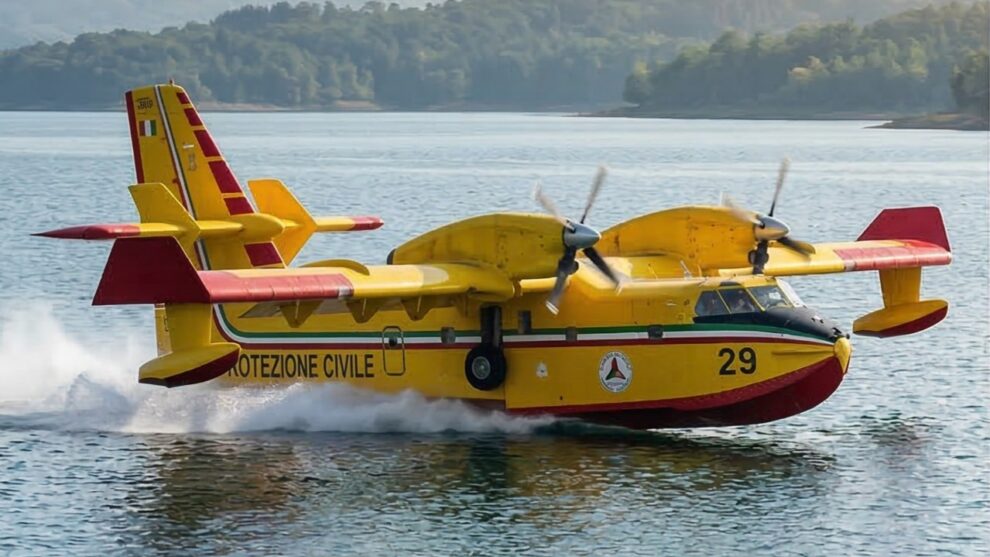
The Canadair CL-415 is a turboprop amphibious firefighting aircraft developed from the successful Canadair CL-215. It keeps the same basic “scooper” concept, yet it adds more power, improved systems and better firefighting performance. As a result, the CL-415 became one of the most recognized water bombers in the world.
The aircraft can land on water, scoop thousands of litres of water in seconds, climb away and drop the load over a wildfire. Therefore, it gives firefighting agencies a fast and repeatable way to attack fires near lakes, rivers, reservoirs or coastal waters. Instead of returning to an airport after every drop, the aircraft can reload directly from a suitable water source.
The Canadair CL-415 first flew on December 6, 1993, and deliveries began in 1994. Although the design comes from the earlier CL-215, the CL-415 uses Pratt & Whitney Canada turboprop engines instead of radial piston engines. Consequently, it offers stronger performance, improved reliability and a more modern operating profile.
Canadair CL-415 General Characteristics
| Feature | Specification |
|---|---|
| Aircraft Type | Amphibious aerial firefighting aircraft |
| Main Category | Special-Purpose Aircraft |
| Additional Category | Civil and Commercial Aircraft |
| Manufacturer | Canadair |
| Later Program Owner | Bombardier Aerospace |
| National Origin | Canada |
| First Flight | December 6, 1993 |
| First Deliveries | 1994 |
| Developed From | Canadair CL-215 |
| Primary Role | Aerial firefighting and water bombing |
| Secondary Roles | Search and rescue, maritime patrol and utility support |
| Crew | Two pilots |
| Status | In service with several firefighting operators |
The aircraft uses a high-wing layout, a flying boat hull and retractable landing gear. Because of this amphibious design, it can operate from both water and land. In addition, its structure supports repeated scooping cycles, low-altitude flying and demanding firefighting operations.
CL-415 Water Bomber Mission
The CL-415 works as a purpose-built water bomber. During a firefighting mission, the crew descends toward a suitable water surface and begins a scooping run. The aircraft then fills its tanks while moving across the water and climbs away toward the fire zone.
This mission profile gives the aircraft a major advantage over aircraft that must reload at an airport. If a fire sits close to a lake or coastline, the Canadair CL-415 can repeat the water pickup and drop cycle many times during one mission. Therefore, it can deliver a high volume of water in a short period.
The aircraft can carry about 6,137 litres of water. It can also carry foam, which allows crews to improve firefighting effectiveness in selected mission profiles. Moreover, pilots can control water release patterns to match the fire line, terrain and tactical requirements.
Canadair CL-415 Dimensions
| Feature | Specification |
|---|---|
| Length | 19.8 m / 65.0 ft |
| Wingspan | 28.6 m / 93.8 ft |
| Height | 9.02 m / 29.5 ft |
| Wing Area | 100.34 m² / 1,080 ft² |
| Horizontal Stabilizer Span | 10.97 m / 36.0 ft |
| Wheel Track | 5.25 m / 17.2 ft |
| Wheelbase | 7.22 m / 23.7 ft |
| Propeller Diameter | 3.97 m / 13.0 ft |
The Canadair CL-415 has a practical shape rather than a purely aerodynamic one. Its high wing keeps the engines and propellers away from water spray during scooping. Meanwhile, the flying boat hull allows the aircraft to operate repeatedly from water surfaces.
Compared with the piston-powered CL-215, the CL-415 has visible aerodynamic and systems improvements. In addition, its turboprop engines give it a more modern appearance and stronger mission capability.
Canadair CL-415 Engines and Performance
The Canadair CL-415 uses two Pratt & Whitney Canada PW123AF turboprop engines. These engines mark one of the biggest differences between the CL-415 and the earlier CL-215. They provide better power response, improved reliability and stronger performance during demanding water operations.
| Feature | Specification |
|---|---|
| Engines | 2 × Pratt & Whitney Canada PW123AF turboprop engines |
| Engine Type | Turboprop |
| Propellers | Multi-blade constant-speed propellers |
| Maximum Cruise Speed | 346 km/h / 187 kt |
| Normal Cruise Speed | 333 km/h / 180 kt |
| Long-Range Cruise Speed | 259 km/h / 140 kt |
| Stall Speed | 126 km/h / 68 kt in landing configuration |
| Ferry Range | 2,333 km / 1,260 nautical miles |
| Average Fuel Consumption | 597 kg/h at long-range cruise speed |
These performance figures help the aircraft move quickly between water sources and fire zones. However, the CL-415 does not rely only on speed. Its true strength comes from its ability to fly low, scoop water quickly and repeat the same cycle many times.
Water and Foam Capacity
| Feature | Specification |
|---|---|
| Water Tank Capacity | 6,137 litres / 1,621 US gallons |
| Foam Tank Capacity | 680 litres / 180 US gallons |
| Scooping Time | About 12 seconds for full water tank capacity |
| Water Pickup Method | Retractable scoops under the hull |
| Drop System | Controlled water release doors |
The Canadair CL-415 can fill its tanks in about 12 seconds under suitable conditions. This quick scooping ability makes the aircraft highly effective when a usable water source sits near the fire. Consequently, crews can deliver repeated drops without long turnaround delays.
The foam tank adds another layer of flexibility. In some operations, crews can mix foam with water to improve coverage and firefighting effect. Nevertheless, the aircraft’s main identity remains direct water bombing and rapid wildfire response.
Weights and Operating Capability
| Feature | Specification |
|---|---|
| Operating Empty Weight | 12,995 kg / 28,650 lb |
| Maximum Usable Fuel | 4,626 kg / 10,200 lb |
| Maximum Takeoff Weight, Utility Category | 18,597 kg / 41,000 lb |
| Maximum Takeoff Weight, Restricted Category | 19,890 kg / 43,850 lb |
| Maximum Takeoff Weight from Water | 17,170 kg / 37,850 lb |
| Maximum Landing Weight on Land | 16,783 kg / 37,000 lb |
| Maximum Landing Weight on Water | 16,783 kg / 37,000 lb |
| Maximum Lift-Off Weight After Scooping | 21,364 kg / 47,000 lb |
These figures show how specialized the aircraft is. It must handle land takeoffs, water takeoffs, water landings, scooping runs and heavy lift-off conditions after collecting water. Therefore, Canadair designed the CL-415 around a very demanding mission profile.
Why the Canadair CL-415 Was Built
Canadair and later Bombardier developed the CL-415 because firefighting agencies needed a more powerful successor to the CL-215. The earlier CL-215 proved that a purpose-built amphibious water bomber could transform wildfire response. However, operators also wanted better power, improved systems and stronger performance.
The Canadair CL-415 answered that need. It kept the basic amphibious scooper design but replaced the piston engines with turboprops. In addition, it improved the cockpit, water bombing system and operational efficiency.
This made the aircraft especially valuable in wildfire-prone regions. Countries with many lakes, coastlines or reservoirs could use the aircraft to attack fires quickly. As a result, the CL-415 became a familiar sight in Mediterranean, Canadian and other wildfire response fleets.
Operational Role
The CL-415 usually works as part of a larger firefighting system. Ground crews contain the fire, helicopters support precise local drops and fixed-wing aircraft deliver larger loads. Meanwhile, the Canadair CL-415 provides rapid water drops when suitable water sources are available nearby.
The aircraft can also support search and rescue, maritime patrol and utility missions in selected configurations. However, its main role remains aerial firefighting. Its amphibious design, strong engines and water tank system make it highly specialized for wildfire suppression.
Although production of the original CL-415 ended, the design continues through the newer De Havilland Canadair 515 program. This shows the long-term value of the CL-215 and CL-415 family. More importantly, it confirms that purpose-built amphibious water bombers still have a clear role in modern wildfire response.
Comparison with the Canadair CL-215
The Canadair CL-415 developed directly from the CL-215, but the two aircraft are not the same. The CL-215 uses radial piston engines, while the CL-415 uses turboprop engines. Therefore, the CL-415 offers a more modern powerplant, stronger performance and improved operational capability.
The CL-215 established the scooper concept. The CL-415 refined it. Because of that, many aviation enthusiasts see the CL-415 as the more modern and more capable version of the original Canadair water bomber family.
Frequently Asked Questions
What is the Canadair CL-415 used for?
The aircraft mainly performs aerial firefighting. It scoops water from suitable water sources and drops it over wildfire areas.
How much water can the CL-415 carry?
The Canadair CL-415 can carry about 6,137 litres of water, or 1,621 US gallons.
What engines does the Canadair CL-415 use?
It uses two Pratt & Whitney Canada PW123AF turboprop engines.
Is the CL-415 amphibious?
Yes. The aircraft can operate from both land and water because it has a flying boat hull and retractable landing gear.
What is the difference between the CL-215 and CL-415?
The CL-215 uses radial piston engines, while the CL-415 uses turboprop engines. The CL-415 also includes improved systems and better firefighting performance.
Canadair CL-415 Summary
The Canadair CL-415 is a purpose-built turboprop amphibious firefighting aircraft developed from the CL-215. It can scoop about 6,137 litres of water in roughly 12 seconds, operate from land or water and deliver repeated drops during wildfire missions. With its high-wing layout, flying boat hull, Pratt & Whitney Canada turboprop engines and specialized water bombing system, the CL-415 remains one of the most important firefighting aircraft ever built.
Did you know AviationStream.com has a YouTube channel? Check out TheAeroGraphyOfficial and subscribe to watch fun, highly engaging aviation Shorts!