










Last Updated: 1 week ago
Initially, many passengers think the autopilot is just a magical button. Specifically, they believe it lets pilots relax completely during the flight. However, from an aviation perspective, aircraft autopilot systems are highly complex. Indeed, they represent a perfectly coordinated network of sensors, computers, and actuators.
Therefore, the autopilot never acts as an independent artificial intelligence. Instead, it operates strictly under precise programming and constant pilot supervision. Consequently, let us break down how these heavy machines stay on course accurately.
Data Collection: The Senses of the Plane
First, the system relies on continuous monitoring of the plane’s state. Specifically, it uses the Air Data Inertial Reference System (ADIRS).
Naturally, pitot tubes and static ports measure airspeed and altitude constantly. Furthermore, gyroscopes and accelerometers track pitch, roll, yaw, and acceleration.
Additionally, modern designs utilize GPS for incredibly accurate global positioning. Also, they rely on angle-of-attack and temperature sensors. Basically, without this crucial data, the system simply cannot operate safely.
Flight Control Computers in Aircraft Autopilot Systems
Next, sensors send all gathered data to the Flight Control Computers (FCCs). Basically, these computers act as the true brain of the operation. Therefore, modern aircraft autopilot systems rely on advanced algorithms instead of simple loops.
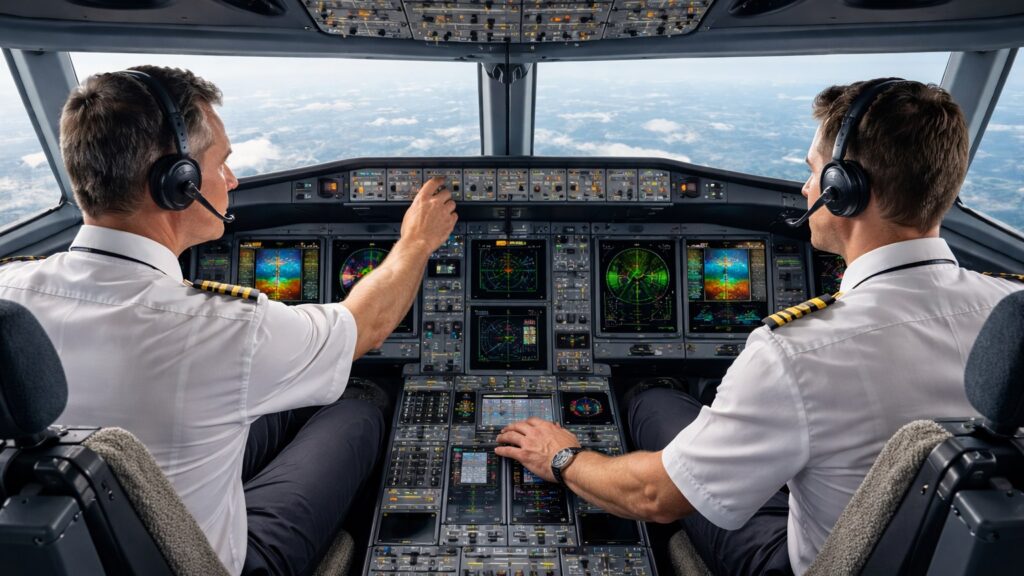
During flight, pilots set targets on the Mode Control Panel (MCP). For example, they input specific altitude, heading, or vertical speed values. Consequently, the FCC compares these targets with actual sensor readings. Ultimately, it sends precise commands to correct the plane’s motion smoothly.
Fly-by-Wire Technology and Actuators
Subsequently, the FCC sends commands as electrical signals. Specifically, these signals travel through the Fly-by-Wire system to various actuators. As a result, these actuators physically move the ailerons, elevators, and rudder.
Interestingly, while the control signals remain entirely electrical, the actuators do not. Instead, they rely heavily on hydraulic power to provide the necessary mechanical force.
Safety Redundancy and The Pilot’s Role
Crucially, engineers build aircraft autopilot systems primarily for absolute safety. For instance, modern planes usually feature three independent computers and multiple sensors. Therefore, if one component fails, the others immediately take over control.
Moreover, the technology does much more than just steer the plane. Specifically, it manages engine thrust, optimizes fuel, and executes automated landings.
In conclusion, pilots remain absolutely essential in the modern cockpit. Ultimately, they act as vital system managers who constantly supervise the flight.
Frequently Asked Questions (FAQs) – Aircraft Autopilot Systems
Can an autopilot land a plane completely by itself? Yes. Modern aircraft autopilot systems can perform fully automated landings in low-visibility conditions using CAT II/III certified Autoland technology.
What happens if the autopilot computer fails? Aviation engineering requires extreme redundancy. Airplanes have multiple independent Flight Control Computers. If one fails, the backup systems instantly take control.
Is the autopilot artificial intelligence? No. It does not think independently. It strictly follows complex mathematical algorithms, precise sensor data, and direct inputs from the pilots.
Did you knowAviationStream.com has a YouTube channel? Check out TheAeroGraphyOfficial and subscribe to watch fun, highly engaging aviation Shorts!








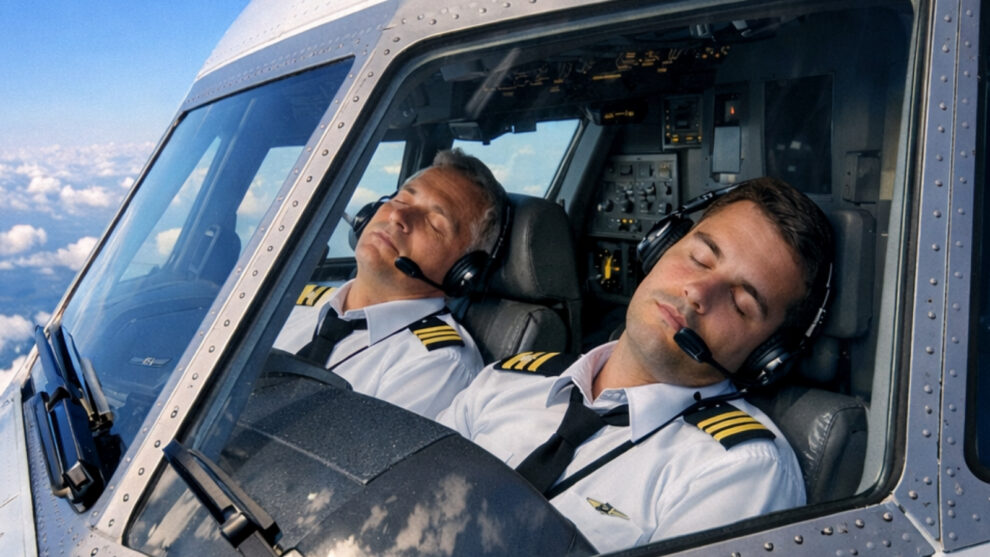
I just wondered who decided to put sleeping pilots photo on featured 🙂