





Last Updated: 4 months ago
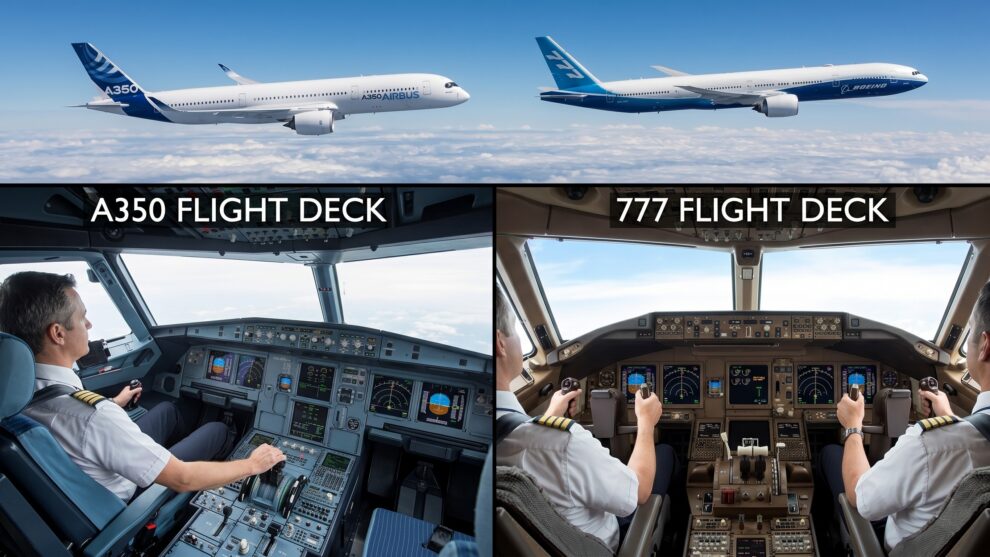
Step into the flight deck of a widebody jet soaring over the Bay of Bengal, and you are sitting inside a flying supercomputer. Asian skies are a massive battleground for long-haul supremacy, dominated heavily by two engineering marvels: the Boeing 777 and the Airbus A350 XWB. Airlines like Cathay Pacific, Singapore Airlines, and ANA rely on these workhorses to navigate fierce monsoons, high-density traffic, and immense oceanic distances.
While aviation geeks love to debate composite fuselages versus aluminum frames, the true heart of this rivalry beats beneath the floorboards. The digital brains governing how these aircraft fly represent two fundamentally different engineering philosophies. Let us dive deep into the fly-by-wire (FBW) logic of the 777 and the A350, decoding the zeros and ones that keep these titans airborne.
The Airbus Way: The A350 and “Normal Law”
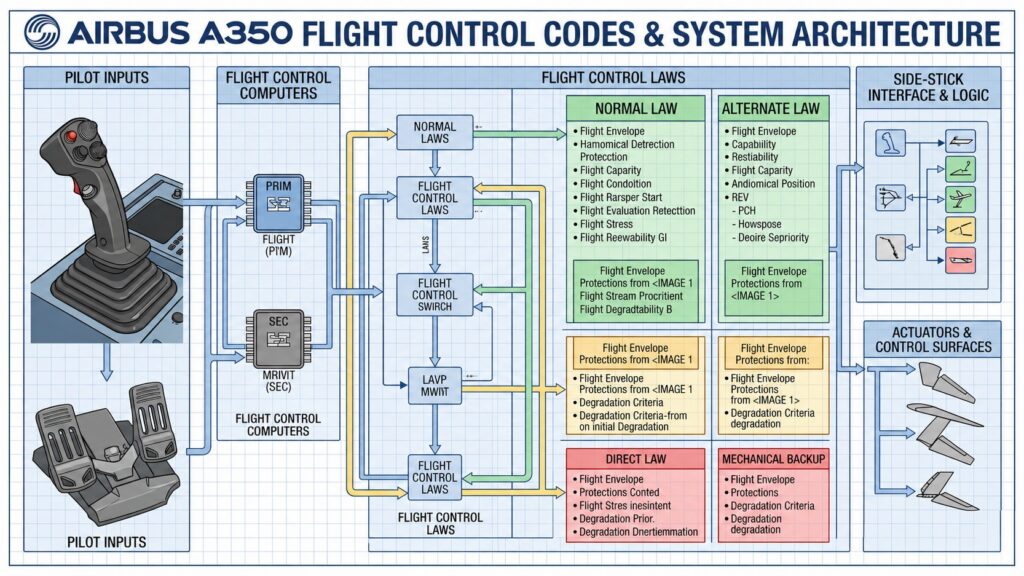
Airbus treats the fly-by-wire system as an invisible co-pilot that never sleeps, never panics, and never exceeds structural limits. The A350 XWB represents the pinnacle of this European design philosophy, utilizing a highly advanced digital flight control system.
Hardware and the AFDX Network
At the core of the A350’s flight controls are three Primary Flight Computers (PRIMs) and three Secondary Flight Computers (SECs). These units process atmospheric and spatial data from the Air Data Inertial Reference Units (ADIRUs).
Older jets relied on the ARINC 429 data bus, which was slow and heavy. The A350 utilizes AFDX (Avionics Full-Duplex Switched Ethernet). Operating at a blistering 100 Mbps, this network uses “virtual links” to guarantee bandwidth for critical flight control data, ensuring that a commanded roll or pitch adjustment reaches the actuators with zero lag.
Normal Law and Hard Limits
Under standard conditions, the A350 operates in Normal Law. This logic provides absolute flight envelope protection. The computers will physically prevent the pilot from making inputs that could stall or overstress the airframe.
- Pitch Limits: Restricted to 30 degrees nose up and 15 degrees nose down.
- Bank Angle: The system halts any roll at exactly 67 degrees.
- Alpha Floor: If the angle of attack reaches a critical threshold, the computers bypass the throttles and automatically apply TOGA (Takeoff/Go-Around) thrust.
The interface for these commands is the passive side-stick. The captain and first officer have independent sticks that are not mechanically linked. If both pilots push their sticks simultaneously in opposite directions, the computers algebraically sum the inputs and trigger a stark “DUAL INPUT” audio warning to prevent confusion.
The Boeing Way: The 777 and C*U Logic
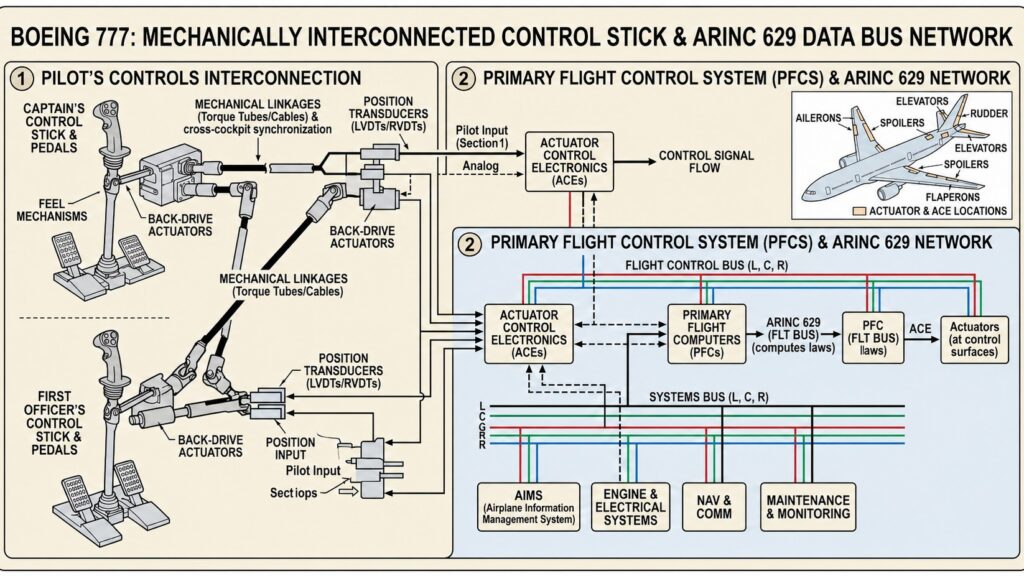
Across the Atlantic, Boeing’s approach with the Triple Seven places the pilot as the undisputed final authority. The 777 was Boeing’s debut foray into civilian fly-by-wire, and they designed it to feel exactly like a conventional aircraft.
The ARINC 629 Data Highway
Underneath the 777’s cockpit lie three Primary Flight Computers (PFCs) that talk to four Actuator Control Electronics (ACEs). The ACEs serve as the crucial translators between the digital computers and the analog hydraulic world. They communicate via the bidirectional ARINC 629 data bus. Operating at 2 Mbps, this architecture is completely unique to the 777.
Once the PFCs calculate the necessary control surface movement, the digital signal travels back to the ACE, which then fires an analog electrical signal to the Power Control Units (PCUs). These PCUs use the aircraft’s robust 3,000 psi hydraulic systems to physically move the ailerons, elevators, and rudder.
C*U Logic and Envelope Protection
Instead of strict limits, Boeing employs envelope protection. The 777 utilizes a control law known as C*U (C-star-U). The “C-star” portion blends pitch rate and g-load to keep the aircraft’s flight path incredibly stable, regardless of turbulence. The “U” stands for speed stability. Unlike the A350, which auto-trims to maintain a trajectory, the 777 requires pilots to manually use the trim switches when changing airspeeds. This gives the pilot the classic, tactile sensation of flying.
Boeing computers will resist dangerous maneuvers, but they will not block them. If a pilot needs to exceed the 35-degree bank angle limit to avoid a mid-air collision, they simply pull or push through the artificial feedback force. Applying roughly 10 to 25 pounds of physical pressure on the yoke overrides the system’s resistance. The traditional yokes are mechanically back-driven; when the captain turns left, the first officer’s yoke mirrors the exact movement, providing instant visual and tactile awareness.
Head-to-Head: Systems Comparison
To clearly see the dividing lines between these engineering marvels, we can examine their core architectures side-by-side.
| Feature | Boeing 777 | Airbus A350 |
| Control Interface | Mechanically linked yokes | Independent passive side-sticks |
| Primary Brains | 3 PFCs, 4 ACEs | 3 PRIMs, 3 SECs |
| Data Network | ARINC 629 (2 Mbps) | AFDX Ethernet (100 Mbps) |
| Flight Envelope | Soft Protection (Pilot can override) | Hard Limits (System prevents override) |
| Speed Stability | Synthetic (Requires manual trim) | Auto-trimmed (Flight path stable) |
| Hydraulic Power | 3,000 psi (Left, Center, Right) | 5,000 psi (Yellow, Green) |
Dominating the Asian Skies
Navigating the dense airspace over Tokyo, the turbulent typhoon alleys near Hong Kong, or the high-altitude terrain flanking the Himalayas demands absolute precision. The 777’s tactile feedback offers crews an immense sense of physical connection during brutal crosswind landings at Narita. In contrast, the A350’s rapid AFDX data processing and flawless gust-alleviation functions provide an unbelievably smooth ride for passengers cruising through unstable equatorial weather systems. Both philosophies achieve phenomenal safety records; they just speak different digital languages to get the job done.
Frequently Asked Questions (FAQ)
1. What happens if all flight computers fail in flight?
In the rare event of a total electrical and computer failure, both aircraft have survival contingencies. The Boeing 777 retains a physical, mechanical cable link from the cockpit to the stabilizer trim and a pair of spoiler panels, allowing basic pitch and roll control. The A350 relies on a Backup Control Module (BCM) powered by the drop-down Ram Air Turbine (RAT), maintaining a simplified digital connection to critical control surfaces.
2. Are the A350’s side-sticks actively coupled like the new Gulfstream jets?
No. While some modern business jets feature active control sticks that physically move to mirror the other pilot’s input, the A350 retains Airbus’s traditional passive side-stick design. The pilots rely on cockpit displays and “DUAL INPUT” audio alerts to maintain awareness of who is controlling the aircraft.
3. Why does the A350 use 5,000 psi hydraulics while the 777 uses 3,000 psi?
Airbus increased the hydraulic pressure on the A350 to 5,000 psi to save weight. Higher pressure allows for smaller hydraulic lines, smaller fluid reservoirs, and lighter actuators. This weight reduction directly contributes to the A350’s exceptional fuel efficiency on ultra-long-haul Asian routes.
What is your take on the ultimate fly-by-wire philosophy? Do you prefer Boeing’s “pilot in command” yoke, or do you trust Airbus’s high-tech, hard-limit side-stick? Drop your thoughts, technical questions, and experiences in the comments below! Let’s keep the avgeek discussion going.
Did you know AviationStream.com has a YouTube channel? Check out TheAeroGraphyOfficial and subscribe to watch fun, highly engaging aviation Shorts!