British Eagle International Airlines Flight 802/6
A British Eagle Bristol Britannia carrying skiers to Innsbruck flew into the Glungezer mountain on 29 February 1964. All 83 people on board died.
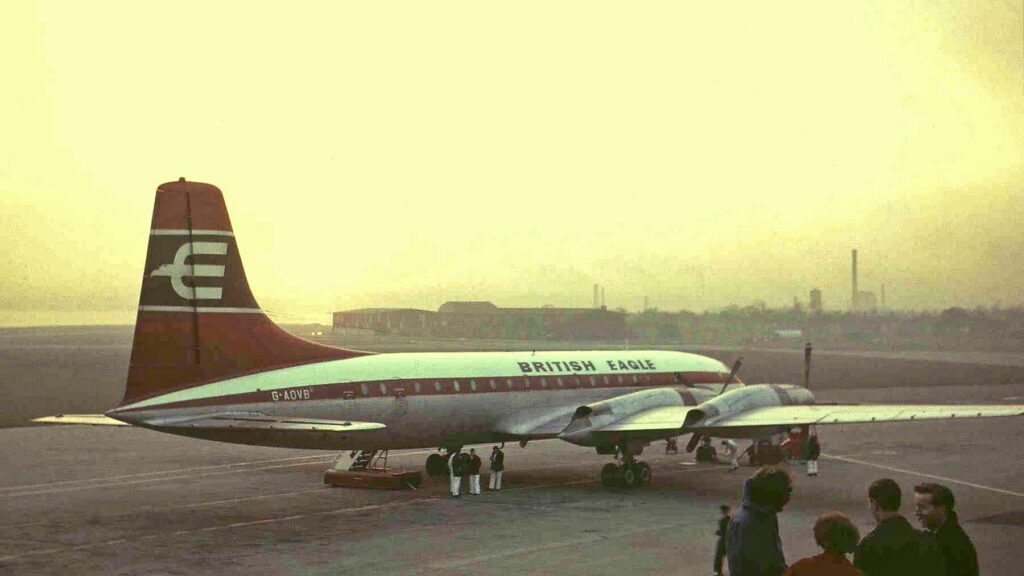
British Eagle Flight 802/6 was a Bristol Britannia flying holidaymakers from London to Innsbruck that struck the Glungezer mountain in the Austrian Alps on 29 February 1964. All 83 people on board died. The crash, on an approach surrounded by high terrain and in poor weather, is one of the deadliest air accidents in Austria and a lasting example of why approaches into mountain valleys demand special procedures.
Flight 802/6 at a glance
- Date: Saturday 29 February 1964
- Aircraft: Bristol Britannia 312, a four-engine turboprop airliner
- Operator: British Eagle International Airlines
- Route: London Heathrow to Innsbruck, Austria
- On board: 75 passengers and 8 crew
- Fatalities: 83, with no survivors
- Place: Glungezer mountain, south-east of Innsbruck
- Investigation: Austrian aviation authorities
A difficult approach
Innsbruck Airport lies in the narrow Inn valley, with mountains rising more than 2,000 metres above the runway on both sides. In 1964 there was no instrument landing system. Aircraft let down using radio beacons and then had to continue visually along the valley, which required good visibility below the cloud.
On the afternoon of the accident, cloud covered the mountains around the valley. The Britannia, full of passengers heading for a skiing holiday, was making its approach to Innsbruck when it flew into the slopes of the Glungezer, a peak of about 2,600 metres, at high altitude above the valley floor. The aircraft was destroyed and caught fire. Rescue teams reached the site, high on a snow-covered mountainside, only with great difficulty.
Why it happened
The investigation concluded that the aircraft had descended below the minimum safe altitude for the area while in or near cloud, without the visual contact with the ground that the approach required. The exact reasons for the crew’s decision could not be fully established. The accident illustrated how small errors in position or altitude leave no margin when the terrain rises steeply on all sides.
What changed
- Mountain approaches. Innsbruck is today one of Europe’s most demanding airports. Crews need specific training and briefing before they may fly there, and the approaches use precise procedures that keep aircraft clear of the surrounding peaks.
- Terrain awareness. Accidents like this one, where a serviceable aircraft is flown into the ground, were behind the later development of ground proximity and terrain awareness warning systems, now standard on airliners.
The Austrian airline Lauda Air was later involved in the loss of Flight 004 in Thailand in 1991, a very different accident caused by an uncommanded thrust reverser deployment.
Remembering the victims
Most passengers were British families and young people on a winter holiday. The loss of 83 people on a holiday flight shocked both Britain and Austria.
Sources
Austrian aviation authorities’ report on the accident to the British Eagle Bristol Britannia (1964); contemporary reports in the UK and Austrian press.
Related Historical Aviation Accidents Events
More significant events from aviation history
Assassination of Juvénal Habyarimana and Cyprien Ntaryamira: The 1994 Aircraft Shootdown in Rwanda
🗓 6 April, 1994 📍 Presidential Palace gardens, near Kigali International Airport, Kigali, Rwanda, 1°58′32″S 30°10′26″E / 1.9756°S 30.1739°E / -1.9756; 30.1739 ★★★★☆ Read full story →
1996 Charkhi Dadri Collision: The Deadliest Mid-Air Crash
🗓 12 November, 1996 📍 Charkhi Dadri, Haryana, India, 28°33′38″N 76°18′15″E / 28.56056°N 76.30417°E / 28.56056; 76.30417 ★★★★☆ Read full story →
United Airlines Flight 736: The Crash That Changed Aviation
🗓 21 April, 1958 📍 Clark County, Nevada, United States ★★★★☆ Read full story →
The Tragedy of Lauda Air Flight 004
🗓 26 May, 1991 📍 Phu Toei National Park, Suphan Buri province, Thailand, 14°56′48″N 99°27′10″E / 14.94667°N 99.45278°E / 14.94667; 99.45278 ★★★☆☆ Read full story →