TWA Flight 800
A Boeing 747 exploded minutes after leaving New York on 17 July 1996. The NTSB traced it to fuel vapour igniting in the centre wing tank, and airliners now carry inerting systems.
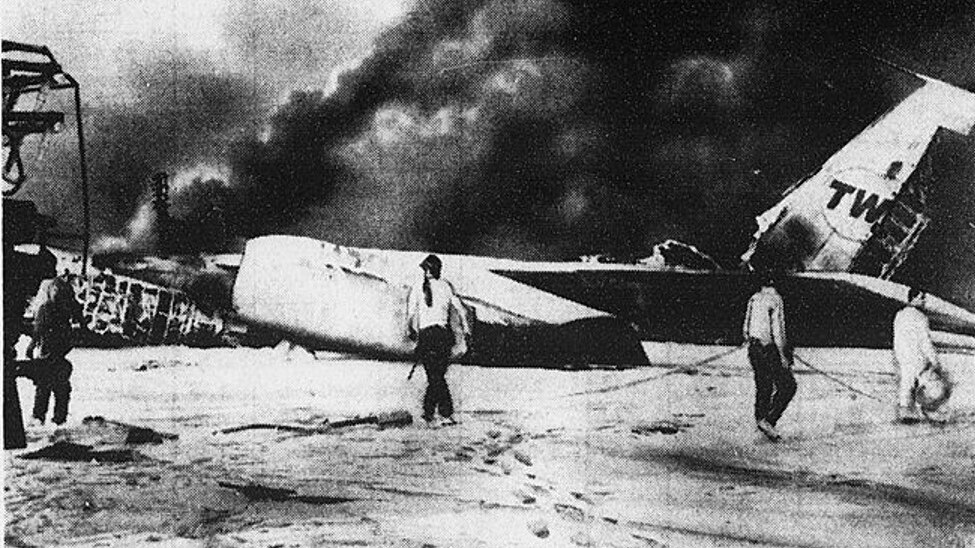
TWA Flight 800 was a Boeing 747 that exploded and broke apart over the Atlantic Ocean off Long Island, New York, on 17 July 1996, twelve minutes after taking off from JFK for Paris. All 230 people on board died. After one of the longest and most complex investigations in its history, the NTSB concluded that fuel vapour in the nearly empty centre wing tank had ignited. The finding changed how airliners are designed: many now fill their fuel tanks with nitrogen-enriched air so that they cannot explode.
TWA Flight 800 at a glance
- Date: Wednesday 17 July 1996, about 20:31 local time
- Aircraft: Boeing 747-131, delivered in 1971
- Route: New York JFK to Paris Charles de Gaulle, continuing to Rome
- On board: 212 passengers and 18 crew
- Fatalities: 230, with no survivors
- Place: Atlantic Ocean near East Moriches, Long Island, New York
- Investigation: US National Transportation Safety Board (NTSB)
What happened
Flight 800 left JFK in the evening after a delay. It was climbing through about 13,700 feet when the centre wing fuel tank exploded. The blast weakened the structure ahead of the wing, and the front of the aircraft separated. The rest of the 747 continued briefly before falling into the sea in flames. People on the shore and in other aircraft saw a streak of light and a fireball.
Because the explosion happened just weeks before the Atlanta Olympics and many witnesses described a streak rising towards the aircraft, the FBI opened a criminal investigation alongside the NTSB. Divers and trawlers recovered more than 95 per cent of the aircraft from the seabed, and investigators rebuilt a large section of the fuselage around the centre tank on a frame in a hangar.
Why the NTSB blamed the fuel tank
The centre wing tank held only a small amount of fuel. The 747 had been parked in summer heat with its air-conditioning packs running; they sit directly below that tank and warmed it. The remaining fuel gave off vapour, and the mix of vapour and air inside the tank was flammable.
The NTSB found no evidence of a bomb or missile: no damage from a high-velocity warhead and no explosive residue that could not be explained. The reconstruction showed the explosion began inside the tank. The board concluded that the most likely ignition source was a short circuit outside the tank that let excess voltage into the wiring of the fuel quantity indication system. The FBI closed its investigation having found no evidence of a crime.
The witness reports were studied in detail. The NTSB and the CIA concluded that most witnesses had seen the burning aircraft after the explosion, climbing briefly as the nose came off, rather than a missile.
What changed after TWA 800
- Fuel tank inerting. In 2008 the FAA required airliners with heated centre tanks to reduce tank flammability. Most do it with a nitrogen generation system that fills the empty space in the tank with nitrogen-enriched air. Our article on the A350 nitrogen generation system explains how these systems work.
- Wiring. Ageing wiring became a safety subject in its own right, with new rules on inspection, separation of fuel system wires and protection against sparks inside tanks.
- Family assistance. The handling of the victims’ families led to the Aviation Disaster Family Assistance Act of 1996 in the United States.
Remembering the victims
Among the victims were 16 students and five chaperones from a high school French club in Montoursville, Pennsylvania. A memorial with the names of all 230 victims stands at Smith Point County Park on Long Island, facing the sea where the aircraft came down.
Sources
NTSB Aircraft Accident Report NTSB/AAR-00/03, In-flight Breakup Over the Atlantic Ocean, Trans World Airlines Flight 800 (2000); FAA Fuel Tank Flammability Reduction rule (2008).
Related Historical Aviation Accidents Events
More significant events from aviation history
Assassination of Juvénal Habyarimana and Cyprien Ntaryamira: The 1994 Aircraft Shootdown in Rwanda
🗓 6 April, 1994 📍 Presidential Palace gardens, near Kigali International Airport, Kigali, Rwanda, 1°58′32″S 30°10′26″E / 1.9756°S 30.1739°E / -1.9756; 30.1739 ★★★★☆ Read full story →
1996 Charkhi Dadri Collision: The Deadliest Mid-Air Crash
🗓 12 November, 1996 📍 Charkhi Dadri, Haryana, India, 28°33′38″N 76°18′15″E / 28.56056°N 76.30417°E / 28.56056; 76.30417 ★★★★☆ Read full story →
United Airlines Flight 736: The Crash That Changed Aviation
🗓 21 April, 1958 📍 Clark County, Nevada, United States ★★★★☆ Read full story →
The Tragedy of Lauda Air Flight 004
🗓 26 May, 1991 📍 Phu Toei National Park, Suphan Buri province, Thailand, 14°56′48″N 99°27′10″E / 14.94667°N 99.45278°E / 14.94667; 99.45278 ★★★☆☆ Read full story →