Eugene Ely Makes the First Take-off From a Ship
On 14 November 1910, civilian pilot Eugene Ely flew a Curtiss pusher off a wooden platform on the cruiser USS Birmingham, the first aircraft take-off from a ship.
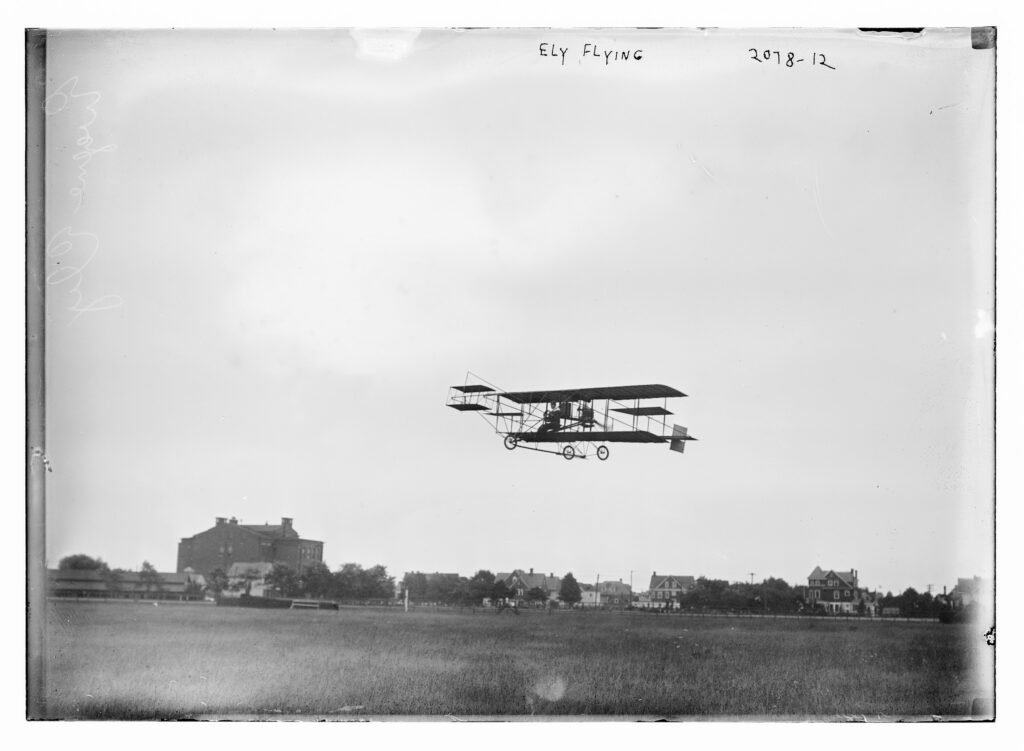
On 14 November 1910, a civilian pilot named Eugene Ely flew a Curtiss pusher biplane off a sloping wooden platform built over the bow of the US Navy cruiser USS Birmingham, anchored off Hampton Roads, Virginia. It was the first time an aircraft had taken off from a ship, and the first step towards the aircraft carrier.
Eugene Ely’s flight at a glance
- Date: 14 November 1910
- Pilot: Eugene B. Ely, a civilian exhibition pilot flying for Glenn Curtiss
- Aircraft: Curtiss pusher biplane
- Ship: cruiser USS Birmingham
- Place: Hampton Roads, Virginia, United States
- Outcome: successful take-off; landing on the shore at Willoughby Spit
Why the Navy wanted to try it
By 1910 aircraft could fly reliably enough to interest the world’s navies. A plane that could scout ahead of a fleet would see far beyond the horizon visible from a ship’s mast. Captain Washington Irving Chambers, the officer given responsibility for naval aviation, arranged the experiment with Glenn Curtiss’s team, and Ely, one of Curtiss’s exhibition pilots, volunteered to fly.
A wooden platform was built over the Birmingham’s bow, sloping down towards the water. It was only a few dozen metres long, far too short for a comfortable take-off by the standards of the day.
The take-off
Rain and low cloud delayed the attempt until the afternoon. When the weather briefly improved, Ely started the engine and rolled down the ramp. The aircraft dropped as it left the bow and its wheels and propeller touched the water, throwing spray that drenched Ely’s goggles. Half-blinded, he kept the aircraft flying, regained height and, rather than heading for the Norfolk Navy Yard as planned, landed on the beach at nearby Willoughby Spit after a flight of only a few minutes.
What came next
Two months later, on 18 January 1911, Ely made the first landing on a ship, touching down on a platform built on the stern of the armoured cruiser USS Pennsylvania in San Francisco Bay. Ropes stretched across the deck and weighted with sandbags caught hooks under the aircraft, an early form of the arresting gear still used on carriers today. He then took off again from the same platform.
Ely never saw where his flights led. He died in a crash at an exhibition in Macon, Georgia, in October 1911. In 1933 he was posthumously awarded the Distinguished Flying Cross for his contribution to naval aviation.
Why it matters
Within a decade, navies were building ships with full-length flight decks, and by the Second World War the aircraft carrier had replaced the battleship as the centre of naval power. Every carrier launch, from biplanes to today’s jets, traces back to a short, wet take-off from a wooden ramp in Hampton Roads.
See what else happened in aviation this month in our Aviation History Calendar, or read about another pioneering record, the first non-stop flight from Paris to New York.
Sources
- Naval History and Heritage Command, records on Eugene Ely and USS Birmingham (1910)
- Smithsonian National Air and Space Museum, early naval aviation collections
Related Aviation Milestones Events
More significant events from aviation history
Paris to New York flight: First Non-Stop 1948 Journey
🗓 28 April, 1948 📍 Paris,New York ★★★☆☆ Read full story →
Women’s World Speed Record
🗓 1 May, 1963 📍 Edwards Air Force Base, California. ★★☆☆☆ Read full story →
Boom XB-1 Breaks the Sound Barrier
🗓 28 January, 2025 📍 Mojave Air & Space Port, California, United States ★★☆☆☆ Read full story →
1996 Charkhi Dadri Collision: The Deadliest Mid-Air Crash
🗓 12 November, 1996 📍 Charkhi Dadri, Haryana, India, 28°33′38″N 76°18′15″E / 28.56056°N 76.30417°E / 28.56056; 76.30417 ★★★★☆ Read full story →