United Airlines Flight 232
After a fan disk failure cut all three hydraulic systems on 19 July 1989, the crew of a DC-10 steered with engine thrust alone to a crash landing at Sioux City. 184 people survived.
United Airlines Flight 232 was a McDonnell Douglas DC-10 that crash-landed at Sioux Gateway Airport in Iowa on 19 July 1989, after the failure of its tail-mounted engine destroyed all three hydraulic systems. With no working flight controls, the crew steered the aircraft for about 40 minutes by changing the power of the two remaining engines. 112 people died, but 184 survived an accident that simulators had suggested was not survivable at all.
Flight 232 at a glance
- Date: 19 July 1989
- Aircraft: McDonnell Douglas DC-10-10
- Route: Denver Stapleton to Chicago O’Hare, continuing to Philadelphia
- On board: 285 passengers and 11 crew
- Fatalities: 112; 184 survived
- Place: Sioux Gateway Airport, Sioux City, Iowa, United States
- Investigation: US National Transportation Safety Board (NTSB)
What happened
About an hour into the flight, cruising at 37,000 feet over Iowa, the crew heard a bang and felt the aircraft shake. The fan disk of the number two engine, mounted in the tail, had broken apart. Fragments tore through the tail, and the three hydraulic systems that powered the flight controls all lost their fluid. The DC-10 had been designed so that a total loss of hydraulics was considered almost impossible, and there was no checklist for it.
Captain Al Haynes, First Officer Bill Records and Second Officer Dudley Dvorak found that the aircraft wanted to roll and turn. The only control they had was the thrust of the two wing engines: more power on one side turned the aircraft, and more power on both raised the nose. Dennis Fitch, a United DC-10 training captain travelling as a passenger, came to the cockpit and took over the throttles so the others could concentrate on the rest.
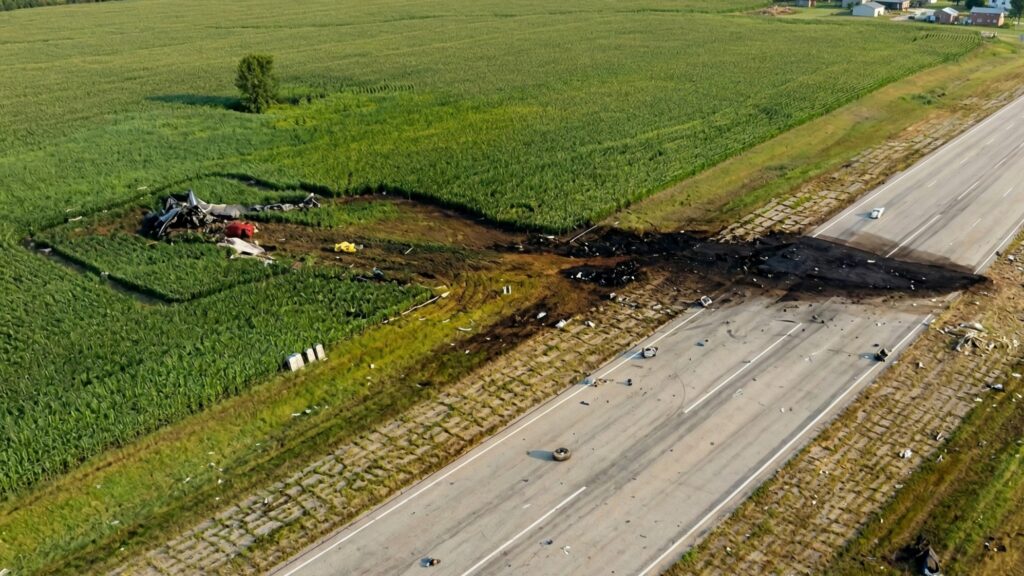
The aircraft could only turn right reliably and it swung up and down in long oscillations. The crew brought it round in a series of right turns to line up with Sioux City, where emergency services had been alerted. At touchdown the DC-10 was descending and travelling far faster than a normal landing. The right wing struck the runway, the aircraft broke apart and caught fire, and part of the fuselage came to rest in a cornfield. Many survivors walked out of the wreck through the corn.
Why the engine failed
The NTSB found a small defect in the titanium fan disk, a “hard alpha” inclusion created when the metal was made about 18 years earlier. A fatigue crack had grown from it over thousands of flights. The crack should have been found during an inspection, but it was not detected. When the disk failed, the fragments severed hydraulic lines that, in the tail, ran close together.
What changed after Flight 232
- Engine parts. Titanium production and the inspection of rotating engine parts were improved to find defects like the one in the disk.
- Hydraulic protection. Fuses were added to the DC-10’s hydraulic system so that damage in the tail could no longer drain all the fluid.
- Crew resource management. Haynes credited the outcome to teamwork. Flight 232 became one of the clearest examples of crew resource management working under extreme pressure.
- Emergency planning. Sioux City had rehearsed a major air disaster two years earlier, and that preparation is credited with saving lives.
- Thrust-only control. The flight, like Japan Air Lines Flight 123 four years earlier, inspired NASA research into landing aircraft using engine power alone.
Remembering the victims
A memorial in Sioux City shows a local guardsman, Lt Col Dennis Nielsen, carrying a child from the wreck, a scene captured in a photograph that became the image of the day. Survivors, crew and rescuers have met in Sioux City on many anniversaries.
Sources
NTSB Aircraft Accident Report NTSB/AAR-90/06, United Airlines Flight 232, McDonnell Douglas DC-10-10, Sioux Gateway Airport (1990).
Related Historical Aviation Accidents Events
More significant events from aviation history
Assassination of Juvénal Habyarimana and Cyprien Ntaryamira: The 1994 Aircraft Shootdown in Rwanda
🗓 6 April, 1994 📍 Presidential Palace gardens, near Kigali International Airport, Kigali, Rwanda, 1°58′32″S 30°10′26″E / 1.9756°S 30.1739°E / -1.9756; 30.1739 ★★★★☆ Read full story →
1996 Charkhi Dadri Collision: The Deadliest Mid-Air Crash
🗓 12 November, 1996 📍 Charkhi Dadri, Haryana, India, 28°33′38″N 76°18′15″E / 28.56056°N 76.30417°E / 28.56056; 76.30417 ★★★★☆ Read full story →
United Airlines Flight 736: The Crash That Changed Aviation
🗓 21 April, 1958 📍 Clark County, Nevada, United States ★★★★☆ Read full story →
The Tragedy of Lauda Air Flight 004
🗓 26 May, 1991 📍 Phu Toei National Park, Suphan Buri province, Thailand, 14°56′48″N 99°27′10″E / 14.94667°N 99.45278°E / 14.94667; 99.45278 ★★★☆☆ Read full story →