TACA Flight 110
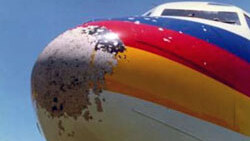
The miraculous survival of TACA Airlines Flight 110 stands as one of the most remarkable technical feats in the history of commercial aviation. On May 24, 1988, a brand-new Boeing 737-300 lost all engine power while descending through a severe thunderstorm toward New Orleans, Louisiana.
With both turbofan engines destroyed by hail and no airport within gliding distance, the flight crew executed an unprecedented dead-stick landing—landing a completely unpowered commercial airliner—on a narrow grass levee. The incident became a definitive case study in double engine flameout analysis and forced permanent modifications to modern jet engine design.
Flight Profile, Aircraft Data, and Weather Matrix
TACA Flight 110 was a scheduled international passenger service routing from San Salvador, El Salvador, to New Orleans, with an intermediate stop in Belize City.
- The Aircraft: A Boeing 737-300 (registration N7535A). The airframe was virtually brand new, with only 60 total flight hours on the engines, representing the cutting edge of late-1980s narrow-body commercial aviation.
- The Engines: The aircraft was equipped with two advanced CFM56-3B1 turbofan engines, which were highly regarded for their fuel efficiency and reliability.
- The Flight Crew: The flight deck was commanded by Captain Carlos Dardano, a highly experienced 29-year-old pilot with over 13,400 flight hours. Remarkably, Dardano flew with only one eye, having lost his left eye to crossfire during a civil conflict in El Salvador years prior. Alongside him was First Officer Dionisio Lopez.
Chronology of a Double Engine Flameout
The flight proceeded normally across the Gulf of Mexico until it initiated its descent into the New Orleans metropolitan area from a flight level of 29,000 feet (FL290).
As the aircraft descended through 16,500 feet, the flight crew noted areas of heavy precipitation on their onboard weather radar. To safely navigate the convective activity, Captain Dardano selected a route through what appeared to be a lighter gap between intense storm cells.
The Storm Encounter
The gap proved to be an illusion. The Boeing 737 flew directly into an un-mapped, violently developing convective storm cell characterized by torrential rain, heavy lightning, and massive, dense hail.
The sheer volume of water and hail ingestion completely choked the airflow into the combustion chambers of the CFM56 engines. This sudden, massive thermal shock caused both engines to experience a complete flameout.
The Attempted Restart
Gliding rapidly through the cloud layer without thrust, the pilots successfully executed an in-flight restart protocol using the Auxiliary Power Unit (APU) to provide electrical power. However, the relief was short-lived. The intense hail had severely damaged the internal compressor blades of both engines. As the engines spooled up, they lacked proper airflow, causing an immediate over-temperature condition (thermal runaway).
Fearing a catastrophic mid-air engine fire or structural breakup of the wing, Captain Dardano was forced to shut down both engines permanently. At 3,500 feet, the 737 was converted into a 60-ton glider.
The Dead-Stick Landing on the NASA Levee
As the aircraft broke through the bottom of the cloud ceiling at roughly 2,000 feet, the pilots were met with a harrowing sight: the industrial landscape of eastern New Orleans, surrounded by the waters of Lake Borgne and local bayous. There was insufficient altitude to glide to New Orleans International Airport (MSY).
Captain Dardano initially prepared for a ditching—a water landing—in the bayou, which carried an exceptionally high risk of the aircraft flipping over and breaking apart. However, as he scanned the horizon, he spotted a narrow, flat strip of green land: a grass levee located adjacent to the NASA Michoud Assembly Facility.
The Slip Maneuver
The aircraft was flying too fast and too high to safely touch down on the short levee. To rapidly shed altitude without gaining dangerous forward airspeed, Captain Dardano executed a classic aerodynamic maneuver rarely attempted in wide-body commercial jets: a sideslip.
By cross-controlling the rudder and ailerons, he turned the aircraft sideways into the wind, dramatically increasing aerodynamic drag. Just before touching the ground, he straightened the fuselage.
The Boeing 737 touched down smoothly on the unpaved grass levee. Dardano utilized maximum braking and reversed whatever residual mechanical systems were available to bring the unpowered jetliner to a complete stop.
Damage Assessment and Casualties
The outcome of TACA Flight 110 is widely considered a miracle of pilot performance and luck.
| Metric / Attribute | TACA Flight 110 Incident Data |
| Total Onboard Complement | 45 (38 Passengers, 7 Crew Members) |
| Fatalities | 0 |
| Injuries | Minor localized contusions (minor injuries only) |
| Aircraft Damage | Left engine completely destroyed internally; skin minor dents from hail |
| Evacuation Success | 100% emergency slide deployment and evacuation within 90 seconds |
Remarkably, the aircraft sustained so little structural damage that Boeing engineers decided to fix it on-site. Weeks after the incident, engineers replaced the destroyed CFM56 engines directly on the grass levee. A test pilot then taxied the aircraft down an adjacent industrial road and flew the plane off the levee to a maintenance facility for permanent certification.
How Flight 110 Reshaped Jet Engine Engineering
The investigation led by the National Transportation Safety Board (NTSB) focused extensively on why a modern turbofan engine could be completely disabled by precipitation. The final NTSB safety recommendations forced the aerospace industry to redesign how engines handle water and solid objects:
- Redesigning Spinner Cones: The aerodynamic nose cones (spinners) at the center of the engine fan blades were redesigned with sharper points and specific spiral contours. This mechanical design forces heavy hail and water to sling outward into the bypass duct of the engine rather than entering the core compressor.
- Modifying Electronic Controls: The incident accelerated the integration of Full Authority Digital Engine Control (FADEC) systems, which can automatically adjust fuel-to-air ratios during extreme weather to prevent a flameout from occurring.
- Updating Weather Radar Protocols: Pilot training was updated globally to highlight that dense pockets of hail can sometimes “scatter” radar waves, causing a dangerous convective storm cell to appear completely clear or safe on cockpit displays.
Conclusion
TACA Airlines Flight 110 remains a legendary milestone in transport safety. The structural integrity of the Boeing 737, combined with the extraordinary, split-second decision-making of Captain Carlos Dardano, prevented a major aviation catastrophe. The technical data harvested from the dead engines of Flight 110 continues to safeguard modern aircraft flying through severe convective weather lines today.
Related Historical Aviation Accidents Events
More significant events from aviation history
Assassination of Juvénal Habyarimana and Cyprien Ntaryamira: The 1994 Aircraft Shootdown in Rwanda
🗓 6 April, 1994 📍 Presidential Palace gardens, near Kigali International Airport, Kigali, Rwanda, 1°58′32″S 30°10′26″E / 1.9756°S 30.1739°E / -1.9756; 30.1739 ★★★★☆ Read full story →
1996 Charkhi Dadri Collision: The Deadliest Mid-Air Crash
🗓 12 November, 1996 📍 Charkhi Dadri, Haryana, India, 28°33′38″N 76°18′15″E / 28.56056°N 76.30417°E / 28.56056; 76.30417 ★★★★☆ Read full story →
United Airlines Flight 736: The Crash That Changed Aviation
🗓 21 April, 1958 📍 Clark County, Nevada, United States ★★★★☆ Read full story →
The Tragic Mystery of China Northern Airlines Flight 6136
🗓 7 May, 2002 📍 Bohai Bay, near Dalian Zhoushuizi International Airport, Dalian, Liaoning, China, 39°00′N 121°48′E / 39°N 121.8°E / 39; 121.8 ★★★☆☆ Read full story →