







Last Updated: 3 months ago
← Back to Aircraft Database| General Characteristics | |
| Type | Special-Purpose Aircraft |
|---|---|
| National Origin | Canada |
| Manufacturer | Canadair |
| Variants | Canadair CL-415 |
| Status | In service |
| First Flight | 23 October 1967 |
| Introduction | 1969 |
| Primary Users | Canada, Greece, Spain, United States |
| Number Built | 125 |
| Developed From | N/A |
| Capacity & Dimensions | |
| Cockpit Crew | Two |
| Typical Seating | Up to 26 forward facing seats |
| Max Seating | 26 seats |
| Overall Length | 19.82 m (65 ft 0 in) |
| Wing Span | 28.6 m (93 ft 10 in) |
| Wing Sweep | 0 degrees |
| Wing Area | 100.33 m2 (1,079.9 sq ft) |
| Overall Height | 8.92 m (29 ft 3 in) |
| Weights, Powerplant & Performance | |
| MTOW | 9,731 kg (43,499 lb) on land / 17,100 kg (37,700 lb) on water |
| OEW | 12,160 kg (26,808 lb) |
| Fuel Capacity | 5,910 L (1,561.3 US gal) |
| Engines | 2 × Pratt & Whitney R-2800-83AM 18-cylinder air-cooled radial piston engines |
| Max. Thrust | 2 × 1,566 kW (2,100 hp) each |
| Typical Cruise Speed | 291 km/h (181 mph, 157 kn) |
| Max. Speed | 291 km/h |
| Range | 2,094 km (1,301 mi, 1,131 nmi) |
| Takeoff Distance | N/A |
| Service Ceiling | N/A |
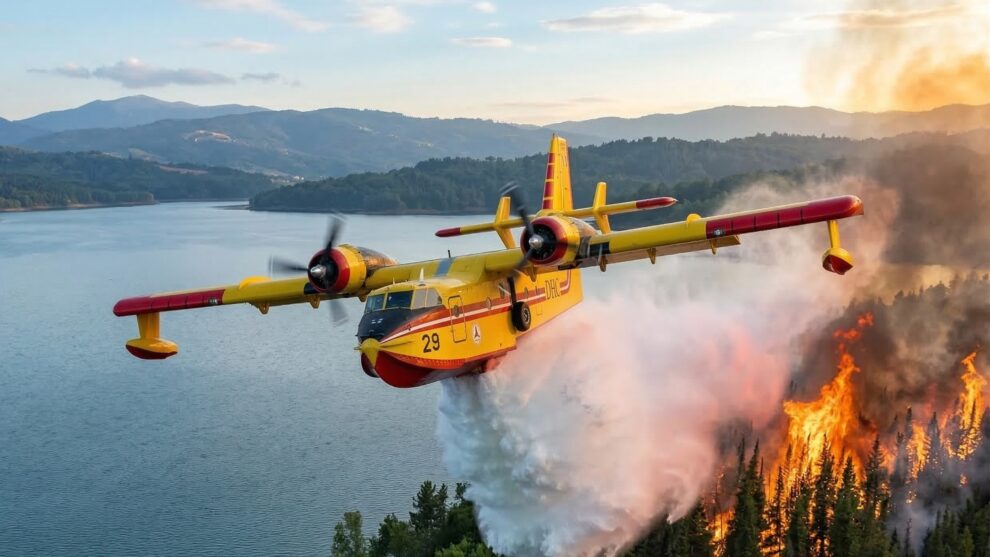
The Canadair CL-215 is one of the most important firefighting aircraft in aviation history. Canadair designed this amphibious aircraft specifically to fight wildfires, especially in regions with lakes, rivers and coastal waters close to forest areas. As a result, the CL-215 became a highly recognizable water bomber in many countries.
Unlike converted cargo or passenger aircraft, the Canadair CL-215 started life as a purpose-built aerial firefighting aircraft. It can land on water, scoop water while moving across the surface, take off again and drop the load over a fire area. Therefore, the aircraft can repeat the same cycle many times without returning to an airport after every drop.
The aircraft first flew on October 23, 1967, and entered service in 1969. Its first production delivery went to the French Civil Protection agency, which used the aircraft for wildfire response. Although newer aircraft such as the CL-415 and DHC-515 later continued the same design philosophy, the original Canadair CL-215 remains the aircraft that established the modern “scooper” concept.
Canadair CL-215 General Characteristics
| Feature | Specification |
|---|---|
| Aircraft Type | Amphibious aerial firefighting aircraft |
| Main Category | Special-Purpose Aircraft |
| Additional Category | Civil and Commercial Aircraft |
| Manufacturer | Canadair |
| National Origin | Canada |
| First Flight | October 23, 1967 |
| First Delivery | June 1969 |
| Primary Role | Water bombing and wildfire suppression |
| Secondary Roles | Search and rescue, utility transport and maritime support |
| Crew | Two pilots |
| Status | In service with selected operators |
The CL-215 combines a flying boat hull with retractable landing gear. Because of this amphibious design, it can operate from both water and conventional runways. This flexibility makes the aircraft especially useful in remote areas where lakes may be closer to a wildfire than an airport.
CL-215 Water Bomber Mission
The Canadair CL-215 works best when it can scoop water from a nearby lake, river, reservoir or coastal area. During a scooping run, the aircraft skims across the water and uses pickup probes to fill its internal tanks. Then, the crew climbs away and flies directly toward the fire zone.
This operating cycle gives the aircraft a major advantage. Instead of landing at an airport to reload, the CL-215 can collect water close to the fire and return quickly. Consequently, it can deliver repeated water drops during the same mission.
The aircraft can scoop about 5,436 litres of water in approximately 12 seconds. In firefighting operations, that speed matters because every minute can affect how fast a wildfire spreads. Moreover, the aircraft can drop water directly on or near fire lines to support ground crews.
Canadair CL-215 Dimensions
| Feature | Specification |
|---|---|
| Length | About 65 ft / 19.82 m |
| Wingspan | About 93 ft 10 in / 28.60 m |
| Height | About 29 ft 6 in / 8.98 m |
| Wing Layout | High-wing configuration |
| Landing Gear | Retractable amphibious landing gear |
| Hull Type | Flying boat hull |
The high-wing design helps keep the engines and propellers above water spray during scooping operations. In addition, the flying boat hull allows the aircraft to handle repeated water operations. This layout gives the CL-215 its distinctive appearance and practical firefighting capability.
Although the aircraft is not large compared with modern airliners, it has a strong and rugged structure. Canadair designed it to handle low-speed flight, water impact loads and the demanding environment around forest fires. Therefore, the aircraft has the durability needed for repeated firefighting cycles.
Engines and Performance
The original CL-215 uses two Pratt & Whitney R-2800 Twin Wasp radial piston engines. These engines give the aircraft the power needed for low-altitude operations, water takeoffs and repeated climb-outs after scooping water.
| Feature | Specification |
|---|---|
| Engines | 2 × Pratt & Whitney R-2800 Twin Wasp radial engines |
| Engine Type | Air-cooled radial piston engine |
| Power | About 2,200 hp per engine |
| Normal Cruise Speed | About 157 knots / 291 km/h |
| Service Ceiling | About 14,600 ft / 4,450 m |
| Normal Range | About 1,130 nautical miles / 2,090 km |
| Maximum Takeoff Weight from Water | About 37,700 lb / 17,100 kg |
| Maximum Takeoff Weight from Land | About 43,500 lb / 19,730 kg |
The radial engines give the Canadair CL-215 a very different sound and character from the later turboprop CL-415. However, they also reflect the aircraft’s original 1960s design. While later turbine-powered versions improved performance, the piston-powered CL-215 remains historically important as the first model in the family.
Water Capacity and Firefighting System
| Feature | Specification |
|---|---|
| Water Capacity | About 5,436 litres |
| US Gallon Equivalent | About 1,436 US gallons |
| Scooping Time | About 12 seconds |
| Water Tanks | Internal water tanks |
| Drop Role | Direct water bombing and fire line support |
The aircraft carries water inside internal tanks and releases it through belly doors. Because the tanks sit near the aircraft’s centre of gravity, filling and dropping water does not dramatically change handling when crews follow normal operating procedures.
This design helps pilots fly accurately during low-altitude firefighting passes. In addition, the ability to scoop water quickly allows the aircraft to maintain a fast cycle between the water source and the fire. As a result, the CL-215 became a valuable tool for wildfire agencies.
Why the Canadair CL-215 Was Built
Canadair built the CL-215 because many countries needed a modern aircraft designed specifically for wildfire response. Before aircraft like this, firefighting agencies often used converted aircraft that were not originally built for scooping water or repeated low-level drops.
Therefore, the CL-215 represented a major step forward. It combined amphibious operation, purpose-built water tanks, rugged structure and low-speed handling in one aircraft. This made it highly useful in forested regions where water sources were common.
The aircraft also supported missions beyond firefighting. Depending on configuration, operators could use it for search and rescue, maritime patrol, cargo work and utility transport. Nevertheless, its strongest identity remains aerial firefighting.
Operational Role
The Canadair CL-215 served in several countries, including Canada, France, Greece, Spain and other wildfire-prone regions. Government agencies and specialized operators used it to respond quickly to forest fires, especially during hot and dry seasons.
In real operations, the aircraft often works as part of a larger firefighting system. Ground crews contain the fire, helicopters support precise drops and fixed-wing water bombers deliver larger loads. Meanwhile, the CL-215 helps slow fire spread by dropping water where crews need support.
Although newer aircraft now offer improved systems, the CL-215 remains respected because it proved the value of purpose-built amphibious water bombers. Its design directly influenced later aircraft such as the CL-415 and the new DHC-515.
Comparison with the CL-415
The CL-415 developed from the CL-215 concept but introduced turboprop engines and other improvements. In contrast, the original CL-215 uses radial piston engines. Therefore, the two aircraft may look similar, but they differ significantly in powerplant, systems and performance.
The Canadair CL-215 is best understood as the original scooper that started the family. The CL-415 continued the idea with more modern technology, while the DHC-515 carries the same firefighting lineage into a newer generation.
Frequently Asked Questions
What is the Canadair CL-215 used for?
The aircraft mainly performs aerial firefighting. It can scoop water from lakes, rivers or coastal waters and drop it over wildfire areas.
How much water can the CL-215 carry?
The aircraft can carry about 5,436 litres of water, depending on configuration and operating conditions.
What engines does the Canadair CL-215 use?
The original CL-215 uses two Pratt & Whitney R-2800 Twin Wasp radial piston engines.
Is the CL-215 amphibious?
Yes. It can operate from both water and land because it has a flying boat hull and retractable landing gear.
Is the Canadair CL-215 the same as the CL-415?
No. The CL-415 developed from the CL-215, but it uses turboprop engines and includes several improvements.
Canadair CL-215 Summary
The Canadair CL-215 is a purpose-built amphibious firefighting aircraft that changed wildfire response. It can scoop water directly from a suitable water source, climb away and drop the load over a fire zone. With its twin radial engines, high-wing design, flying boat hull and 5,436-litre water capacity, the CL-215 became one of the most recognizable water bombers ever built.
Did you know AviationStream.com has a YouTube channel? Check out TheAeroGraphyOfficial and subscribe to watch fun, highly engaging aviation Shorts!