





Last Updated: 5 days ago
Thrust is the propulsive force that moves an aircraft forward through the air. It is one of the four basic forces of flight, together with lift, weight, and drag. While lift acts upward and weight acts downward, drag acts backward. Thrust, however, acts mainly in the direction of travel.
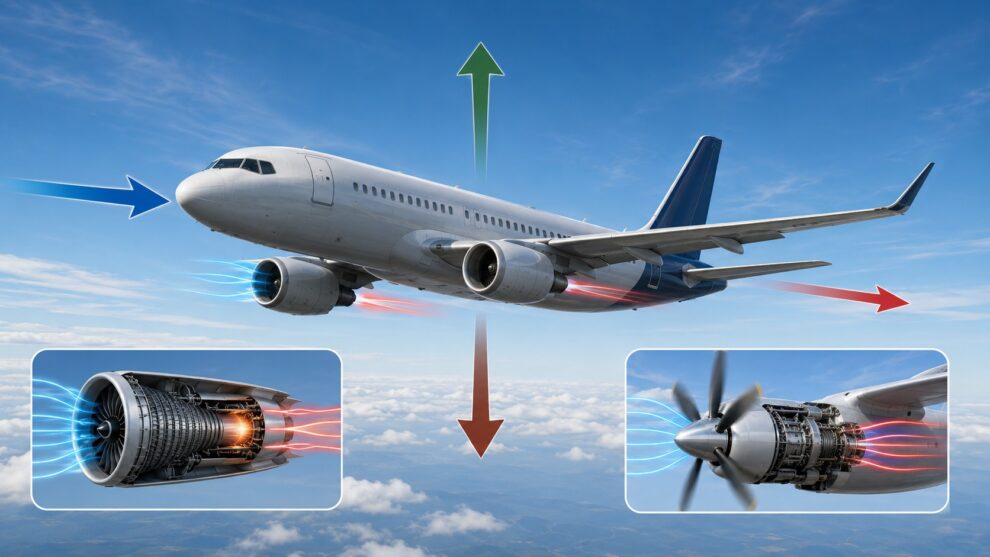
In aviation, this force usually comes from an engine or propulsion system. A jet engine creates it by accelerating air and exhaust gases backward. Similarly, a propeller creates forward force by pushing a large mass of air backward. As a result, the aircraft moves forward according to Newton’s third law of motion.
Because of this, thrust is essential for takeoff, climb, acceleration, and sustained flight.
Meaning in Aviation
In simple terms, thrust helps an aircraft overcome drag. Drag always resists movement through the air, so the propulsion system must produce enough forward force to keep the aircraft moving.
During takeoff, the engines accelerate the aircraft along the runway. After liftoff, they continue to provide the force needed for climb. In cruise, the engines usually produce enough thrust to balance drag and maintain a steady speed.
However, the required amount of thrust changes during flight. A heavy aircraft needs more force during takeoff than during cruise. Likewise, climbing requires more energy than level flight.
Without propulsion, a powered aircraft cannot maintain level flight indefinitely. A glider can continue descending without an engine, but a powered airplane depends on engine force for long-duration flight.
How Propulsive Force Works
Thrust follows Newton’s third law of motion: for every action, there is an equal and opposite reaction.
A propulsion system accelerates mass in one direction. In response, the aircraft experiences a force in the opposite direction. For example, a jet engine pulls air into the intake, compresses it, mixes it with fuel, burns the mixture, and ejects high-speed exhaust through the nozzle.
As the exhaust moves backward, the aircraft receives a forward reaction force. A propeller works differently, but the basic principle remains similar. Its rotating blades accelerate air backward, and this action pushes the aircraft forward.
Therefore, both jet engines and propellers create thrust by moving air or gas in the opposite direction of travel.
Thrust and the Four Forces of Flight
Aviation often explains flight through four forces: lift, weight, drag, and thrust. These forces constantly interact with each other.
| Force | Direction | Main Role in Flight |
|---|---|---|
| Lift | Upward | Supports the aircraft against weight |
| Weight | Downward | Pulls the aircraft toward Earth through gravity |
| Drag | Rearward | Resists aircraft motion through the air |
| Thrust | Forward | Moves the aircraft forward and helps overcome drag |
In steady, level flight, lift roughly equals weight, while thrust roughly equals drag. If engine force becomes greater than drag, the aircraft accelerates. If drag becomes greater than engine force, the aircraft slows down.
As a result, pilots and engineers must understand how these forces change during different phases of flight.
Jet Engine Thrust
Jet engines create thrust by accelerating air through the engine. Air enters the front of the engine, passes through the compressor, mixes with fuel, and burns inside the combustion chamber. Then, the expanding gases leave the engine at high speed.
Modern airliners mostly use turbofan engines. These engines move a large amount of air through a large front fan. In fact, much of the propulsive force comes from fan-driven airflow rather than only from the hot exhaust core.
This design improves fuel efficiency and reduces noise. For this reason, turbofan engines are well suited to high-subsonic commercial flight.
Military aircraft may use different engine designs. For instance, some fighter jets use afterburners to create extra thrust for short periods. However, afterburners consume much more fuel.
Propeller Thrust
Propeller aircraft create forward force with rotating blades. Each blade has an airfoil shape, much like a small wing. As the propeller spins, the blades accelerate air backward and create a forward reaction.
Propellers are efficient at lower speeds. Therefore, they are common on training aircraft, turboprops, regional aircraft, and many utility airplanes.
Several factors affect propeller thrust. These include blade angle, RPM, air density, aircraft speed, and engine power. In addition, propeller efficiency changes as the aircraft accelerates.
A turboprop engine combines a gas turbine with a propeller. This arrangement gives strong performance at lower and medium speeds, especially on short regional routes or rough-field operations.
Thrust vs Power
Thrust and power are related, but they are not the same thing.
Thrust is a force. Engineers usually measure it in newtons or pounds-force. Power, on the other hand, describes the rate of doing work. It is measured in watts, kilowatts, or horsepower.
Because of this difference, jet engines and piston engines are often described differently. Jet engines are usually rated by thrust. Piston engines are usually rated by horsepower.
For example, a jet engine may be described as producing thousands of pounds of thrust. A piston aircraft engine, however, may be described as producing one hundred eighty horsepower.
Why This Force Matters
Thrust affects almost every phase of flight. More available force can improve takeoff acceleration, climb rate, go-around performance, and high-altitude capability.
However, more thrust is not always the only goal. Aircraft designers must also consider fuel consumption, engine weight, noise, emissions, reliability, maintenance cost, and mission requirements.
For example, a small training aircraft does not need the same propulsion system as a fighter jet. Similarly, a cargo turboprop and a long-haul airliner use different engines because their missions are different.
In the end, the best propulsion system is the one that provides the right balance of force, efficiency, reliability, and operating cost.
Why the Term Matters
Understanding thrust helps explain how aircraft move, accelerate, climb, and maintain flight. It also connects Newton’s laws with real aviation performance.
Additionally, the term helps readers understand the relationship between engines, propellers, jets, drag, and aircraft speed. For aviation students, pilots, mechanics, engineers, and enthusiasts, it is one of the most important basic concepts in flight.
Overall, thrust is not just an engine number. It is the forward force that allows powered aircraft to overcome drag and continue flying safely.
Did you know AviationStream.com has a YouTube channel? Check out TheAeroGraphyOfficial and subscribe to watch fun, highly engaging aviation Shorts!