







Last Updated: 3 days ago
Airlines frequently spend millions of dollars to upgrade their fleets. However, they do not just buy luxury passenger seats. Instead, airlines invest heavily in engineering marvels like carbon fiber aircraft brakes. Therefore, a logical question arises. Why do airlines transition to such an expensive technology? The answer directly connects to aircraft weight and overall economics.
The Battle of Weight: Steel vs. Carbon
Historically, steel brakes dominated traditional aviation. Nevertheless, steel remains an incredibly heavy metal. Optimizing an aircraft’s takeoff weight is an engineer’s absolute top priority. Therefore, finding lighter alternatives is crucial. This is exactly where carbon composite brakes step in to change the game.
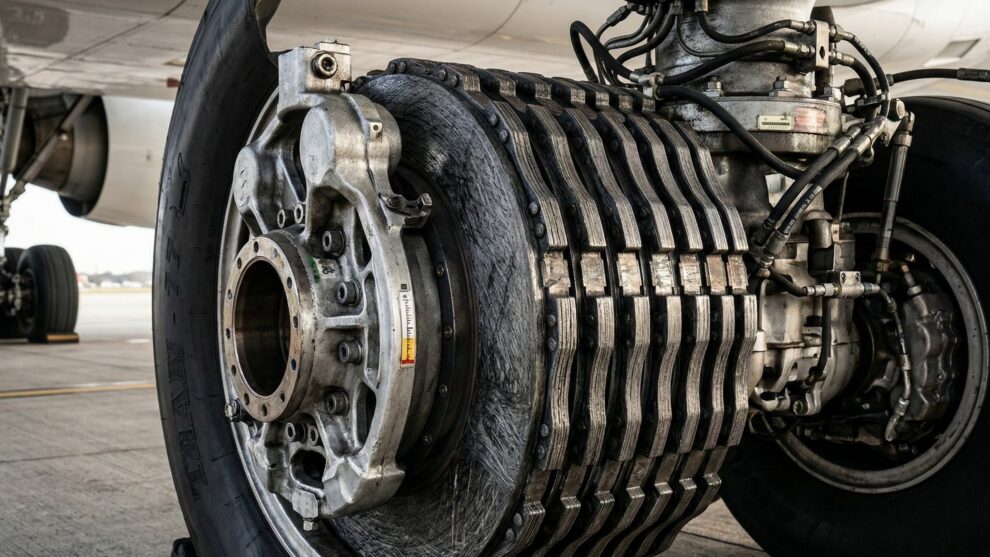
Switching from traditional steel to advanced Carbon-Carbon (C-C) composite brakes dramatically decreases the aircraft mass. For instance, replacing the braking system helps a Boeing 777 shed nearly 1,500 pounds! In aviation, the golden rule is quite simple. Less weight inherently means engines burn less fuel.
Fuel Efficiency: Where Physics Meets Economics
Furthermore, choosing aviation carbon brakes is a highly strategic business decision. Consequently, that 1,500-pound weight reduction directly decreases jet fuel consumption during every flight. Imagine multiplying this over dozens of jets in an airline fleet. The aircraft fuel efficiency improves massively.
As a result, this material upgrade saves airlines hundreds of thousands of dollars in annual fuel costs. Investing millions into carbon fiber brakes might seem expensive initially. However, the system quickly pays for itself within a few years.
Superior Performance Even at 2,000°F
In addition to financial benefits, we must consider critical safety and physics aspects. Stopping a heavy jet on a runway converts massive kinetic energy into heat energy. Unfortunately, traditional steel brakes can warp or suffer from “brake fade” during overheating.

Conversely, carbon fiber aircraft brakes easily survive extreme temperatures up to 2,000°F without warping. In fact, carbon brakes actually provide better friction and stopping power as they heat up. Ultimately, the laws of physics and airline economics always fly together in modern aerospace engineering.
Frequently Asked Questions (FAQ) – Carbon fiber aircraft brakes
1. How much lighter are carbon fiber aircraft brakes compared to steel brakes? Generally, carbon brakes are approximately 40% lighter than their steel counterparts. Consequently, wide-body commercial aircraft like the Boeing 777 save up to 1,500 pounds.
2. Do carbon composite brakes last longer than traditional steel brakes? Yes, they absolutely do. Moreover, Carbon-Carbon composite brakes typically endure two to three times more landing cycles. As a result, this significantly reduces maintenance costs and hangar downtime.
3. How do aviation carbon brakes perform on wet runways? Initially, early-generation carbon brakes experienced slight reaction delays in damp conditions. However, engineers specifically designed modern carbon fiber aircraft brakes for optimal performance. They safely stop planes on dry and wet runways under extreme temperatures.
| Feature | Steel Brakes | Carbon Brakes |
|---|---|---|
| Weight | Heavy | Up to 40% lighter |
| Heat Resistance | Moderate | Extremely high |
| Lifespan | Shorter | 2–3x longer |
| Fuel Efficiency | Lower | Higher |
| Maintenance | Frequent | Reduced |
Did you knowAviationStream.com has a YouTube channel? Check out TheAeroGraphyOfficial and subscribe to watch fun, highly engaging aviation Shorts!