Boeing 737 MAX 10
The Boeing 737 MAX 10 is the largest member of the 737 family, built to compete with the Airbus A321neo. Launched in 2017 and first flown in 2021, it was certified by the FAA on 20 October 2026 after years of delays.
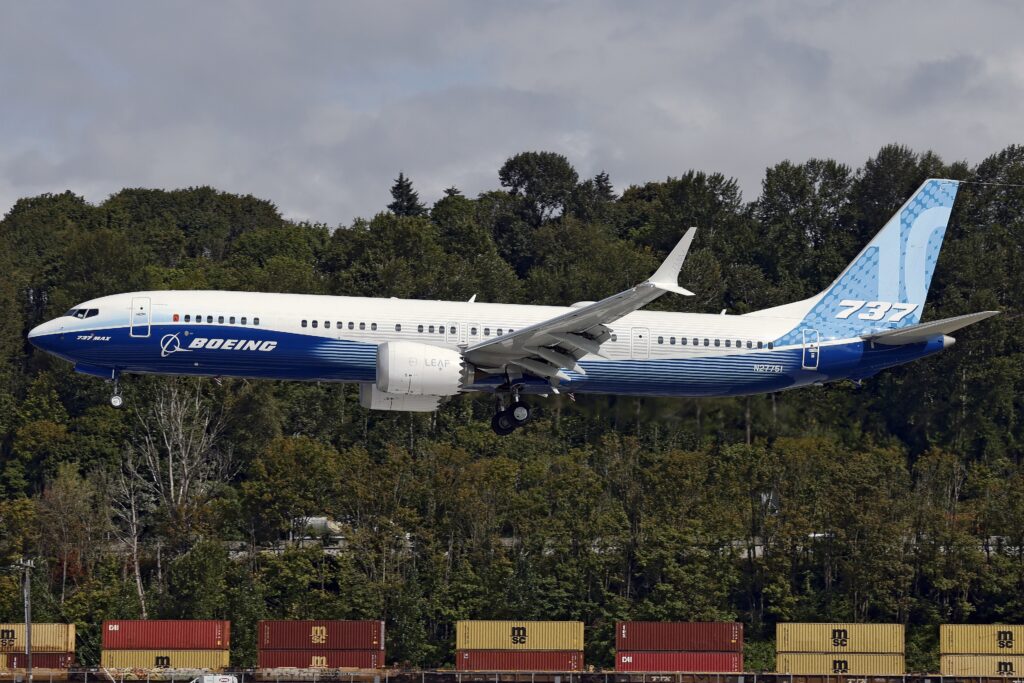
| General Characteristics | |
| Type | Narrow-body airliner, Civil and Commercial Aircraft |
|---|---|
| National Origin | United States |
| Manufacturer | Boeing |
| Variants | 737 MAX 7, 737 MAX 8, 737 MAX 9, 737 MAX 10 |
| Status | Certified October 2026; deliveries not yet begun |
| First Flight | 18 June 2021 |
| Primary Users | United Airlines, Ryanair, Delta Air Lines (on order) |
| Developed From | Boeing 737 MAX 9 |
| Capacity & Dimensions | |
| Cockpit Crew | Two |
| Typical Seating | 188–204 (two-class) |
| Max Seating | 230 |
| Overall Length | 43.8 m (143 ft 8 in) |
| Wing Span | 35.92 m (117 ft 10 in) |
| Weights, Powerplant & Performance | |
| MTOW | 89,760 kg (197,900 lb) |
| Engines | 2 × CFM International LEAP-1B |
| Range | 5,740 km (3,100 nmi) |
| Service Ceiling | 12,497 m (41,000 ft) |
The Boeing 737 MAX 10 is the longest and largest member of the 737 family, a single-aisle airliner that can seat up to 230 passengers. Boeing launched it at the Paris Air Show on 19 June 2017 as its answer to the Airbus A321neo, flew it for the first time on 18 June 2021, and received certification from the US Federal Aviation Administration (FAA) on 20 October 2026, more than five years later than first planned. It was the last of the four main 737 MAX models to be certified.
Why Boeing Built the MAX 10
By the mid-2010s, the Airbus A321neo was outselling the 737 MAX 9 by about five to one. Large customers such as United Airlines and Korean Air asked Boeing for a bigger 737 that could match it. Boeing studied a new wing and larger engines, but chose a simpler and lower-risk design: a modest stretch of the MAX 9 that kept the existing wing and the same CFM LEAP-1B engines. The programme was launched with 240 orders and commitments from more than ten customers, and United became the largest customer by converting 100 of its MAX 9 orders.
Design
The MAX 10 is 43.8 m (143 ft 8 in) long, about 1.7 m longer than the MAX 9, with two extra fuselage sections added in front of and behind the wing. A longer body sits closer to the runway when the nose is raised for take-off, so Boeing gave the MAX 10 a new semi-levered main landing gear. A telescoping strut and a down-swinging lever let the gear extend about 24 cm (9.5 in) taller for take-off, then a shrink-link mechanism pulls it shorter as it retracts, so it still fits in the standard 737 wheel well. The aircraft keeps the 35.92 m (117 ft 10 in) wingspan of other MAX models, including the split-tip winglets.
Cabin and Capacity
Boeing quotes 188 to 204 seats in a typical two-class layout and a maximum of 230 in a single class. Like the MAX 9, the MAX 10 has an extra pair of exit doors behind the wing, which is what allows the higher maximum seating. The cabin uses the Boeing Sky Interior, with larger overhead bins and LED lighting, and the cross-section is the same as on every 737 since the 1960s, with six seats across in a 3-3 layout.
Engines and Performance
Two CFM International LEAP-1B turbofans power the MAX 10. The maximum take-off weight is 89,760 kg (197,900 lb), and Boeing gives a range of about 5,740 km (3,100 nmi), slightly less than the MAX 9 because of the extra weight. The service ceiling is 41,000 ft. Boeing has claimed a 5% lower trip and seat cost than the A321neo, although the Airbus aircraft can be ordered in long-range versions that fly much further.
The Long Road to Certification
The first MAX 10 was rolled out at Renton, Washington, on 22 November 2019, during the worldwide grounding of the 737 MAX that followed the Lion Air and Ethiopian Airlines accidents. Entry into service had been planned for 2020, but the grounding, new safety rules and design problems pushed it back again and again. A US law passed in 2020 required new types to have a modern crew-alerting system unless they were certified by the end of 2022. In December 2022 Congress allowed the MAX 7 and MAX 10 to be certified without it, but required a third angle-of-attack sensor and a switch to silence the stick shaker on all 737 MAX aircraft.
Further delays followed. In 2023 Boeing found that the engine anti-ice system could overheat the composite engine inlet if pilots left it running in dry air, and the company had to redesign it. United Airlines publicly said in 2024 that it would no longer include the MAX 10 in its fleet planning, and turned to Airbus for more A321neos. The FAA finally certified the MAX 10 on 20 October 2026, issuing an amended type certificate and authorising production.
Customers
United Airlines, Ryanair and Delta Air Lines are among the largest customers. Ryanair ordered up to 300 MAX 10s in May 2023, 150 firm with options on 150 more, for its European network. Delta ordered 100 in 2022, with options for 30 more. For airlines that already fly the 737 MAX 8 or older 737s, the MAX 10’s main appeal is commonality: pilots can fly it on the same type rating, and engineers can use the same spare parts and tools.
Frequently Asked Questions
How many passengers does the 737 MAX 10 carry? Typically 188 to 204 in two classes, and up to 230 in a single class.
When was the 737 MAX 10 certified? The FAA certified it on 20 October 2026.
Is the 737 MAX 10 bigger than the A321neo? It is slightly longer and can seat about the same number of passengers, but the A321neo has more range in its long-range versions.
Start the discussion
Commenting on this aircraft: Boeing 737 MAX 10