Bombing of Air India Flight 182

On June 23, 1985, Air India Flight 182 disappeared from radar screens at 31,000 feet over the Atlantic Ocean, off the coast of Ireland. The Boeing 747 was destroyed by an explosive device detonated in the forward cargo hold.
Air India Flight 182 was a scheduled international flight from Toronto Pearson International Airport (as Air India Flight 181) to Mumbai’s Sahar International Airport with regular Mirabel-London-Delhi stops. On the morning of June 23, 1985, the Boeing 747-237B serving the Montreal-London segment exploded near the coast of Ireland from a bomb planted by Sikh terrorists from the Babbar Khalsa. All 329 people on board were killed including 268 Canadian citizens, 27 British citizens, and 22 Indian citizens.
The investigation into the disaster exposed significant vulnerabilities in mid-1985 aviation security and resulted in permanent changes to how checked baggage is handled globally.
Flight Profile and Crew Data
Air India Flight 182 was a scheduled international passenger service flying a multi-leg route from Vancouver to Toronto, Montreal, London, and finally Delhi and Bombay.
- The Aircraft: A Boeing 747-237B, registered as VT-EFO and named Emperor Kanishka. The airframe had a clean service record prior to the incident.
- The Demographics: The passenger manifest included 268 Canadian citizens, 27 British citizens, and 24 Indian citizens. Among the victims were 86 children.
The Sequence of Events
At 07:14 GMT, the flight crew contacted Shannon Air Traffic Control for a routine position report. The aircraft was tracking normally along its designated airway. Exactly one minute later, without any distress call or structural warnings from the cockpit, the radar target vanished.
Subsequent wreckage analysis and forensic data confirmed that a bomb, constructed using digital timers and commercial explosives, detonated inside a piece of checked luggage located in the left forward cargo bay. The resulting overpressure caused a sudden and catastrophic structural failure of the forward fuselage, rendering the aircraft unflyable. The debris settled in water approximately 6,700 feet deep, 120 miles southwest of County Cork, Ireland.
The Security Vulnerabilities Exposed
The Canadian and international investigations focused heavily on how the explosive device breached airport security lines in Vancouver. The plot succeeded due to two primary procedural gaps standard in the industry at the time:
1. Lack of Passenger-Bag Reconciliation
The suitcase containing the explosive was checked in by a passenger utilizing the alias “M. Singh” during an interline transfer. The individual successfully checked the bag onto a connecting flight but failed to board the aircraft himself. In 1985, airlines were not legally required to verify that every piece of checked cargo belonged to a passenger physically on board the aircraft.
2. Technical Equipment Limits
At the Toronto stopover, the bag was scanned using a first-generation explosive sniffer. The device, which relied on chemical vapor detection, failed to register the presence of the bomb. Security personnel also conducted manual inspections, but the sophistication of the device allowed it to pass through visually unnoticed.
The Coordinated Incident at Narita Airport
The scope of the security failure was highlighted less than an hour prior to the loss of Flight 182. A separate piece of luggage, checked under similar circumstances in Vancouver, exploded prematurely at Tokyo’s Narita Airport at 06:19 GMT.
That bomb was intended for Air India Flight 301. The premature detonation killed two Japanese baggage handlers and confirmed to investigators that they were dealing with a coordinated, multi-target technical operation.
Technical and Procedural Changes to Global Aviation
The formal inquiries into the Air India disaster led by Canadian and international regulators resulted in immediate, mandatory updates to International Civil Aviation Organization (ICAO) standards.
- Mandatory Positive Passenger-Baggage Reconciliation (PPBR): This protocol became absolute international law. If a passenger checks a bag but fails to board the aircraft, the flight cannot depart until that specific piece of luggage is physically located and removed from the cargo hold.
- Automated Explosive Detection Systems (EDS): The failure of early vapor sniffers accelerated the development and deployment of high-resolution X-ray and CT-scan technologies capable of automatically detecting dense materials and matching chemical profiles in checked luggage.
- Intelligence Integration: The disaster highlighted a lack of communication between law enforcement (the RCMP) and intelligence agencies (CSIS). This prompted structural reforms in how threat assessments are shared with civil aviation authorities.
Related Historical Aviation Accidents Events
More significant events from aviation history
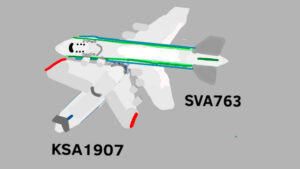
1996 Charkhi Dadri Collision: The Deadliest Mid-Air Crash
🗓 12 November, 1996 📍 Charkhi Dadri, Haryana, India, 28°33′38″N 76°18′15″E / 28.56056°N 76.30417°E / 28.56056; 76.30417 ★★★★☆ Read full story →
Assassination of Juvénal Habyarimana and Cyprien Ntaryamira: The 1994 Aircraft Shootdown in Rwanda
🗓 6 April, 1994 📍 Presidential Palace gardens, near Kigali International Airport, Kigali, Rwanda, 1°58′32″S 30°10′26″E / 1.9756°S 30.1739°E / -1.9756; 30.1739 ★★★★☆ Read full story →
United Airlines Flight 736: The Crash That Changed Aviation
🗓 21 April, 1958 📍 Clark County, Nevada, United States ★★★★☆ Read full story →
China Airlines Flight 140: The 1994 Airbus A300 Crash in Nagoya
🗓 26 April, 1994 📍 Nagoya Airport, Nagoya, Japan, 35°14′43″N 136°55′56″E / 35.2453°N 136.9323°E / 35.2453; 136.9323 ★★★☆☆ Read full story →