Bombing of TWA Flight 840
On 2 April 1986 a bomb tore a hole in a TWA Boeing 727 approaching Athens. Four passengers were swept out and killed; the crew landed the aircraft safely with everyone else on board.
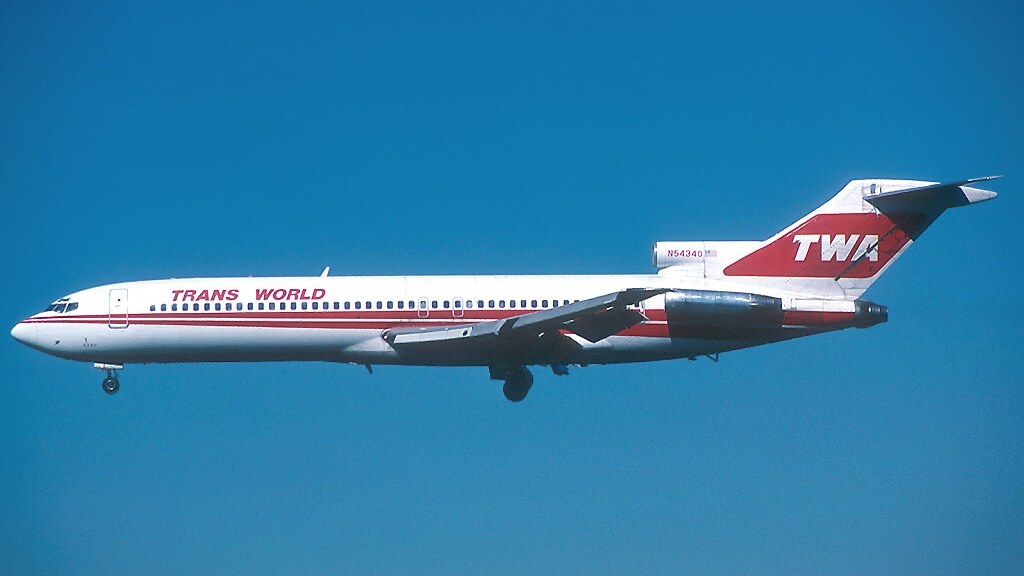
TWA Flight 840 was a Boeing 727 flying from Rome to Athens when a bomb exploded under a passenger seat on 2 April 1986. The blast tore a hole in the right side of the fuselage over Argos in southern Greece. Four passengers, including a baby, were swept out of the aircraft and killed. The crew brought the damaged jet down and landed safely in Athens, saving everyone else on board.
Flight 840 at a glance
- Date: 2 April 1986
- Aircraft: Boeing 727-231
- Route: Los Angeles to Cairo via New York, Rome and Athens; the explosion happened on the Rome to Athens leg
- Fatalities: 4 passengers; 7 others were injured
- Place: over Argos, Greece, about 20 minutes before landing in Athens
- Investigation: Greek and Italian authorities with the FBI
What happened
The aircraft was descending towards Athens at around 15,000 feet when the bomb went off beneath seat 10F, next to the cabin wall. The explosion blew a hole roughly a metre wide in the fuselage. The cabin lost pressure instantly and four passengers seated next to the hole were pulled out of the aircraft: a man travelling alone, and a woman with her daughter and her nine-month-old granddaughter.
Oxygen masks dropped and the cabin filled with debris and cold air. Captain Richard Petersen and his crew kept control, completed an emergency descent and landed at Athens. The aircraft’s structure held around the damage, and the remaining passengers and crew survived. Our explainer on why oxygen masks only last about 15 minutes shows why an emergency descent like this is the crew’s first task after a decompression.
Who planted the bomb
The device, made of a small amount of plastic explosive, had been hidden under seat 10F. Investigators linked it to a passenger who had occupied that seat on the previous leg, from Cairo to Rome, and left the aircraft in Rome. A group calling itself the Arab Revolutionary Cells claimed the attack as retaliation for US clashes with Libya in the Gulf of Sidra a week earlier. The suspect denied involvement and was never brought to trial.
What changed after Flight 840
- Searching aircraft between flights. The bomb had been left on board by someone who got off before it exploded. Airlines tightened searches of cabins on multi-leg flights and the screening of transit passengers.
- Explosives detection. Flight 840 was one of a series of bombings of airliners in the 1980s, which culminated in Lockerbie in 1988. Together they led to new screening technology and to an international convention requiring plastic explosives to be marked so that they can be detected.
- Structural resilience. The fact that the 727 stayed controllable after a hole in its side was studied as an example of how airliner structures are designed to contain damage.
You can read more about the aircraft family in our Boeing 727-200 Advanced entry.
Remembering the victims
The four people killed were American citizens. Their deaths, and the survival of everyone else on board, made Flight 840 one of the most widely reported attacks on civil aviation of the 1980s.
Sources
Greek civil aviation and Italian authorities’ findings on TWA Flight 840; contemporary FBI and US State Department statements on the attack.
Related Historical Aviation Accidents Events
More significant events from aviation history
Assassination of Juvénal Habyarimana and Cyprien Ntaryamira: The 1994 Aircraft Shootdown in Rwanda
🗓 6 April, 1994 📍 Presidential Palace gardens, near Kigali International Airport, Kigali, Rwanda, 1°58′32″S 30°10′26″E / 1.9756°S 30.1739°E / -1.9756; 30.1739 ★★★★☆ Read full story →
1996 Charkhi Dadri Collision: The Deadliest Mid-Air Crash
🗓 12 November, 1996 📍 Charkhi Dadri, Haryana, India, 28°33′38″N 76°18′15″E / 28.56056°N 76.30417°E / 28.56056; 76.30417 ★★★★☆ Read full story →
United Airlines Flight 736: The Crash That Changed Aviation
🗓 21 April, 1958 📍 Clark County, Nevada, United States ★★★★☆ Read full story →
The Tragic Mystery of China Northern Airlines Flight 6136
🗓 7 May, 2002 📍 Bohai Bay, near Dalian Zhoushuizi International Airport, Dalian, Liaoning, China, 39°00′N 121°48′E / 39°N 121.8°E / 39; 121.8 ★★★☆☆ Read full story →