Japan Air Lines Flight 123
On 12 August 1985 a Boeing 747SR lost most of its tail and all hydraulic power. The crew fought for 32 minutes before the jet struck a ridge in Gunma; 520 people died.
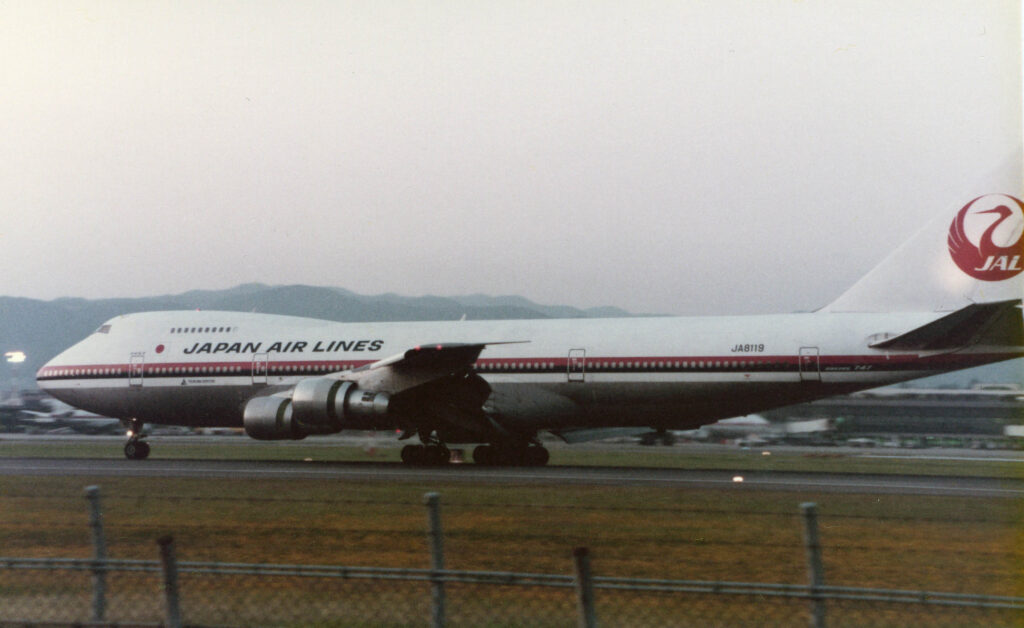
Japan Air Lines Flight 123 was a domestic flight from Tokyo Haneda to Osaka that crashed into the mountains of Gunma Prefecture on 12 August 1985. Twelve minutes after take-off the Boeing 747’s rear pressure bulkhead failed, tearing away much of the tail and every hydraulic line the pilots needed to steer. 520 of the 524 people on board died, making it the deadliest accident involving a single aircraft.
Flight 123 at a glance
- Date: 12 August 1985, the start of the Obon holiday
- Aircraft: Boeing 747SR-46, a short-range version built for busy Japanese domestic routes
- Route: Tokyo Haneda to Osaka Itami
- On board: 509 passengers and 15 crew
- Fatalities: 520; four passengers survived
- Crash site: a ridge near Mount Takamagahara (Osutaka ridge), Ueno, Gunma Prefecture
- Investigation: Aircraft Accident Investigation Commission of Japan
The flight
The 747 left Haneda in the early evening, full of families travelling home for Obon. While climbing through about 24,000 feet over Sagami Bay, the crew heard a loud bang. The cabin lost pressure and the oxygen masks dropped. More importantly, the explosive rush of air from the cabin into the unpressurised tail had blown off most of the vertical stabilizer and cut all four hydraulic systems.
Without hydraulics the crew could not move the rudder, elevators or ailerons. The aircraft began to roll and pitch in long, slow oscillations. Captain Masami Takahama, First Officer Yutaka Sasaki and Flight Engineer Hiroo Fukuda tried to control it with the only thing left: the thrust of the four engines. For 32 minutes they managed to keep the jet in the air, turning back towards Tokyo and then drifting over the mountains to the north-west, before it struck a ridge and then a second ridge and burned.
Search teams located the wreck during the night, but ground rescuers only reached the site the next morning. Survivors later said they had heard other passengers alive after the crash, and the delay remains one of the most painful parts of the story.
Why the bulkhead failed
Seven years earlier, in 1978, the same aircraft had struck its tail on the runway while landing at Osaka. Boeing engineers repaired the damaged lower half of the rear pressure bulkhead. The repair called for a single splice plate fastened with two rows of rivets; instead, the plate was cut in two, and at one joint only one row of rivets carried the load.
That joint was far weaker than designed. Every flight pressurised and depressurised the fuselage, and over more than 12,000 cycles fatigue cracks grew along the rivet line until the bulkhead finally gave way. The commission found that the faulty repair, and inspections that did not detect the growing cracks, caused the accident.
What changed after JAL 123
- Repair oversight. The accident showed that a structural repair can be as critical as the original design. Repair approval and follow-up inspections were tightened at Boeing, at JAL and by regulators.
- Protecting the controls. Boeing modified the 747 so that a failure in the tail could no longer drain every hydraulic system, and added a cover so that cabin air could not burst into the fin.
- Flying on engines alone. The crew’s fight to steer with thrust, like the later United Airlines Flight 232, led researchers to study how aircraft could be landed using engine power alone.
Remembering the victims
Every year on 12 August relatives climb to the crash site on Osutaka ridge, where a memorial stands. In 2006 Japan Airlines opened its Safety Promotion Center near Haneda, where parts of the wreck, including the failed bulkhead, are shown to every new employee so that the lesson is never lost.
Sources
Aircraft Accident Investigation Commission of Japan, final report on Japan Air Lines JA8119 (1987); Japan Airlines Safety Promotion Center.
Related Historical Aviation Accidents Events
More significant events from aviation history
Assassination of Juvénal Habyarimana and Cyprien Ntaryamira: The 1994 Aircraft Shootdown in Rwanda
🗓 6 April, 1994 📍 Presidential Palace gardens, near Kigali International Airport, Kigali, Rwanda, 1°58′32″S 30°10′26″E / 1.9756°S 30.1739°E / -1.9756; 30.1739 ★★★★☆ Read full story →
1996 Charkhi Dadri Collision: The Deadliest Mid-Air Crash
🗓 12 November, 1996 📍 Charkhi Dadri, Haryana, India, 28°33′38″N 76°18′15″E / 28.56056°N 76.30417°E / 28.56056; 76.30417 ★★★★☆ Read full story →
United Airlines Flight 736: The Crash That Changed Aviation
🗓 21 April, 1958 📍 Clark County, Nevada, United States ★★★★☆ Read full story →
The Tragedy of Lauda Air Flight 004
🗓 26 May, 1991 📍 Phu Toei National Park, Suphan Buri province, Thailand, 14°56′48″N 99°27′10″E / 14.94667°N 99.45278°E / 14.94667; 99.45278 ★★★☆☆ Read full story →