Potomac River Mid-Air Collision: American Eagle Flight 5342
On 29 January 2025, American Eagle Flight 5342 and a US Army UH-60 Black Hawk collided over the Potomac River on approach to Reagan National Airport. All 67 people on both aircraft died. The NTSB blamed systemic failures in airspace design and oversight.
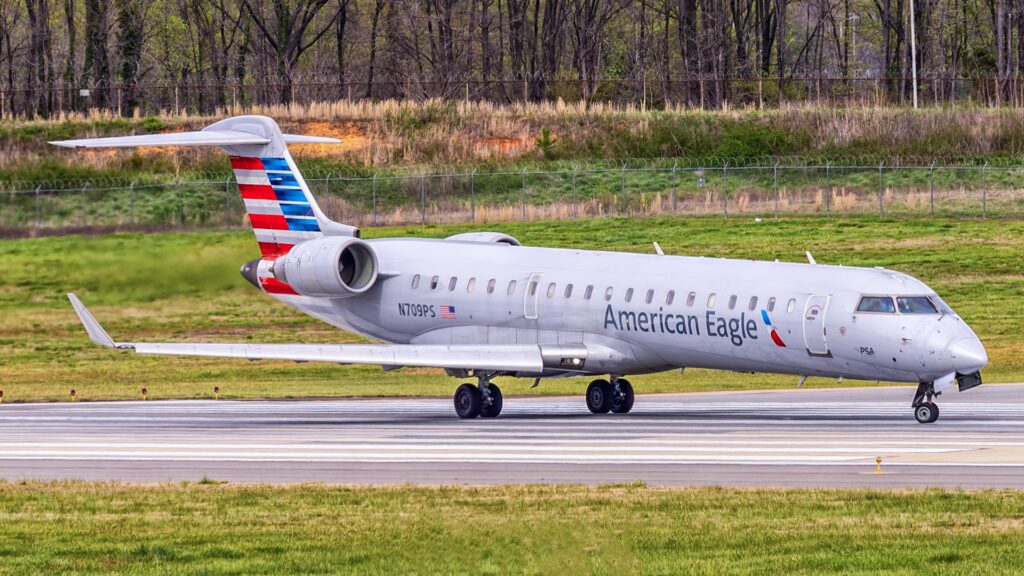
On the evening of 29 January 2025, American Eagle Flight 5342, a Bombardier CRJ700 operated by PSA Airlines, collided with a US Army Sikorsky UH-60L Black Hawk over the Potomac River while on final approach to Ronald Reagan Washington National Airport. All 64 people on the airliner and the three soldiers on the helicopter were killed. The Potomac River mid-air collision was the deadliest aviation accident in the United States since November 2001.
The Potomac River mid-air collision at a glance
- Date and time: 29 January 2025, 20:48 Eastern time
- Airliner: Bombardier CRJ700, registration N709PS, operated by PSA Airlines as American Eagle Flight 5342 from Wichita, Kansas
- Helicopter: Sikorsky UH-60L Black Hawk, US Army, callsign PAT25, on a night training and evaluation flight
- Place: over the Potomac River, about half a mile southeast of Reagan National Airport
- Fatalities: 67 (64 on the airliner, 3 on the helicopter); no survivors
- Investigator: US National Transportation Safety Board (NTSB)
The collision
Flight 5342 had flown in from Wichita and was approaching Reagan National in clear night conditions. Air traffic control asked the crew to land on runway 33, a shorter runway whose approach path crosses the river. At the same time, the Army helicopter was flying south along a published helicopter route that follows the river, beneath the approach corridor.
The tower controller asked the helicopter crew whether they had the airliner in sight and instructed them to pass behind it. The crew confirmed they had the traffic in sight and would maintain visual separation. Moments later the two aircraft collided over the river. Both fell into the water. Among the passengers were young figure skaters, their parents and coaches returning from a national development camp held in Wichita.
What the NTSB found
The NTSB adopted its final report on 27 January 2026, almost exactly a year after the accident, with 74 findings and 50 safety recommendations. It described the collision as the result of long-standing, systemic failures rather than a single mistake:
- The FAA’s helicopter route design allowed helicopters to fly directly beneath an active airliner approach path without procedural separation, and the risk was never properly reassessed.
- Safety data had shown repeated close encounters between helicopters and airliners near Reagan National, and local controllers had raised concerns, but the FAA did not act on them.
- The helicopter was flying above the maximum altitude published for its route, and the Army had no flight data monitoring programme that would have revealed such routine excursions.
- The airliner’s collision avoidance system worked as designed, but at such low altitude it was not allowed to issue a resolution advisory telling the crew how to manoeuvre. The NTSB found that a system using ADS-B traffic information could have given the crew a first alert about 59 seconds before the collision.
- A high workload in the tower and the use of separate radio frequencies for helicopters and airplanes reduced the controllers’ ability to spot the developing conflict.
After the accident
Within weeks, following urgent NTSB recommendations, the FAA closed the stretch of helicopter route next to the airport’s runways to most traffic when those runways are in use. The final report’s recommendations cover airspace design around busy airports, collision avoidance equipment, Army safety management and air traffic control practice.
Why it matters
The accident ended a run of more than fifteen years without a major fatal crash of a US airline and exposed how much the safety of crowded airspace depends on design and oversight, not only on pilots seeing each other. It is now studied alongside earlier US accidents such as American Airlines Flight 587, the last US accident with a higher death toll.
More events from this month are in our Aviation History Calendar.
Sources
- NTSB, Systemic Failures Led to Midair Collision Over Potomac River in Washington, press release, January 2026
- NTSB, Aircraft Accident Report AIR-26-02: Midair Collision over the Potomac River, adopted 27 January 2026
- NTSB, Investigative hearing, midair collision of a PSA Airlines CRJ700 and a UH-60 helicopter, 2025
- AVweb, NTSB: DCA midair collision was preventable, January 2026
Related Historical Aviation Accidents Events
More significant events from aviation history
1996 Charkhi Dadri Collision: The Deadliest Mid-Air Crash
🗓 12 November, 1996 📍 Charkhi Dadri, Haryana, India, 28°33′38″N 76°18′15″E / 28.56056°N 76.30417°E / 28.56056; 76.30417 ★★★★☆ Read full story →
Assassination of Juvénal Habyarimana and Cyprien Ntaryamira: The 1994 Aircraft Shootdown in Rwanda
🗓 6 April, 1994 📍 Presidential Palace gardens, near Kigali International Airport, Kigali, Rwanda, 1°58′32″S 30°10′26″E / 1.9756°S 30.1739°E / -1.9756; 30.1739 ★★★★☆ Read full story →
United Airlines Flight 736: The Crash That Changed Aviation
🗓 21 April, 1958 📍 Clark County, Nevada, United States ★★★★☆ Read full story →
China Airlines Flight 140: The 1994 Airbus A300 Crash in Nagoya
🗓 26 April, 1994 📍 Nagoya Airport, Nagoya, Japan, 35°14′43″N 136°55′56″E / 35.2453°N 136.9323°E / 35.2453; 136.9323 ★★★☆☆ Read full story →