







Last Updated: 3 months ago
← Back to Aircraft Database| General Characteristics | |
| Type | Civil and Commercial Aircraft, Narrow-body airliner |
|---|---|
| National Origin | United States |
| Manufacturer | Boeing |
| Variants | Boeing 737 MAX 7, Boeing 737 MAX 8, Boeing 737 MAX 9 |
| Status | In service |
| First Flight | January 29, 2016; 10 years ago (2016-01-29) |
| Introduction | May 22, 2017, with Malindo Air |
| Primary Users | Southwest Airlines, Ryanair, United Airlines, Alaska Airlines |
| Number Built | 2,200 as of February 2026 |
| Developed From | Boeing 737 Next Generation |
| Capacity & Dimensions | |
| Cockpit Crew | 2 |
| Typical Seating | 153 (8J + 145Y) |
| Max Seating | 172 |
| Overall Length | 116 ft 8 in (35.56 m) |
| Wing Span | 117 ft 10 in (35.92 m) |
| Wing Sweep | 25.02° |
| Wing Area | 1,370 sq ft (127 m²) |
| Overall Height | 40 ft 4 in (12.3 m) |
| Weights, Powerplant & Performance | |
| MTOW | 177,000 lb (80,000 kg) |
| OEW | 99,360 lb (45,070 kg) |
| Fuel Capacity | 6,853 US gal (25,941 L) |
| Engines | 2 x CFM International LEAP-1B |
| Max. Thrust | 29,317 lbf (130.41 kN) |
| Typical Cruise Speed | 839 km/h (453 kn) at altitude |
| Max. Speed | Mach 0.82 |
| Range | 3,800 nmi (7,000 km; 4,400 mi) |
| Takeoff Distance | 7,000 ft (2,100 m) (at SL, ISA, MTOW) |
| Service Ceiling | 41,000 ft (12,500 m) |
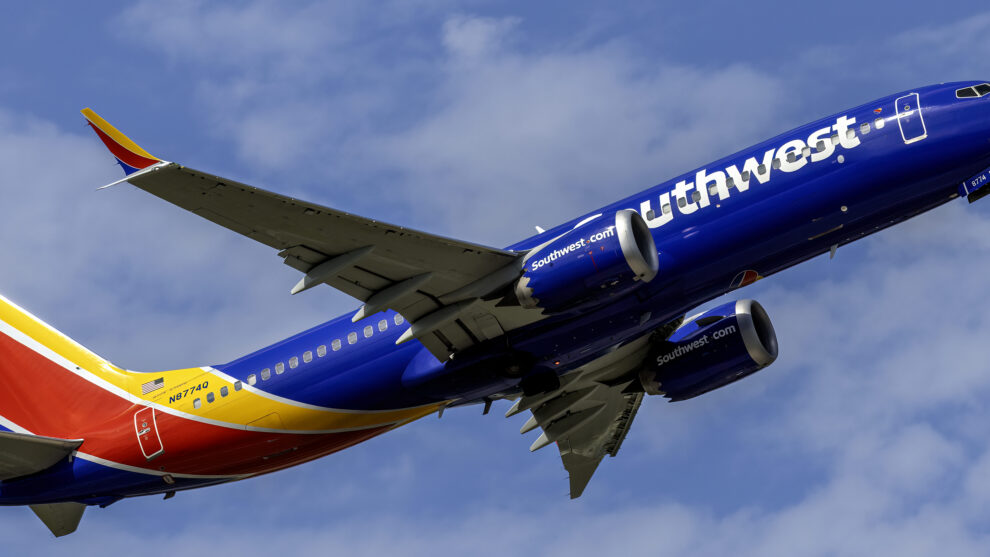
The Boeing 737 MAX 7 is the smallest member of the Boeing 737 MAX family. It was designed to give airlines strong range, modern fuel efficiency and lower-capacity flexibility within the MAX single-aisle lineup. As a result, the aircraft serves a different market position from the larger MAX 8, MAX 9 and MAX 10.
Boeing developed the MAX family to improve fuel burn, range, noise performance and operating economics compared with previous 737 generations. The Boeing 737 MAX 7 keeps that same design philosophy, yet it uses a shorter fuselage and offers fewer seats. Therefore, it works best for airlines that need long range and single-aisle efficiency without the higher capacity of larger MAX variants.
The aircraft first flew on March 16, 2018. However, the Boeing 737 MAX 7 has experienced a long certification process. At the time of writing in July 2026, Boeing reported that certification flight testing was finished and that final certification deliverables were being completed for FAA review. Consequently, this aircraft should be presented as a near-certification MAX family variant rather than a fully established in-service model.
Boeing 737 MAX 7 General Characteristics
| Feature | Specification |
|---|---|
| Aircraft Type | Narrow-body twin-engine jet airliner |
| Main Category | Civil and Commercial Aircraft |
| Additional Category | Narrow-body airliner |
| Manufacturer | Boeing Commercial Airplanes |
| National Origin | United States |
| Aircraft Family | Boeing 737 MAX |
| Variant | Boeing 737 MAX 7 / Boeing 737-7 |
| First Flight | March 16, 2018 |
| Certification Status | Final certification process, as of July 2026 |
| Cockpit Crew | Two pilots |
| ICAO Code | B37M |
| Primary Role | Short- and medium-haul passenger transport |
| Market Position | Smallest and longest-range 737 MAX family member |
The Boeing 737 MAX 7 belongs to the fourth generation of the 737 family. It shares the same basic platform as other MAX models, including LEAP-1B engines, advanced winglets and updated flight deck features. In addition, it offers strong commonality with other 737 MAX variants, which helps airlines reduce training and maintenance complexity.
737 MAX 7 Cabin and Seating
The Boeing 737 MAX 7 is designed for lower-capacity routes compared with the MAX 8 and MAX 9. Boeing lists 135 to 160 seats in a two-class layout and up to 172 seats in a maximum seating configuration. Therefore, the aircraft gives operators a smaller MAX option without leaving the 737 family.
| Feature | Specification |
|---|---|
| Typical Two-Class Seating | 135–160 passengers |
| Maximum Seating | 172 passengers |
| Cabin Type | Single-aisle narrow-body cabin |
| Typical Economy Layout | Six-abreast seating |
| Cabin Concept | Boeing Sky Interior-style single-aisle cabin |
| Typical Use | Short-haul, medium-haul and thinner longer-range routes |
This seating range makes the aircraft useful for routes where a 737 MAX 8 may offer more seats than needed. In addition, the MAX 7 can help airlines maintain frequency on lower-demand routes while keeping fleet commonality with larger 737 MAX aircraft.
Because the aircraft has fewer seats, it does not aim to maximize capacity. Instead, it focuses on flexibility, range and efficiency. As a result, the Boeing 737 MAX 7 can serve thinner city pairs, developing markets and longer routes that require a smaller narrow-body aircraft.
Boeing 737 MAX 7 Dimensions
The 737 MAX 7 has the shortest fuselage in the 737 MAX family. However, it uses the same MAX family wingspan as the larger variants. This combination gives the aircraft a compact fuselage with modern aerodynamic features.
| Feature | Specification |
|---|---|
| Overall Length | 35.6 m / 116 ft 8 in |
| Wingspan | 35.9 m / 117 ft 10 in |
| Overall Height | 12.3 m / 40 ft 4 in |
| Fuselage Type | Short narrow-body fuselage |
| Wing Layout | Low-wing swept configuration |
| Wingtip Design | Boeing Advanced Technology winglets |
| Engine Layout | Two underwing turbofan engines |
The shorter fuselage helps distinguish the MAX 7 from other MAX variants. Meanwhile, the advanced winglets support aerodynamic efficiency and range. Therefore, the aircraft combines compact size with one of the strongest range figures in the family.
Although the Boeing 737 MAX 7 is smaller than the MAX 8, it is not simply a regional aircraft. It remains a mainline single-aisle jet with transcontinental and medium-haul capability, depending on payload, route structure and airline configuration.
Engines and Performance
The Boeing 737 MAX 7 uses two CFM International LEAP-1B turbofan engines. These engines are one of the main differences between the 737 MAX family and the earlier Boeing 737 Next Generation aircraft. They help improve fuel efficiency, lower noise and support longer range.
| Feature | Specification |
|---|---|
| Engines | 2 × CFM International LEAP-1B turbofan engines |
| Engine Type | High-bypass turbofan |
| Maximum Takeoff Weight | 80,280 kg / 177,000 lb |
| Range | Up to 3,800 nautical miles / 7,040 km |
| Maximum Operating Speed | About Mach 0.82 |
| Typical Cruise Speed | About Mach 0.79 |
| Number of Engines | Two |
| Typical Mission | Short-, medium- and selected longer-range single-aisle routes |
The aircraft offers the longest published range in the 737 MAX family. Therefore, airlines can use it on longer thin routes where demand may not justify a larger aircraft. Moreover, the MAX 7 can support network planning where range matters more than seat count.
In addition, the LEAP-1B engines work with the MAX wing and winglet design to improve overall efficiency. This helps airlines lower fuel use compared with older narrow-body aircraft, especially when the aircraft matches the route demand correctly.
Why Airlines Choose the 737 MAX 7
Airlines choose the Boeing 737 MAX 7 when they need a smaller aircraft with strong range and MAX family commonality. It can replace older 737-700 aircraft while offering more modern engines, better range and improved operating economics.
The aircraft may also support routes with seasonal or moderate demand. For example, an airline can use a smaller aircraft to maintain service without flying too many empty seats. As a result, the MAX 7 can improve route economics where larger narrow-body aircraft may be too much capacity.
Another advantage is fleet simplicity. Airlines that already operate 737 MAX aircraft can benefit from common pilot training, maintenance procedures, spare parts and ground handling. Consequently, the Boeing 737 MAX 7 can add flexibility without creating a completely separate fleet type.
Operational Role
The Boeing 737 MAX 7 is intended for short- and medium-haul airline routes, but its range also supports selected longer missions. It can serve domestic routes, regional international sectors and thinner city pairs where airlines want modern single-aisle performance.
Because it has fewer seats than the MAX 8, the aircraft can fit markets with lower demand. However, it still provides enough range for longer services. Therefore, it gives airlines a useful balance between capacity control and network reach.
The aircraft is especially relevant for operators that need to replace older 737-700 fleets. Those airlines can keep similar route roles while gaining the performance and efficiency benefits of the MAX generation. Nevertheless, final certification and delivery timing remain important factors for its commercial future.
Certification and Current Status
The Boeing 737 MAX 7 has followed a longer certification path than originally expected. The wider 737 MAX grounding, later regulatory scrutiny and engine anti-ice system work affected the certification timeline for both the MAX 7 and MAX 10.
By July 2026, Boeing reported that 737-7 certification flight testing had finished and that the program had completed most certification deliverables. The remaining work focused on final submissions, technical approvals and engine anti-ice production certification. Therefore, the aircraft was close to approval, but the status should be updated when final certification and first airline delivery are officially completed.
This status matters for an aircraft database. The Boeing 737 MAX 7 should not be described as a widely operating passenger aircraft until commercial deliveries and airline service begin. Instead, it should be described as a MAX family variant in the final certification stage.
Comparison with the Boeing 737 MAX 8
The Boeing 737 MAX 7 is shorter and carries fewer passengers than the MAX 8. However, it offers a longer published range. This makes it useful for routes where an airline needs distance capability but does not need MAX 8 seating capacity.
The MAX 8 remains the core and most widely used MAX family member. In contrast, the MAX 7 occupies a more specialized role. Therefore, airlines usually choose between them based on passenger demand, range needs and fleet strategy.
Both aircraft share the same engine family, cockpit philosophy and MAX design features. As a result, they can operate together efficiently in the same airline fleet.
Comparison with the Boeing 737-700
The Boeing 737 MAX 7 is often seen as the modern successor to the Boeing 737-700. Both aircraft serve the smaller end of their respective 737 generations. However, the MAX 7 adds newer engines, updated aerodynamics, greater range and improved fuel efficiency.
The 737-700 became popular for airlines that needed a smaller narrow-body aircraft. The MAX 7 aims to fill a similar role with modern technology. Consequently, it can support airlines that want to renew older 737-700 fleets without moving to a much larger aircraft.
Frequently Asked Questions
What is the Boeing 737 MAX 7?
The Boeing 737 MAX 7 is the smallest member of the Boeing 737 MAX family and a modern narrow-body twin-engine airliner.
How many passengers can the 737 MAX 7 carry?
Boeing lists 135–160 passengers in a two-class layout and up to 172 passengers in a maximum seating configuration.
What engines does the Boeing 737 MAX 7 use?
The aircraft uses two CFM International LEAP-1B turbofan engines.
What is the range of the 737 MAX 7?
The aircraft has a published range of up to 3,800 nautical miles, or about 7,040 kilometres.
Is the Boeing 737 MAX 7 certified?
As of July 2026, Boeing reported that certification flight testing had finished and final certification work was underway. This status should be updated after official certification.
Boeing 737 MAX 7 Summary
The Boeing 737 MAX 7 is the smallest and longest-range member of the 737 MAX family. With up to 172 seats, CFM International LEAP-1B engines, advanced winglets and a range of up to 3,800 nautical miles, it gives airlines a compact single-aisle aircraft for thinner routes and fleet renewal. Although certification has taken longer than expected, the MAX 7 remains an important part of Boeing’s modern narrow-body strategy.