






Last Updated: 4 months ago
Heavy Air and Monsoon Gusts: The Changi Challenge
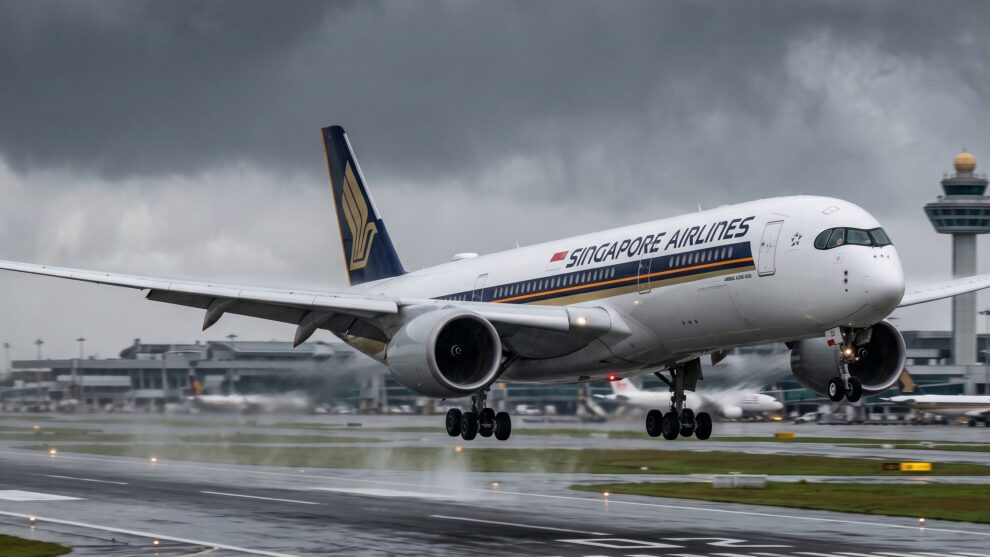
Picture the scene. You are sitting in seat 11A on a Singapore Airlines Airbus A350-900, descending through the thick, humid air over the Malacca Strait. Outside the window, a massive tropical squall is brewing. The Northeast Monsoon is pushing strong, unpredictable crosswinds right across the approach path for Runway 20R at Singapore Changi Airport (WSSS).
As an aviation enthusiast, you know a manual landing in these conditions demands immense skill. Hand-flying a 200-ton machine through shifting wind layers is an art form. Still, modern airlines rely heavily on automation to maximize safety and efficiency in low visibility and turbulent weather. Watching the A350’s auto-flight system handle a heavy crosswind is like watching a symphony of aerodynamics, raw computing power, and high-pressure hydraulics working in perfect unison.
Let’s look under the hood of this fly-by-wire marvel to see exactly what happens when the autopilot takes the reins in tropical weather.
The Brains of the Operation: ADIRUs and PRIMs
To fight a crosswind, the aircraft must know exactly what the wind is doing at a microsecond level. The A350 relies on a highly advanced Air Data Inertial Reference System (ADIRS). Three independent Air Data Inertial Reference Units (ADIRUs) constantly measure static pressure, dynamic pressure, and outside air temperature, blending this with laser-ring gyro data to determine the aircraft’s exact attitude, ground track, and drift angle.
These units feed raw telemetry straight into the Flight Control Primary Computers, known as PRIMs. The A350 uses three PRIMs and three Secondary Flight Control Computers (SECs). When a gust hits the tail fin, trying to push the aircraft off the localizer, the PRIMs calculate the required control surface deflection to counter it almost instantly.
We are not dealing with standard legacy components here. Airbus completely redesigned the electrical and hydraulic architecture for the A350.
The Power Muscles: 5,000 PSI and EHAs
Legacy widebodies rely heavily on traditional 3,000 psi hydraulic systems. The A350 steps up the game with a dual 5,000 psi hydraulic system. Pushing fluid at this immense pressure means the hydraulic pipes can be much narrower, saving crucial weight while delivering explosive force to the control surfaces.
When the autopilot commands an aileron or rudder movement to fight a Changi crosswind, it relies on advanced actuators:
- EHA (Electro-Hydrostatic Actuator): These units contain their own localized, electrically driven hydraulic pumps. If a main hydraulic line fails, the EHA uses the aircraft’s electrical grid to generate its own hydraulic pressure right at the control surface.
- EBHA (Electrical Backup Hydraulic Actuator): Operating normally on the main hydraulic lines, these switch to electrical power seamlessly if pressure drops.
This setup runs on the A350’s robust 230V AC electrical network—double the voltage of the older 115V AC systems found in the A330 or Boeing 777. This high voltage pushes power to the EHAs instantly, allowing the autopilot to deflect the massive rudder and ailerons with zero lag.
Crabbing Through the Squall: The Approach
As the Singapore Airlines A350 captures the Instrument Landing System (ILS) localizer for Runway 20R, the crosswind pushes against the fuselage. To maintain a straight ground track over the extended centerline, the autopilot initiates a “crab” maneuver. The nose points directly into the wind, looking slightly offset from the runway, while the actual path of travel remains perfectly true.
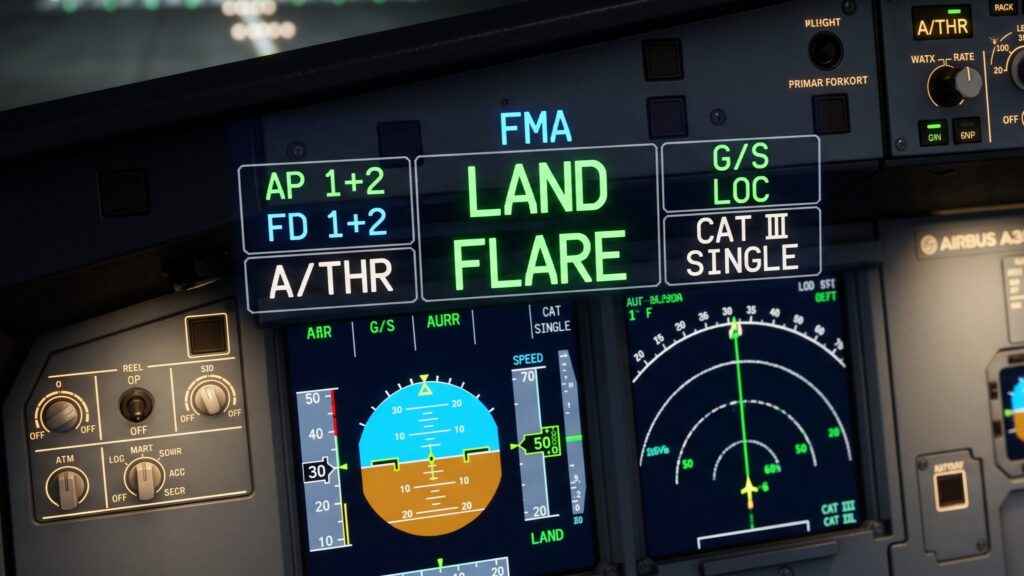
Inside the flight deck, the Captain and First Officer monitor the Flight Mode Annunciator (FMA) on their Primary Flight Displays. They watch for the crucial “LAND” green text, confirming the autopilot has locked onto both the localizer and glideslope with dual-channel redundancy.
Autoland System Comparison
To appreciate the leap in technology, let’s compare the A350’s crosswind auto-flight capabilities with the previous generation of long-haul workhorses.
| System Feature | Previous Gen (e.g., Airbus A330-300) | Airbus A350-900 |
| Hydraulic Pressure | 3,000 psi | 5,000 psi |
| Electrical Architecture | 115V AC | 230V AC |
| Primary Flight Computers | 3 FCECs, 2 SECs | 3 PRIMs, 3 SECs |
| Actuation Redundancy | Traditional Central Hydraulics | EHA & EBHA Localized Actuation |
| Crosswind Autoland Limit | 20 knots | 20-25 knots (Depending on airline SOP) |
| Runway Deceleration | Standard Autobrake (Low/Med/Max) | BTV (Brake to Vacate) System |
The Critical Decrab: 40 Feet Above the Asphalt
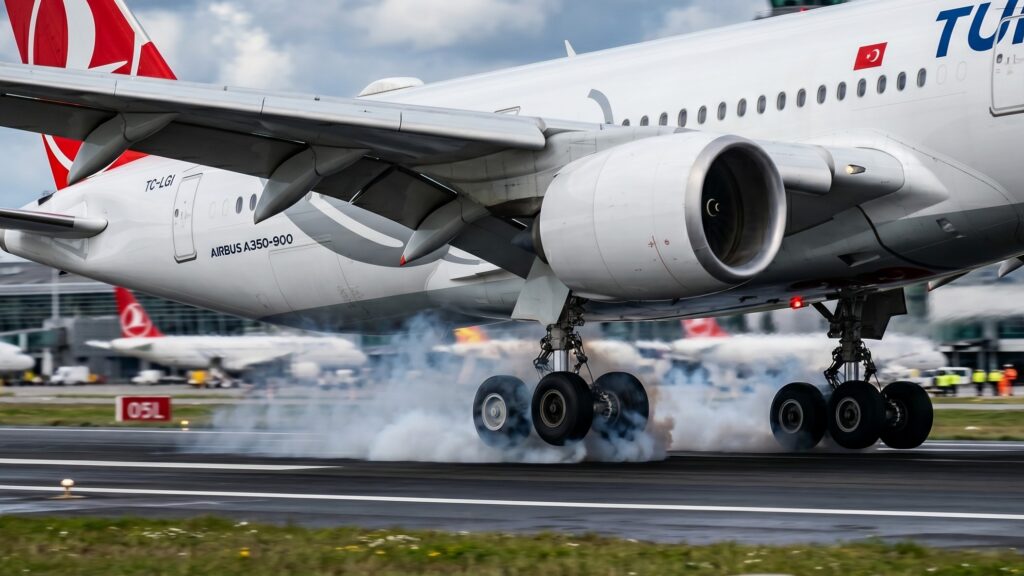
The true magic happens just seconds before the wheels touch the concrete. At exactly 40 feet Above Ground Level (AGL), the radar altimeters trigger the “FLARE” mode.
The A350 cannot land sideways; doing so would place catastrophic lateral stress on the main landing gear bogies. The autopilot executes a flawless decrab maneuver. The PRIMs send a lightning-fast command to the massive tail rudder, aggressively swinging the nose back to align perfectly with the runway centerline.
Simultaneously, the wind tries to blow the now-straight aircraft off the centerline. To counter this, the autopilot drops the upwind wing slightly by deflecting the ailerons, creating a deliberate sideslip. The magnificent Rolls-Royce Trent XWB engines spool back to idle thrust via the Auto-Thrust (A/THR) system.
The heavy widebody settles onto the tarmac. You will almost always feel the upwind main gear kiss the runway a fraction of a second before the downwind gear. It is an incredibly precise, mathematically perfect touchdown managed entirely by silicon and fly-by-wire algorithms.
Once on the ground, the advanced Brake to Vacate (BTV) system takes over, modulating the carbon brakes to slow the aircraft precisely in time for the crew’s pre-selected rapid exit taxiway. The squall continues to howl outside, but inside the cabin, it was just another perfectly smooth arrival at Changi.
Frequently Asked Questions (FAQ)
1. What is the maximum crosswind limit for an A350 autoland?
While the A350 has demonstrated manual crosswind landings at speeds up to roughly 40 knots during flight testing, the automatic landing limit is usually capped around 25 knots. Singapore Airlines’ Standard Operating Procedures (SOPs) generally restrict autolands to a maximum of 20 knots of crosswind to ensure maximum safety margins.
2. Can the A350 land in zero visibility with a crosswind?
Yes. The A350 is certified for CAT IIIb ILS approaches. This allows the aircraft to autoland in weather conditions with no Decision Height (DH) and a Runway Visual Range (RVR) as low as 75 meters, provided the crosswind remains within the certified autoland limits.
3. Why does the A350 use 5,000 psi hydraulics instead of the standard 3,000 psi?
Higher pressure allows for smaller, lighter hydraulic pipes and components throughout the aircraft. This massive weight saving improves fuel efficiency while providing the immense force required to move the large flight control surfaces instantly during turbulent crosswind approaches.
Join the Conversation!
Have you ever experienced a heavy crosswind landing at Changi or another tricky tropical airport? Did you notice the distinct “wing-down” feeling right before touchdown? Drop into the comments below and share your wildest approach stories—we love geeking out over a perfectly executed decrab!
Did you know AviationStream.com has a YouTube channel? Check out TheAeroGraphyOfficial and subscribe to watch fun, highly engaging aviation Shorts!