





Last Updated: 4 days ago
Decoding Flight Envelope Protection: Closed-Loop Algorithms and PID Control in Modern Avionics
Picture the flight deck of an Airbus A350. The sidestick feels incredibly smooth, translating human intent into digital commands with zero mechanical friction. Behind that simple piece of molded plastic lies a labyrinth of data buses, triplex-redundant flight control computers, and closed-loop algorithms working at lightning speed. We are looking at flight envelope protection—the invisible aerodynamic shield keeping a 280-ton machine perfectly balanced on the very edge of the sky.
The transition from purely mechanical flight controls to digital fly-by-wire (FBW) architectures fundamentally rewrote the rules of aerospace engineering. To truly appreciate what keeps modern airliners from tumbling out of the stratosphere, we need to strip away the cockpit panels and dive straight into the logic gates, sensor networks, and localized power systems doing the heavy lifting.
The Transition from Cables to Code
In legacy aircraft like the Boeing 727, pulling back on the yoke physically moved steel cables routed through the entire length of the fuselage. These cables commanded hydraulic actuators attached directly to the elevator. The pilot retained absolute mechanical authority. A momentary lapse in spatial orientation could easily overstress the airframe or induce a catastrophic aerodynamic stall.
Modern aviation flipped this paradigm entirely. Today’s Primary Flight Computers (PFCs) act as the ultimate authority, interpreting pilot inputs as “rate requests” rather than direct surface deflections. The software calculates the exact aerodynamic state of the aircraft using continuous data streams from the Air Data Inertial Reference Units (ADIRU). If a pilot demands a pitch attitude that would breach the critical Angle of Attack limit (αmax), the system simply refuses to pull the elevator any further. The code physically blocks the aircraft from destroying itself.
The Closed-Loop Feedback Architecture
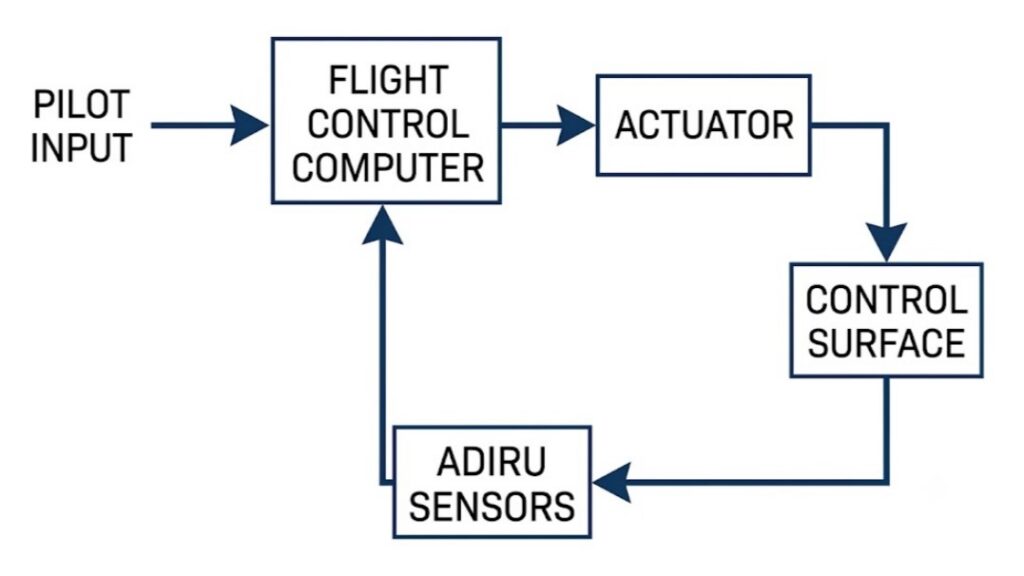
To achieve this seamless protection, avionics rely on an aggressive closed-loop feedback system. A closed-loop architecture continuously monitors its own physical output, comparing the actual state of the aircraft against the desired state commanded by the pilot or the autopilot.
Let’s trace a pitch command in real-time. The sidestick generates an analog voltage, which the flight control computers instantly digitize. The primary communication spine enabling these calculations is the ARINC 429 data bus standard. Flight control computers digest streams of 32-bit words arriving at speeds of up to 100 kilobits per second. These data packets carry invaluable metrics from the ADIRU. Inside the ADIRU, solid-state Ring Laser Gyroscopes (RLGs) measure angular rates by firing counter-rotating laser beams around a closed triangular path, detecting microscopic interference patterns when the aircraft pitches, rolls, or yaws.
The computers analyze the current pitch rate, airspeed, and altitude. They send a precise, millimeter-accurate command to the Trimmable Horizontal Stabilizer Actuator (THSA). Sensors mounted on the actuator measure its exact physical extension and feed this positional data back to the computers hundreds of times per second. Any discrepancy between the requested position and the actual physical position is instantly corrected.
PID Controllers at 40,000 Feet
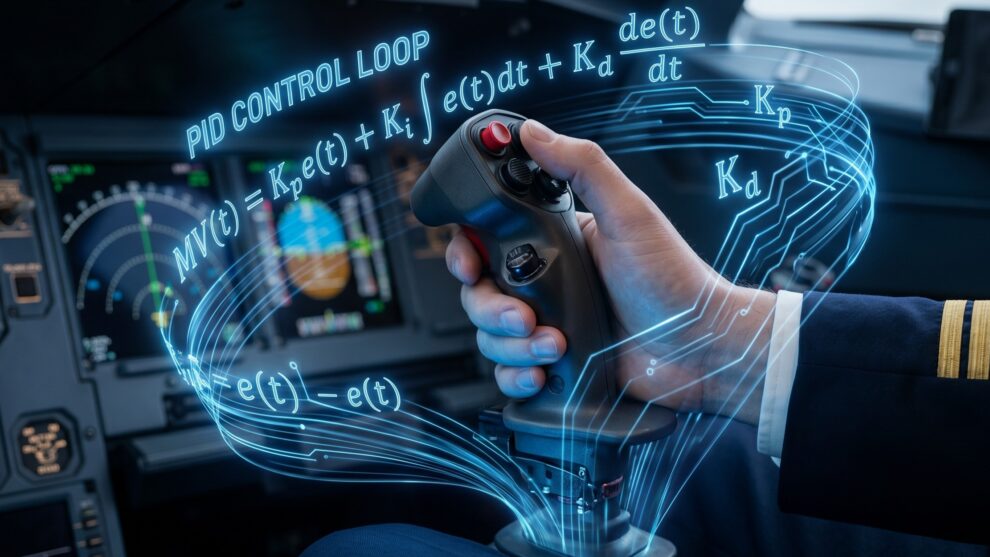
At the absolute mathematical heart of this continuous correction is the PID controller. Proportional, Integral, and Derivative logic loops govern almost every automated physical movement on board, ensuring that aerodynamic corrections are razor-sharp and buttery-smooth.
- Proportional (P): This provides the immediate reaction to an error. If the aircraft is hit by a sudden microburst and pitches down 5 degrees off the target attitude, the proportional controller applies an elevator deflection directly relative to that exact 5-degree error. A massive deviation triggers a massive, rapid control surface movement.
- Integral (I): Wind shear or minor fuel weight imbalances create persistent, steady-state errors that the proportional controller cannot fully erase. The integral component accumulates these microscopic errors over time, applying a slow, steady trim adjustment until the aircraft perfectly holds the commanded flight path without constant yoke input.
- Derivative (D): This is the predictive genius of the flight control system. The derivative controller monitors the rate at which the error is changing. If the nose is pitching up toward the stall limit at an aggressive 10 degrees per second, the derivative logic anticipates the impending aerodynamic breach. It commands counter-elevator pressure before the aircraft ever reaches αprot (the designated protection threshold). It acts as an electronic dampener, completely preventing dangerous pitch overshoots.
High-Voltage Muscles: Translating Code to Force

Algorithms and digital signals require raw physical muscle to move giant aerodynamic surfaces against immense dynamic pressure. In cutting-edge airframes like the A350 and the Boeing 777X, the industry shifted away from centralized, heavy 3000 psi hydraulic lines toward a localized, hybrid approach utilizing Electro-Hydrostatic Actuators (EHAs).
Instead of bleeding engine power to pump hydraulic fluid across 60 meters of internal tubing, the aircraft routes 115V AC / 400Hz electrical power directly to the wing structures. Inside the EHA, a localized electric motor drives a miniature hydraulic pump, pushing fluid at an astonishing 5000 psi directly into the actuator cylinder. This high-pressure localized architecture strips hundreds of kilograms of heavy piping out of the airframe, drastically reducing the basal weight of the aircraft while multiplying the redundancy of the envelope protection systems.
System Comparison: Mechanical vs. Fly-By-Wire
| System Characteristic | Legacy Mechanical (e.g., Boeing 727) | Modern Fly-By-Wire (e.g., Airbus A350) |
| Input Mechanism | Direct steel cables, pulleys, and bellcranks | Digital sidestick via ARINC 429 data buses |
| Actuator Pressure | 3000 psi centralized engine-driven hydraulics | 5000 psi localized Electro-Hydrostatic Actuators |
| Stall Protection | Stick shaker/pusher (requires physical pilot reaction) | Active αprot limitation (system overrides pilot) |
| Overspeed Limit | Aural clacker warning at VMO | Automatic pitch-up command to prevent airframe stress |
| Control Logic | Open-loop direct physical surface drive | Closed-loop continuous PID control architectures |
The integration of closed-loop logic and hyper-responsive actuators ensures that modern commercial flight remains the safest mode of transportation ever engineered. The pilot provides the strategy, while the silicon handles the survival.
Frequently Asked Questions (FAQ)
What exactly is the difference between αprot and αmax in Airbus systems?
αprot (Alpha Protection) is the threshold where the flight control computers actively intervene to prevent a stall, altering the control laws to prioritize pitch protection. αmax is the absolute maximum aerodynamic angle of attack the aircraft can sustain before stalling. The system physically will not allow the pilot to pull the nose past αmax, regardless of how hard the sidestick is deflected.
How do flight control computers handle a complete sensor failure in the closed-loop system?
Avionics utilize deep redundancy, often running three primary and two secondary flight control computers. If pitot tubes freeze or ADIRUs deliver conflicting data, the voting logic isolates the faulty sensor. If too many sensors fail, the system degrades from “Normal Law” (full envelope protection) to “Alternate Law” or “Direct Law,” handing raw proportional control back to the pilot without the PID safety nets.
Why do modern commercial aircraft use 400Hz AC power instead of standard 50Hz or 60Hz?
Operating electrical systems at 400Hz allows transformers, motors, and generators to be built significantly smaller and lighter. In aerospace engineering, weight is the ultimate enemy. The higher frequency means less magnetic core material is required to transfer the exact same amount of power to components like EHAs.
Join the Conversation:
Are you more fascinated by the intricate software algorithms that predict aerodynamic behavior, or the raw localized power of 5000 psi Electro-Hydrostatic Actuators? Drop your thoughts, technical questions, or favorite fly-by-wire aircraft in the comments below! Let’s talk engineering.
Did you know AviationStream.com has a YouTube channel? Check out TheAeroGraphyOfficial and subscribe to watch fun, highly engaging aviation Shorts!