








Last Updated: 4 months ago
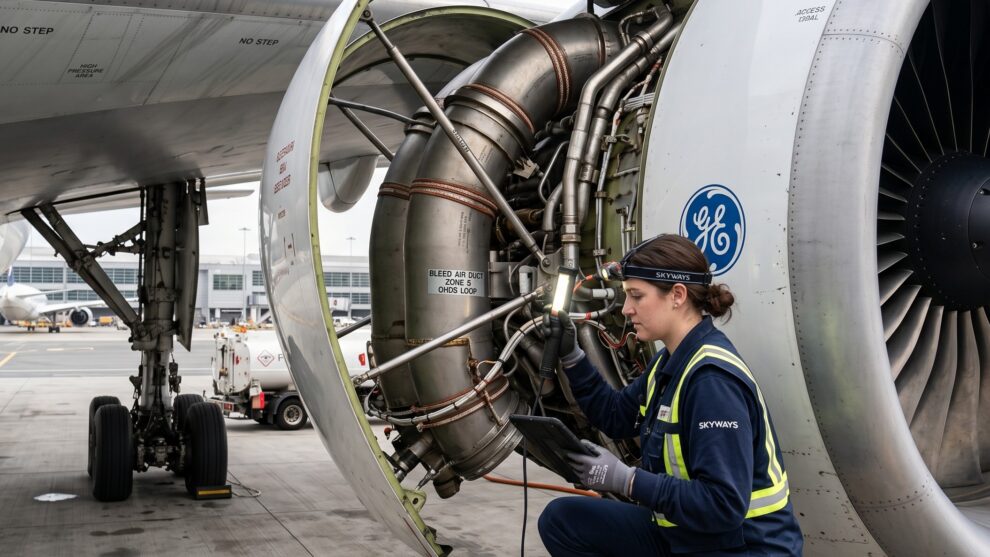
Modern commercial aviation relies on a hidden cardiovascular network, and at the absolute center of its pneumatic safety net stands the Boeing 777 Bleed Air Leak Detection System. Deep beneath the carbon-fiber composite fairings and aerospace-grade aluminum skin of the Triple Seven, high-pressure titanium arteries pulse with immense thermal energy. This complex pipeline, driven by the sheer brute force of massive turbofan engines like the GE90 or Rolls-Royce Trent 800, provides the lifeblood for vital secondary aircraft functions.
While passengers relax in a comfortable, climate-controlled cabin at 35,000 feet, few realize the turbulent journey of the air keeping them comfortable. Just moments prior, that exact air was violently squeezed inside the engine’s high-pressure compressor stage, reaching blistering temperatures exceeding 400°C (750°F) before being tapped off.
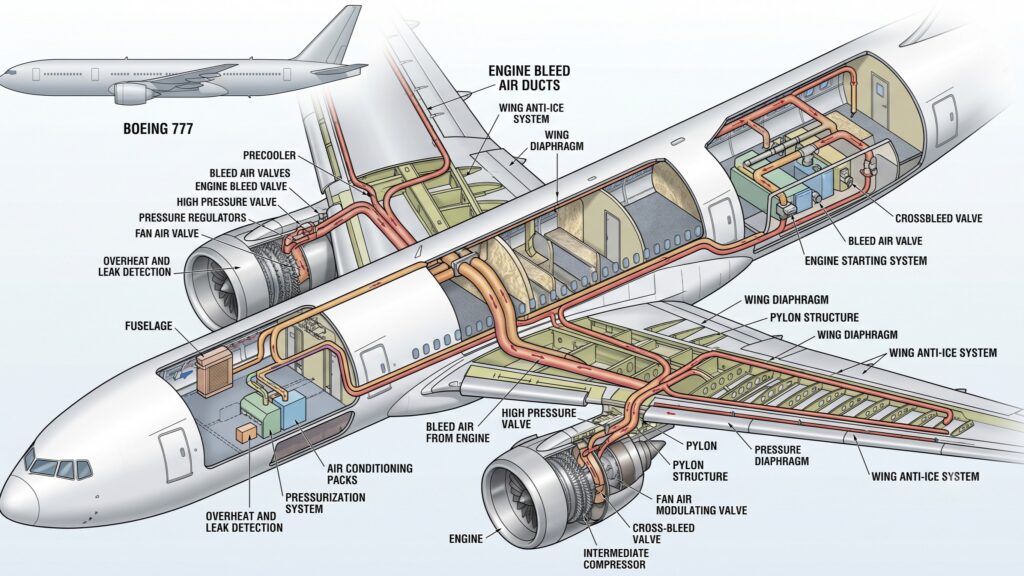
Harnessing this superheated flow powers everything from cabin pressurization and air conditioning packs to engine cowl anti-icing systems. Pumping 40 to 50 psi of scorching air through the airframe carries an incredible structural risk. A ruptured duct blasting jet-engine heat into an enclosed strut, landing gear bay, or wing leading edge can melt fly-by-wire wiring harnesses, boil hydraulic lines, and degrade composite materials in seconds.
To prevent catastrophic structural damage, Boeing engineers developed a highly sophisticated safety system. Let’s grab our digital multi-meters, pull back the cowlings, and examine the exact technical architecture of the Boeing 777 Bleed Air Leak Detection System.
The Anatomy of the Overheat Detection System (OHDS)
At the heart of the 777’s pneumatic safety net lies the Overheat Detection System (OHDS). Instead of relying on isolated temperature sensors scattered randomly across the airframe, the aircraft utilizes continuous sensing elements. These elements run in tandem directly alongside every major bleed air duct, covering the engine struts, the wing leading edges, the air conditioning packs in the fuselage belly, and the long pneumatic line running back to the Auxiliary Power Unit (APU) in the tail.
These sensors are not just simple wires. They are intricate coaxial cables built to withstand severe environmental conditions while maintaining hyper-sensitivity to localized temperature spikes.
The Eutectic Core
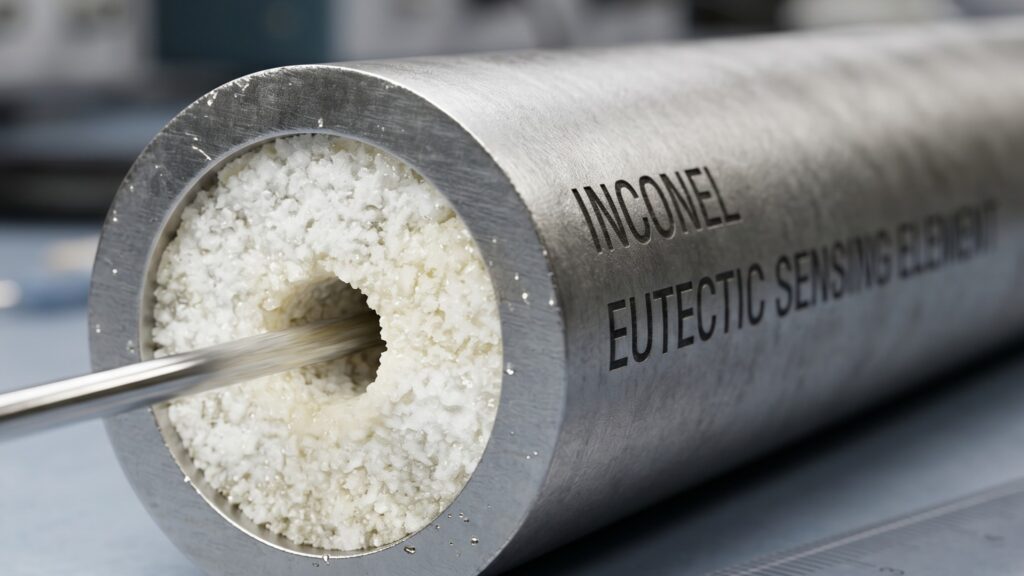
Crack open one of these continuous loop sensors, and you will find three vital components:
- An outer protective capillary tube made of Inconel, a rugged nickel-chromium superalloy highly resistant to oxidation and corrosion.
- A central pure nickel conductor wire running exactly down the middle.
- A specialized eutectic salt compound packed tightly between the outer tube and the inner wire.
At normal cruising temperatures, this eutectic salt acts as a brilliant electrical insulator. It completely prevents any current from flowing between the inner wire and the outer Inconel casing.
When a titanium bleed duct develops a crack, a jet of superheated air impacts the sensing element. The intense localized heat causes the eutectic salt in that exact spot to melt and change its physical state. The moment the salt reaches its specific alarm threshold—which ranges between 124°C and 204°C (255°F to 400°F) depending on the detection zone—its electrical resistance drops off a cliff.
Dual-Loop Redundancy and AIMS Integration
A sudden drop in resistance allows the 28V DC excitation voltage supplied by the system to arc from the center wire to the grounded outer tube. This creates an immediate spike in current.
In older generations of commercial jets, a single short circuit like this would directly illuminate a warning light on the flight engineer’s panel. This legacy design was notoriously prone to false alarms caused by chafing, moisture ingress, or intense vibration. Boeing tackled this flaw on the 777 by implementing a stringent dual-loop architecture.
Every bleed duct is monitored by two parallel sensing cables, simply designated as Loop A and Loop B. Both loops feed their continuous resistance data directly into the Airplane Information Management System (AIMS), the master computer brain of the 777.
AIMS applies an “AND” logic gate to the incoming data. For the system to trigger a legitimate leak warning, both Loop A and Loop B must simultaneously report a massive drop in resistance. If only Loop A detects a fault while Loop B remains normal, AIMS registers a localized sensor failure, records a maintenance fault code for the ground crews, and suppresses the cockpit alarm, allowing the flight to continue without unnecessary disruption.
Generational Leap: Legacy Tech vs. Boeing 777 Architecture
To truly appreciate the 777’s leak detection capabilities, we must look at how far the engineering has evolved.
| System Feature | Legacy Aircraft (e.g., Early 727/747) | Boeing 777 Architecture |
| Sensor Design | Discrete spot thermal switches | Continuous Inconel/eutectic loops |
| Coverage Area | Intermittent, localized zones | 100% parallel duct tracing |
| Monitoring Logic | Single-channel, direct-wired | Dual-loop “AND” logic via AIMS |
| False Alarm Rate | High (susceptible to moisture/vibration) | Extremely low |
| Crew Action Required | Manual valve isolation | Fully automated shutoff sequence |
The Cockpit Perspective: When the System Trips
Imagine a flight crew cruising at FL350 over the North Atlantic. A clamp fails on the right engine strut, allowing 350°C air to escape into the enclosed pylon space.
Within milliseconds, the localized heat melts the eutectic salt in both Loop A and Loop B. The resistance plummets. AIMS detects the dual-current spike and springs into action.
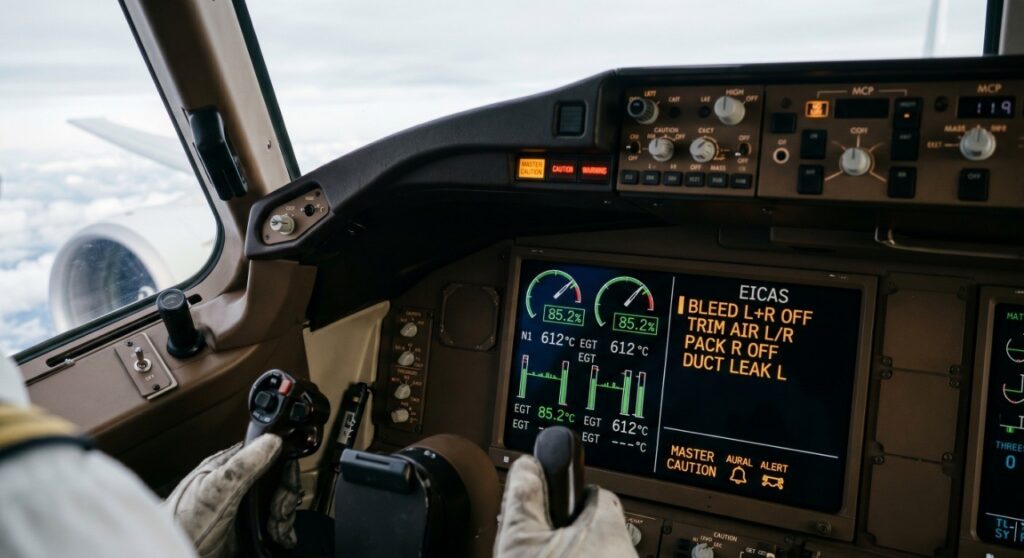
The Master Caution lights flash, an aural beeper sounds in the flight deck, and the amber BLEED LEAK R ENG message populates on the Engine Indicating and Crew Alerting System (EICAS) display.
The brilliance of the 777 is that the system rarely waits for human intervention. The moment AIMS verifies the dual-loop leak, it automatically commands the respective Engine Bleed Air Valve (PRSOV) and the High-Pressure (HP) shutoff valve to slam shut. The source of the scorching air is isolated almost instantly, neutralizing the threat before the pilots even open their non-normal checklist. As the trapped air cools, the eutectic salt solidifies, its resistance climbs back to normal, and the continuous loops reset themselves automatically.
The Boeing 777 Bleed Air Leak Detection System stands as a masterclass in redundancy, materials science, and automated safety. It is a quiet guardian, continuously taking the temperature of the aircraft’s arteries to ensure every flight arrives safely.
Frequently Asked Questions (FAQ)
What happens if both Loop A and Loop B fail in flight?
If a dual-loop failure occurs, AIMS detects the loss of system integrity and generates an EICAS advisory message (e.g., BLEED LEAK DETECT). The flight crew will consult their manuals, which usually dictate avoiding icing conditions since they can no longer safely monitor the pneumatic ducts supplying the anti-ice systems.
Does the Auxiliary Power Unit (APU) have the same leak protection?
Yes. Because the APU is located in the tail cone, its bleed air must travel through a massive duct spanning almost the entire length of the fuselage to reach the air conditioning packs. This entire route is protected by continuous dual-loop eutectic sensors.
Can a bleed leak cause a fire?
While bleed air itself is not a flame, its extreme temperature (up to 400°C/750°F) can ignite nearby flammable fluids if lines are severed, or melt critical flight control wiring. The leak detection system isolates the hot air long before it can reach the auto-ignition temperature of surrounding materials.
Join the Discussion
Have you ever worked hands-on with eutectic continuous loop sensors or experienced a bleed leak isolation in the simulator? Drop your stories and technical insights in the comments below.
Did you know AviationStream.com has a YouTube channel? Check out TheAeroGraphyOfficial and subscribe to watch fun, highly engaging aviation Shorts!