Delta Connection Flight 4819: CRJ900 Overturns at Toronto Pearson
On 17 February 2025, Delta Connection Flight 4819 from Minneapolis landed hard at Toronto Pearson, lost its right wing and came to rest upside down in the snow. All 76 passengers and 4 crew survived; 21 people were taken to hospital.
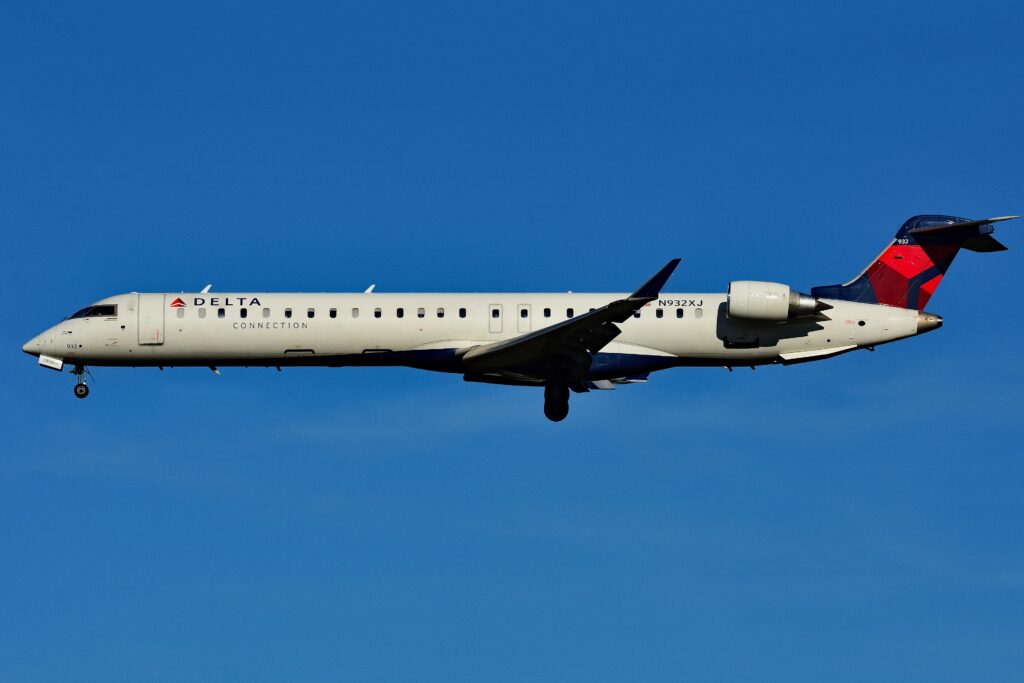
On 17 February 2025, Delta Connection Flight 4819, a Bombardier CRJ900 operated by Endeavor Air, touched down hard on runway 23 at Toronto Pearson International Airport. Its right main landing gear collapsed, the right wing separated and caught fire, and the aircraft rolled over, sliding to a stop upside down on the snow-covered ground. All 80 people on board survived. Pictures of passengers climbing out of an inverted airliner travelled around the world within minutes.
Delta Connection Flight 4819 at a glance
- Date: 17 February 2025, about 14:12 local time
- Aircraft: Bombardier CRJ900LR, registration N932XJ
- Operator: Endeavor Air, flying as Delta Connection
- Route: Minneapolis–Saint Paul (MSP) to Toronto Pearson (YYZ)
- On board: 76 passengers and 4 crew
- Injuries: 21 people taken to hospital; no fatalities
- Investigator: Transportation Safety Board of Canada (TSB), with the US NTSB
The landing
The flight arrived two days after a major snowstorm. Skies were clear, but the wind was strong and gusty, with gusts reported up to about 35 knots. During the final seconds of the approach, the aircraft’s ground proximity warning system sounded a “sink rate” alert. According to the TSB’s preliminary report, published on 20 March 2025, the aircraft touched down descending at about 1,100 feet per minute, well above the rate the main landing gear is certified to absorb, and at about 136 knots, below its reference landing speed of 144 knots.
The right main landing gear side-stay fractured and the gear folded. The right wing root failed and fuel from the wing ignited. The aircraft rolled to the right and slid along the ground on its roof before stopping off the runway.
The evacuation
Inside, passengers found themselves hanging upside down in their seats. Cabin crew and passengers helped one another release their belts and climb out through the exits as firefighters sprayed foam on the burning fuel. Airport rescue crews reached the aircraft within seconds. Three of the injured, including a child, were flown to hospital by air ambulance. The TSB said it was not aware of any failures of seats or belts.
The investigation
The TSB’s preliminary report set out what happened but drew no conclusions about why. In a February 2026 update, the board said its work was continuing, with attention on the metallurgical examination of the landing gear and wing, crew training, and how cabin crew and passengers can evacuate an inverted aircraft. As of November 2026 the final report has not been published. This entry will be updated when it is.
Why it matters
The accident showed how much modern aircraft design, crashworthy seats and quick rescue response can save lives. It also brought attention to landing technique in strong gusty winds (see how airliners handle them in this A350 crosswind landing) and to evacuations from overturned cabins, which crews rarely train for.
Sources
- TSB Canada: Preliminary report on the hard landing of Endeavor Air flight DL4819 (A25O0021), as reported by CBC News, 20 March 2025
- AIN: Investigators note high sink rate in Delta Connection CRJ crash in Toronto, 21 March 2025
- AeroTime: Delta flight received sink rate alert before Toronto crash, March 2025
- AirlineGeeks: Investigators provide update on Toronto Endeavor Air crash, 18 February 2026
Related Historical Aviation Accidents Events
More significant events from aviation history
Assassination of Juvénal Habyarimana and Cyprien Ntaryamira: The 1994 Aircraft Shootdown in Rwanda
🗓 6 April, 1994 📍 Presidential Palace gardens, near Kigali International Airport, Kigali, Rwanda, 1°58′32″S 30°10′26″E / 1.9756°S 30.1739°E / -1.9756; 30.1739 ★★★★☆ Read full story →
1996 Charkhi Dadri Collision: The Deadliest Mid-Air Crash
🗓 12 November, 1996 📍 Charkhi Dadri, Haryana, India, 28°33′38″N 76°18′15″E / 28.56056°N 76.30417°E / 28.56056; 76.30417 ★★★★☆ Read full story →
United Airlines Flight 736: The Crash That Changed Aviation
🗓 21 April, 1958 📍 Clark County, Nevada, United States ★★★★☆ Read full story →
The Tragic Mystery of China Northern Airlines Flight 6136
🗓 7 May, 2002 📍 Bohai Bay, near Dalian Zhoushuizi International Airport, Dalian, Liaoning, China, 39°00′N 121°48′E / 39°N 121.8°E / 39; 121.8 ★★★☆☆ Read full story →
Start the discussion
Commenting on this event: Delta Connection Flight 4819: CRJ900 Overturns at Toronto Pearson