Air Cycle Machine and Air Conditioning Pack Explained
An air cycle machine is the turbine-and-compressor unit at the heart of an airliner's air conditioning pack. It cools hot bleed air by compressing it, cooling it in heat exchangers and then expanding it through a turbine.
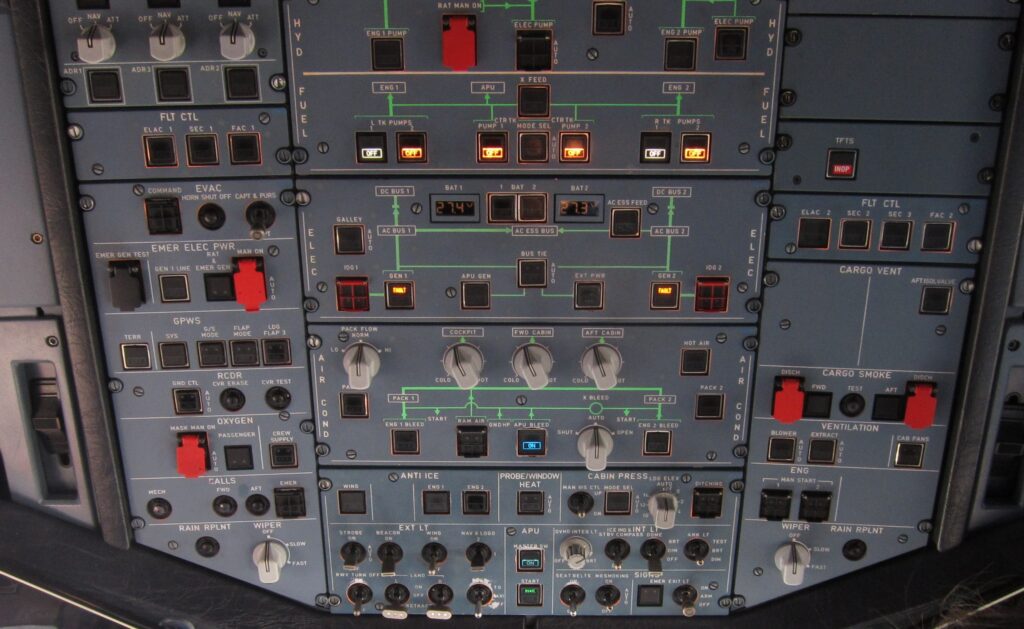
An air cycle machine (ACM) is the turbine-and-compressor unit at the heart of an airliner’s air conditioning pack. It cools hot, compressed bleed air without any refrigerant gas: the air itself is the working fluid. The cooled air from the packs both conditions the cabin and keeps the fuselage pressurised.
How a pack works
A pack takes bleed air at roughly 200 °C and turns it into air that can be colder than freezing, using a sequence of steps:
1. Primary heat exchanger: the hot bleed air passes through a heat exchanger cooled by outside ram air drawn in through an inlet on the underside of the aircraft.
2. Compressor: the air is compressed again by the compressor of the air cycle machine, which raises its pressure and temperature.
3. Secondary heat exchanger: the air is cooled again by ram air. Because it is now at higher pressure, more heat can be removed.
4. Turbine: the air expands through the ACM’s turbine. Expansion does work, which drives the compressor and fan on the same shaft, and the energy taken out makes the air drop sharply in temperature.
5. Water separator: moisture condenses as the air cools and is removed, so that the cabin does not fill with fog and ice does not form in the ducts.
The cold air from the pack is then mixed with recirculated cabin air and with small amounts of hot “trim air” so that each cabin zone and the flight deck can be kept at its own selected temperature.
Where you find it
Packs are usually installed in the unpressurised belly of the aircraft, near the wing root, close to the ram air inlets. Most twin-engine airliners, such as the Airbus A320 and Boeing 737, have two packs; the Boeing 747 has three. On most airliners either pack alone can keep the aircraft pressurised, so the loss of one is normally handled with a checklist rather than as an emergency, sometimes with a lower maximum flight altitude. On the A320 the crew controls them with the PACK 1 and PACK 2 buttons on the overhead panel. On bleed-free aircraft such as the Boeing 787, the packs are supplied by electric cabin air compressors instead of engine bleed air, but they still use the air cycle principle.
Why it matters
Air cycle cooling is simple, light and reliable, and it uses air that the aircraft already has. The trade-off is energy: running the packs costs fuel. That is why some airlines use packs-off take-offs on heavily loaded aircraft and why on the ground the cabin is often cooled by preconditioned air from the terminal instead of by the packs. The roar under the floor near the wings of a parked airliner is often the pack’s ram air fans.
Frequently Asked Questions
Does an aircraft air conditioner use refrigerant? Not normally. The air cycle machine cools air by expansion; some aircraft also have small vapour-cycle units for galleys or electronics.
How many packs does an airliner have? Usually two on twin-engine aircraft and three on some larger types such as the Boeing 747.
Can an airliner fly with one pack? Yes, usually with some limitations on altitude or passenger comfort.
References
- FAA Aviation Maintenance Technician Handbook – Airframe (FAA-H-8083-31), chapter 16: Cabin Environmental Control Systems (air cycle cooling)
- FAA Pilot’s Handbook of Aeronautical Knowledge (FAA-H-8083-25), chapter 7 (Aircraft Systems)
Start the discussion
Commenting on this term: Air Cycle Machine and Air Conditioning Pack Explained