Load Factor Explained: G-Forces, Turns and Structural Limits
Load factor is the total load on an aircraft divided by its weight, expressed in g. It rises in turns, pull-ups and turbulence, and it sets the structural limits every aircraft is certified to.
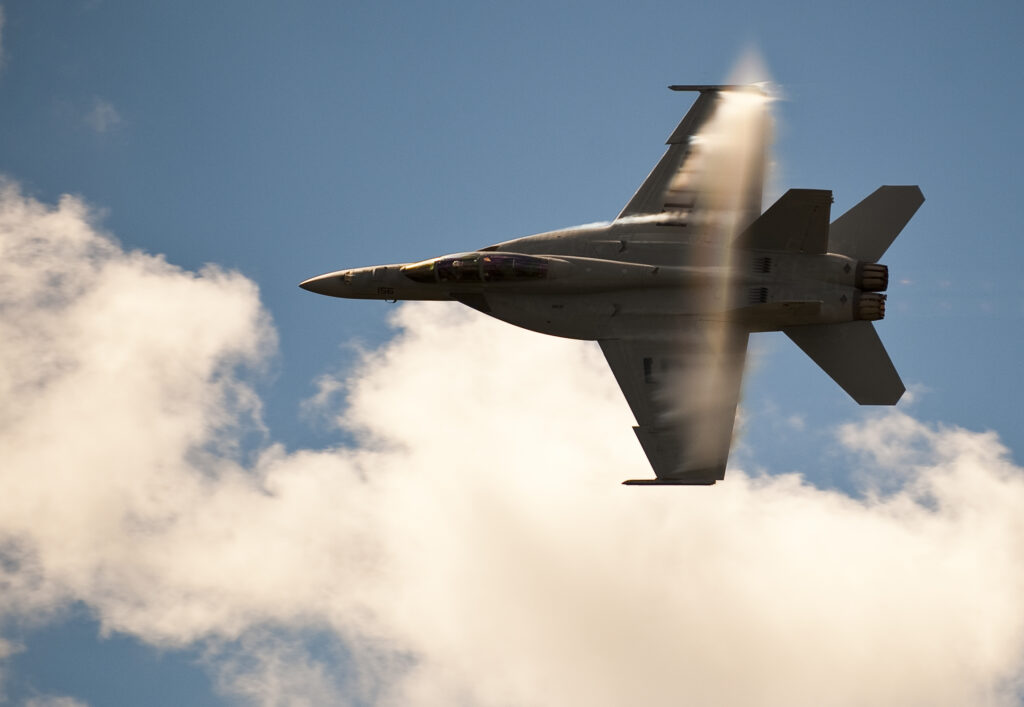
Load factor is the ratio of the total load an aircraft’s wings are carrying to the aircraft’s weight. It is expressed in g. In straight and level flight the wings support exactly the aircraft’s weight, so the load factor is 1 g. In a turn, a pull-up or a gust, the wings must produce more lift, and the load factor rises above 1.
Load factor in a turn
In a level turn, the lift must both hold the aircraft up and pull it around the turn. Because the lift is tilted, it has to grow as the bank angle increases. The load factor in a level, coordinated turn is 1 divided by the cosine of the bank angle:
- 30° of bank: about 1.15 g
- 45° of bank: about 1.41 g
- 60° of bank: 2 g
- 75° of bank: almost 4 g
The rise is slow at first and then very steep, which is why light aircraft are rarely flown above 60° of bank outside aerobatics.
Load factor and stall speed
Because the wing has to produce more lift at a higher load factor, it reaches its critical angle of attack at a higher speed. Stall speed increases with the square root of the load factor. At 2 g, in a 60° banked turn, the stall speed is about 41% higher than in level flight. Accelerated stalls of this kind are a well-known hazard in steep turns close to the ground, for example when turning towards the runway at low speed.
Certified limits
Every aircraft is designed for a limit load factor, the highest load it is expected to meet in service, and it must withstand 1.5 times that load, the ultimate load, without breaking. Typical limits for light aircraft are:
- Normal category: +3.8 g and −1.52 g
- Utility category: +4.4 g and −1.76 g
- Aerobatic category: +6 g and −3 g
Large transport aircraft are designed to at least +2.5 g and −1 g with flaps up, and +2 g with flaps extended, under 14 CFR 25.337. Fighters such as the F/A-18 are built for about +7.5 g.
The design manoeuvring speed, VA, is linked to these limits: at or below it, the wing will normally stall before a single full deflection of one control can push it past the limit load factor. It is not a blanket protection. The FAA warns that repeated or alternating inputs, or full inputs on more than one axis at once, can overstress the structure even below VA. Turbulence also creates load factor, which is why pilots slow down in rough air.
Why it matters
Load factor explains why steep turns feel heavy, why stall speed is not a single number, and why aircraft have speed limits in turbulence. Exceeding the limit can bend the structure permanently, and maintenance inspections are required after a reported overstress.
Frequently Asked Questions
What is load factor in aviation? The ratio of the load on the wings to the aircraft’s weight, in g.
How many g is a 60-degree bank? 2 g in a level, coordinated turn.
Why does stall speed increase in a turn? The wing needs more lift, so it reaches the critical angle of attack at a higher speed.
References
- FAA Pilot’s Handbook of Aeronautical Knowledge (FAA-H-8083-25), chapter 5 (Aerodynamics of Flight): load factors
- 14 CFR 25.337, Limit manoeuvring load factors

Start the discussion
Commenting on this term: Load Factor Explained: G-Forces, Turns and Structural Limits