Emergency Oxygen on Airliners: Masks and Chemical Generators
Emergency oxygen protects passengers and crew if an airliner loses cabin pressure. Passenger masks drop automatically and are usually fed by chemical oxygen generators; pilots have quick-donning masks supplied from oxygen cylinders.
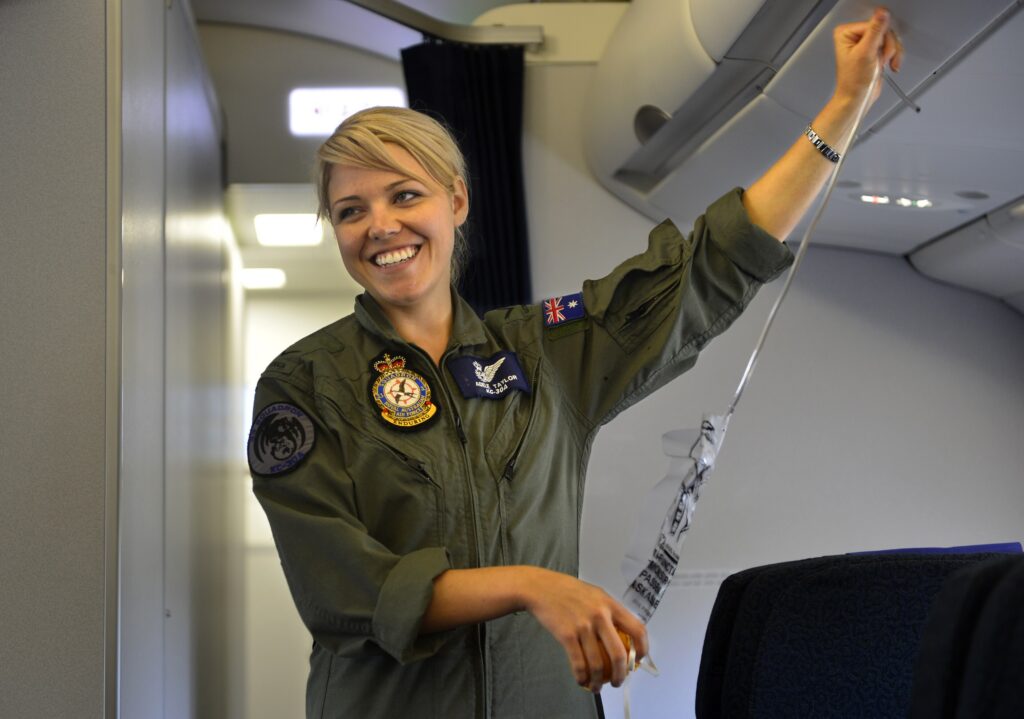
Emergency oxygen is the system that supplies breathing oxygen to passengers and crew if an aircraft loses cabin pressure at high altitude. On an airliner it has two separate parts: drop-down masks for the passengers and cabin crew, and quick-donning masks for the pilots. It gives everyone enough oxygen while the crew makes an emergency descent to a safe altitude, normally 10,000 ft or lower where the terrain allows.
Passenger oxygen
If the cabin altitude rises above about 14,000 ft, compartments above every seat row, in the toilets and at the crew stations open automatically, and the masks fall out. The pilots can also release them with a switch.
Most airliners supply these masks from chemical oxygen generators: small steel canisters containing sodium chlorate mixed with iron powder. Pulling a mask towards you pulls a pin that fires a small igniter, and the chemical reaction releases oxygen for typically 12 to 22 minutes, depending on the aircraft and its route. The reaction cannot be stopped once it has started, and the canister becomes very hot, which is normal. The bag on the mask may not inflate even when oxygen is flowing. Some long-range aircraft use central gaseous oxygen cylinders for the passenger system instead, which can supply oxygen for longer.
The cabin crew safety briefing tells passengers to put their own mask on before helping others. At 35,000 ft, a person has only around half a minute to a minute of useful consciousness after a rapid decompression.
Flight crew oxygen
Pilots have quick-donning masks stored beside their seats, supplied from high-pressure oxygen cylinders. US rules require them to be put on with one hand within five seconds. Squeezing the harness inflates it so that it slides over the head and then grips tightly. The masks can deliver a mix of cabin air and oxygen, 100% oxygen, or oxygen under pressure (emergency setting) to keep smoke out. Each mask has a microphone, so the pilots can keep talking to each other and to air traffic control.
After a decompression
The crew puts on oxygen masks first, then follows the aircraft’s emergency descent procedure, often with spoilers extended, down to a safe altitude. That is usually 10,000 ft or lower, where the air contains enough oxygen to breathe without masks, but never below the minimum safe altitude for the terrain along the route, which over high mountains can be considerably higher. Portable oxygen bottles let the cabin crew move around and give first aid.
Why it matters
The danger of chemical oxygen generators became clear in 1996, when ValuJet Flight 592 crashed in the Florida Everglades after expired generators that had been shipped as cargo started a fire in the hold. Rules on carrying them as cargo were tightened afterwards. On board, properly installed generators are safe and are checked as part of scheduled maintenance.
Frequently Asked Questions
How long do airliner oxygen masks last? Typically 12 to 22 minutes, long enough for an emergency descent.
Why does the oxygen mask bag not inflate? Oxygen flows continuously to the mask; the bag only fills slightly and may not inflate at all.
Why does it smell of burning when masks deploy? The chemical reaction in the generator gets hot and can produce a burning smell. This is normal.
References
- 14 CFR 25.1447, Equipment standards for oxygen dispensing units
- 14 CFR 121.333, Supplemental oxygen for emergency descent and for first aid
- NTSB Aircraft Accident Report AAR-97/06: ValuJet Airlines Flight 592
Start the discussion
Commenting on this term: Emergency Oxygen on Airliners: Masks and Chemical Generators