Angle of Attack Explained: Meaning, Critical Angle and Stall
The angle between a wing and the air flowing towards it decides how much lift the wing makes, and when it stops making it.
Quick Definition
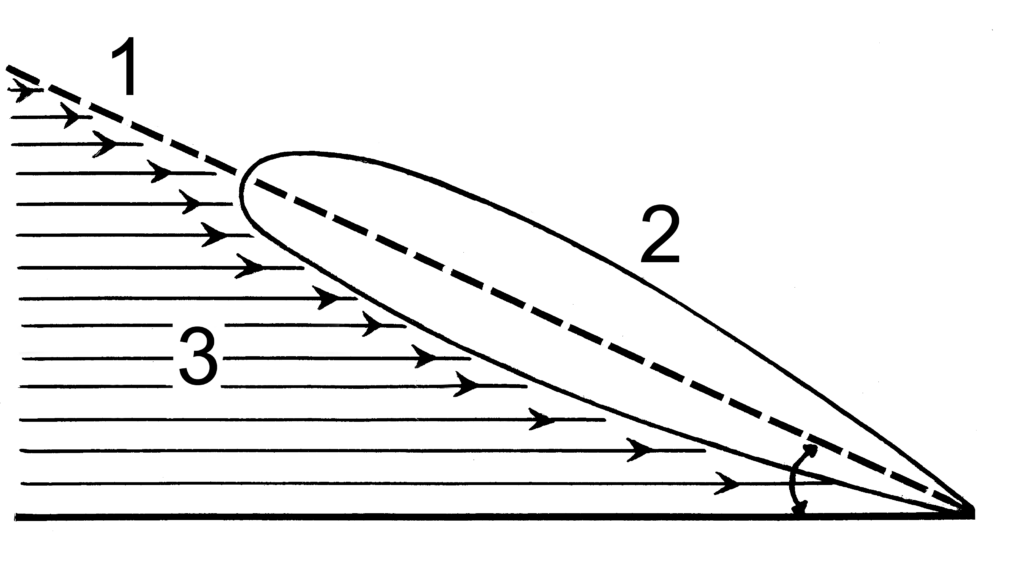
Angle of attack (often written AoA or the Greek letter alpha, α) is the angle between a wing’s chord line, the imaginary straight line from its leading edge to its trailing edge, and the relative wind, the direction of the air flowing towards the wing. It is one of the most important numbers in flying, because it controls how much lift a wing produces and when it stalls.
Angle of attack is not pitch
It is easy to confuse angle of attack with the aircraft’s pitch attitude, the angle of the nose above or below the horizon. They are different. An aircraft can be nose-high and still have a small angle of attack, for example in a fast climb, or nose-level with a large angle of attack, for example when it is slow and sinking. What matters to the wing is not where the nose points but how the air meets it.
How angle of attack creates lift
As angle of attack increases, the wing deflects more air downwards and the pressure difference between its lower and upper surfaces grows, so lift increases. That is why pilots raise the nose to climb or to keep flying level as they slow down. Our guide to how lift works covers the physics in more detail, and flaps change the wing’s shape so it can make enough lift at lower speeds.
The critical angle and the stall
Lift does not increase forever. Beyond a certain point, called the critical angle of attack, the airflow can no longer follow the curved upper surface. It separates from the wing, lift drops sharply and drag rises. This is an aerodynamic stall. For many conventional wings the critical angle is in the region of 15 to 18 degrees, depending on the airfoil and whether flaps and slats are extended.
The key point that every pilot learns is that a wing stalls at its critical angle of attack, not at a particular speed. Published stall speeds are simply the speeds at which, for a given weight and configuration, the wing reaches that angle in level flight. In a steep turn or a sharp pull-up, the wing can reach the critical angle at a much higher speed.
To recover from a stall, the pilot must reduce the angle of attack, usually by lowering the nose, and then add power. Pulling back further only deepens the stall.
How aircraft measure and protect it
Most airliners have angle of attack vanes or probes on the fuselage near the nose. Their data feeds stall warning systems such as the stick shaker, which vibrates the control column as the wing approaches the critical angle. Fly-by-wire aircraft go further: on Airbus types, for example, the flight control computers limit how far the pilot can raise the angle of attack in normal operation. Our article on fly-by-wire technology explains how these protections work.
Angle of attack data must be reliable. On the Boeing 737 MAX, an automated system that relied on a single angle of attack sensor was a central factor in two fatal accidents; you can read the full story in our article on the 737 MAX grounding.
Why the term matters
Understanding angle of attack explains much of what pilots do: why they fly slower approaches with flaps, why turns raise the stall speed, and why the cure for a stall is to push, not pull. It is the bridge between the aerodynamics of a wing and the way an aircraft is actually flown.