






Last Updated: 4 months ago
Quick Definition
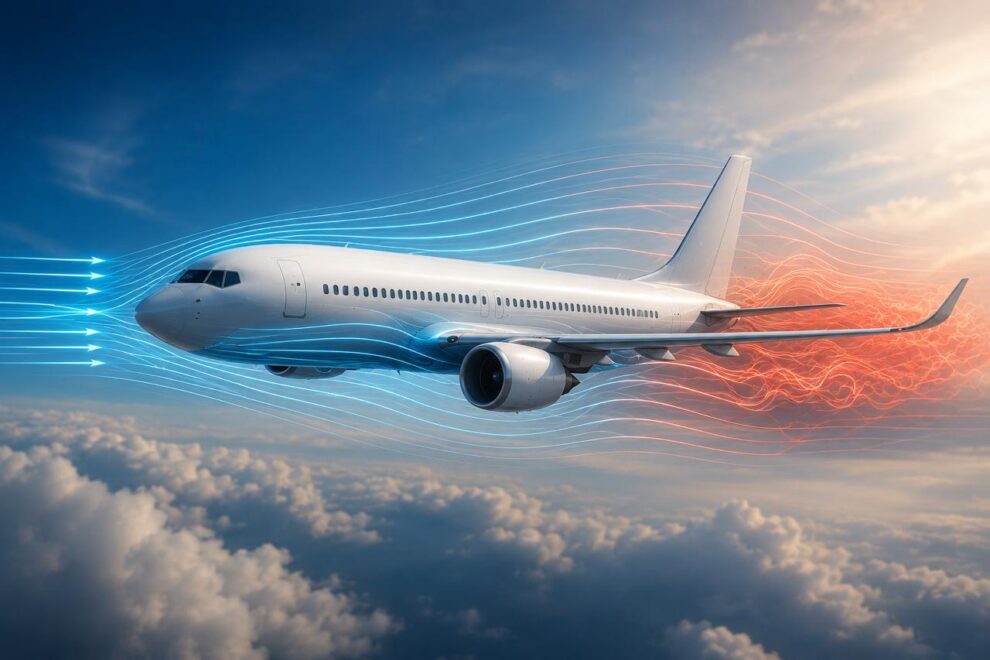
In aviation, drag is the backward aerodynamic force that directly opposes an aircraft’s forward motion through the air. As a plane flies, it pushes through millions of air molecules. These molecules rub against the plane and push back. Consequently, the aircraft’s engines must create enough forward thrust to beat this backward pull. Without enough thrust to overcome this force, the airplane will slow down and eventually lose its ability to fly.
How Does Drag Work?
First, think of drag as the friction of the sky. When you stick your hand out the window of a moving car, the wind pushes your hand backward. The airplane experiences the exact same effect. The faster the plane flies, the harder the air pushes back against it. Therefore, speed plays a massive role in creating this backward force.
Engineers use a specific math formula to measure this force. They call it the standard drag equation:
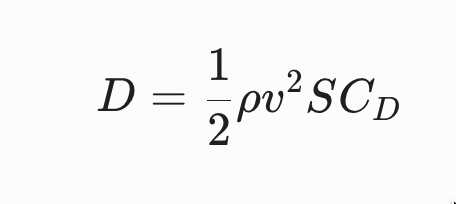
Where:
- D means the total drag force.
- ρ (rho) means the air density. Thicker air creates more resistance.
- v means the speed of the aircraft. As speed goes up, the backward push grows very fast.
- S represents the aircraft reference area, which is typically the wing planform area.
- CD means the coefficient of drag. This number depends on the specific shape of the airplane. A sleek jet has a low number, while a boxy truck has a high number.
As a result, airplane makers spend millions of dollars trying to lower the CD value. They polish the paint, hide the antennas, and design smooth, curved noses. By doing this, the air slides over the plane easily.
Major Factors Influencing Drag
| Factor | Variable | Impact on Flight |
|---|---|---|
| Speed | v | Fast speeds create huge amounts of air resistance. If you double the speed, the backward push grows four times larger. |
| Air Density | ρ | Dense air at lower altitudes creates more drag, while thinner air at higher altitudes reduces aerodynamic resistance. |
| Surface Area | S | Large planes hit more air molecules. Thus, they need giant engines to keep moving. |
| Aircraft Shape | CD | Smooth shapes slice through the air. Boxy shapes crash into the air and slow down. |
Types of Aerodynamic Drag
Aerodynamics experts split this backward force into two main groups: Parasite and Induced. Furthermore, very fast jets face a third type called Wave drag.
| Type | Characteristics | How to Fix It |
|---|---|---|
| Form (Parasite) | The physical shape of the plane hitting the air. | Designers build sleek, narrow noses and hide the landing gear inside the body. |
| Skin Friction (Parasite) | Air molecules rubbing against the metal skin. | Painters apply glossy, smooth paint and use flush rivets on the metal sheets. |
| Interference (Parasite) | Airflows crashing into each other where the wing meets the body. | Engineers add curved pieces of plastic (fairings) to blend the parts together smoothly. |
| Induced | A backward pull created as a direct result of making lift. High pressure air escapes around the wingtips. | Makers add tall, curved winglets to the ends of the wings to stop the air from swirling. |
| Wave | Wave drag begins to appear as parts of the airflow approach the speed of sound and becomes significant in transonic and supersonic flight. | Builders sweep the wings backward at a sharp angle. |
Why Is Drag Important in Aviation?
This force controls how much money an airline makes. First, the engines burn jet fuel to create forward thrust. Because thrust must beat the backward pull, a high-drag plane burns much more fuel. Therefore, reducing air resistance saves airlines millions of dollars every year.
Furthermore, this force limits the top speed of the aircraft. When a plane flies faster, the air pushes back harder. Eventually, the plane reaches a point where the engines cannot push any harder against the wind. As a result, the plane hits its absolute maximum speed.
Finally, pilots use this force to their advantage during landing. When a plane needs to land, it must slow down safely. Consequently, the pilot deploys the flaps and the landing gear. These parts stick out into the wind on purpose. The extra parts act like a parachute, creating massive air resistance to slow the plane down for a safe touchdown. Flaps increase both lift and drag, allowing the aircraft to fly safely at lower speeds during landing.
Interesting Facts
- Golf balls have dimples because the little dents actually reduce the backward pull. Some airplane makers study this to see if bumpy textures can help planes fly faster.
- A dirty airplane burns more fuel than a clean airplane. Just a thin layer of dirt on the wings adds enough skin friction to cost an airline extra money.
- Birds naturally fold their legs close to their bodies when they fly to reduce form drag.
- The famous SR-71 Blackbird spy plane used special, sharp edges on its sides to slice through shockwaves and reduce wave resistance at supersonic speeds.
Frequently Asked Questions (FAQ)
What is aerodynamic drag? It is the backward wind force that tries to slow a flying airplane down. The engines must fight this force to keep the plane moving forward.
What is the difference between parasite and induced drag? Parasite drag comes from the physical shape of the plane and the air rubbing against it. It gets worse as the plane flies faster. Induced drag is a side effect of making lift. It actually gets better (goes down) as the plane flies faster.
Why do airplanes have winglets? Winglets are the small, vertical fins at the tips of the wings. They stop the air from swirling off the ends of the wings. As a result, they cut down induced drag and save fuel.
How do pilots use air resistance to help them? Pilots intentionally create extra air resistance when they want to land. They lower the landing gear and open speed brakes to slow the plane down quickly.
What is the difference between drag and thrust? Drag is the aerodynamic force that resists motion through the air, while thrust is the forward force produced by engines or propellers. An aircraft accelerates when thrust exceeds drag and slows down when drag exceeds thrust.
Key Takeaways
- First, drag is the natural backward force that opposes engine thrust.
- Second, the drag equation shows that speed increases air resistance extremely fast.
- Parasite drag is a collective category that includes form drag, skin-friction drag, and interference drag.
- In addition, smooth shapes and clean surfaces help an airplane fly faster and save fuel.
- Finally, pilots can add extra resistance on purpose using flaps and speed brakes to land safely.
AUTHORITATIVE REFERENCES
- Federal Aviation Administration (FAA) – Pilot’s Handbook of Aeronautical Knowledge (FAA-H-8083-25B), Chapter 4: Principles of Flight.
- National Aeronautics and Space Administration (NASA) – Glenn Research Center: What is Drag?
- Anderson, J. D. (2001). Fundamentals of Aerodynamics. McGraw-Hill Education.