Nosewheel Steering Explained: How Aircraft Turn on the Ground
Nosewheel steering is the system that turns an aircraft's nose wheel so it can be steered on the ground. Airliners use a hydraulic actuator controlled by a tiller and the rudder pedals; many light aircraft link the nose wheel to the pedals.
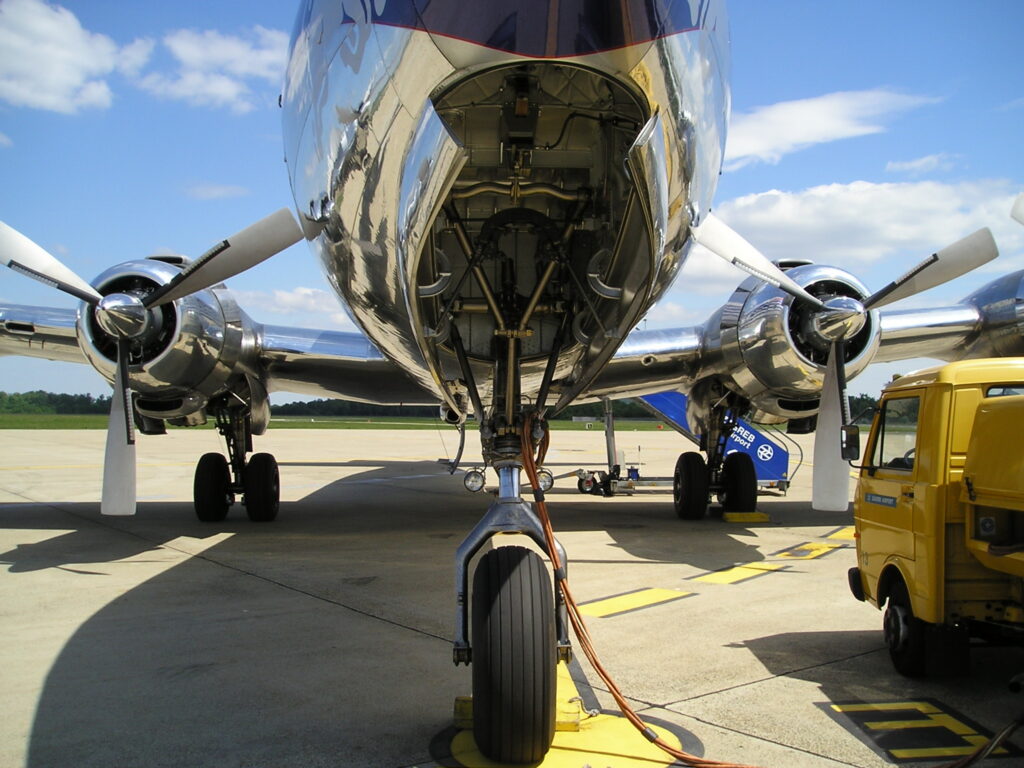
Nosewheel steering is the system that turns the nose wheel of an aircraft with tricycle landing gear, so that the pilots can steer it while taxiing, taking off and landing. On light aircraft the nose wheel is usually linked to the rudder pedals; on airliners and business jets a hydraulic actuator turns it, commanded by a hand wheel called a tiller and, for small corrections, by the rudder pedals.
How it works on light aircraft
On a typical training aircraft such as the Cessna 172, rods and springs connect the rudder pedals to the nose gear. Pushing the left pedal moves the rudder and turns the nose wheel left at the same time. For tighter turns, the pilot adds differential braking, pressing the brake on one main wheel only. Some modern designs, such as the Cirrus SR22 and the Diamond DA40, have a free-castering nose wheel with no steering link at all: the aircraft is steered on the ground only with differential brakes, while the nose wheel follows.
How it works on airliners
Large aircraft are too heavy to steer by muscle power. Their nose gear carries a steering collar turned by one or two hydraulic actuators, powered by one of the aircraft’s hydraulic systems. The pilot’s input travels by cable or electric signal to a steering control valve, and a feedback mechanism stops the wheel when it reaches the commanded angle.
- Tiller: a small wheel or handle beside each pilot, used for sharp turns at low speed. On the Boeing 737 it can turn the nose wheel up to 78 degrees either side.
- Rudder pedals: give only a few degrees of steering, enough to keep the aircraft on the runway centreline during take-off and landing at high speed. On the 737 this is about 7 degrees.
The nose gear also has a shimmy damper, or uses the steering actuators as one, to stop the wheel from oscillating rapidly at speed. When a tug pushes the aircraft back from the gate, a towing lever or bypass pin disconnects the hydraulic steering so the tug can turn the nose wheel without fighting the actuators.
Why it matters
Good ground steering keeps aircraft on narrow taxiways and runways, especially in crosswinds and on wet surfaces. Certification rules for large aeroplanes, such as 14 CFR 25.745, require that the steering system cannot cause dangerous loads on the gear and that the aircraft remains controllable if it fails. If the nosewheel steering is lost, pilots can still steer with differential braking and, at higher speeds, with the rudder. Wide-body aircraft such as the Boeing 777 and Airbus A380 also steer some of their main gear wheels to help in tight turns.
Frequently Asked Questions
Why do airliners have a tiller? Because the rudder pedals give only a few degrees of nosewheel steering, which is safer at high speed but not enough for sharp turns on taxiways and at the gate.
Can a plane taxi without nosewheel steering? Yes, with differential braking and engine thrust, although it is slow and harder to control. Some light aircraft are designed that way.
What is the steering bypass pin? A pin or switch that disconnects hydraulic steering so that a tug can push or tow the aircraft safely.
Related terms: landing gear and oleo strut.
References
- FAA Aviation Maintenance Technician Handbook – Airframe (FAA-H-8083-31), chapter 13: Aircraft Landing Gear Systems (nose wheel steering systems)
- 14 CFR 25.745, Nose-wheel steering
Start the discussion
Commenting on this term: Nosewheel Steering Explained: How Aircraft Turn on the Ground