Spoiler Explained: Flight Spoilers, Ground Spoilers and Lift Dumpers
Spoilers are hinged panels on the upper surface of the wing. Raised in flight they slow the aircraft and help roll it; raised on landing they dump lift so the weight presses the wheels onto the runway and the brakes work better.
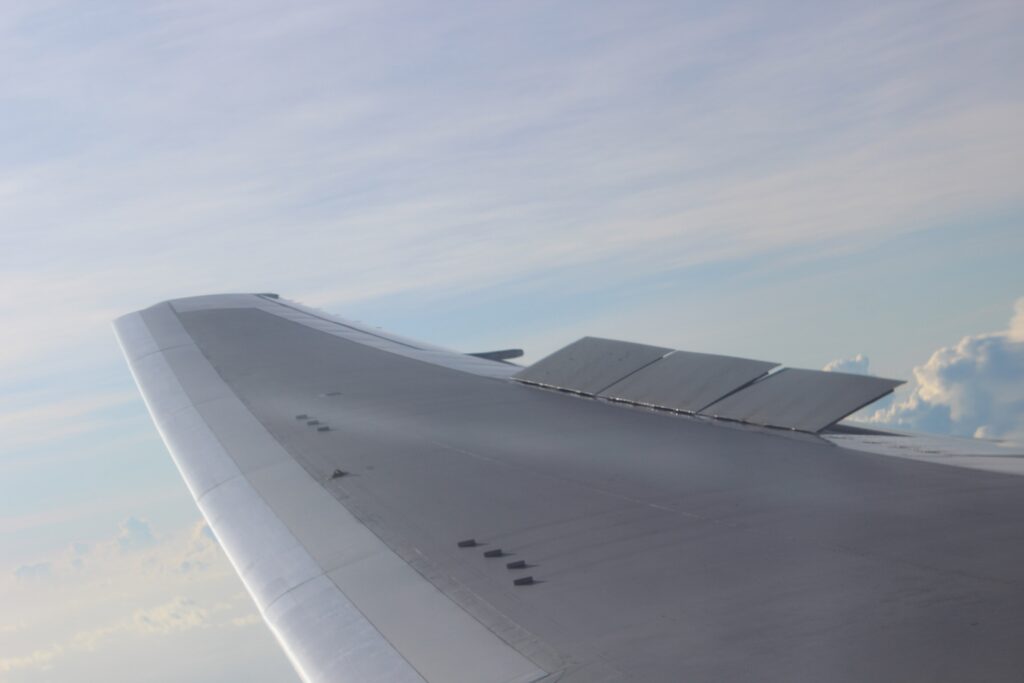
A spoiler is a hinged panel on the upper surface of a wing that can be raised into the airflow to “spoil” it. When it is raised, the smooth flow over the wing breaks up, so the wing makes less lift and more drag. Airliners use spoilers to slow down and descend in flight, to help the ailerons roll the aircraft, and to dump lift on the runway after landing.
How spoilers work
A wing makes lift because air flows smoothly over its curved upper surface. A raised spoiler panel creates a turbulent, separated wake behind it, so the part of the wing behind the panel loses much of its lift and the drag increases sharply. Spoilers sit ahead of the flaps, and most airliners have several panels on each wing, moved by hydraulic actuators.
Flight spoilers
In flight, the pilots can raise spoilers symmetrically on both wings with the speed brake lever, to slow down or to descend faster without gaining speed. Spoilers can also move asymmetrically: when the pilot rolls left, panels on the left wing rise to reduce its lift and help the ailerons. On the Boeing 737 and the Airbus A320 family, roll spoilers work together with the ailerons all the time.
Ground spoilers and lift dumpers
After touchdown, all spoiler panels rise to their maximum angle. These are called ground spoilers or lift dumpers. By destroying most of the wing’s lift, they put the aircraft’s weight onto the landing gear, which makes the wheel brakes far more effective. Before landing, pilots arm the system, and it deploys automatically when sensors detect that the main wheels are on the ground or spinning up. The same happens during a rejected take-off. Some panels work only on the ground, such as the ground spoilers of the Boeing 737.
Where you find spoilers
Nearly all jet airliners and business jets have spoilers, from the Embraer E175 to the Airbus A380. Some aircraft, such as the Mitsubishi MU-2 turboprop, use spoilers instead of ailerons for roll control, and gliders use similar devices called airbrakes or dive brakes to control their descent.
Why the term matters
Spoilers are why a large jet can come down steeply when air traffic control asks, and why it can stop safely on a wet runway. Watching the panels rise on landing, passengers see in seconds how important lift management is for a safe stop.
Frequently asked questions
What is the difference between a spoiler and a flap? A flap increases lift for take-off and landing; a spoiler reduces lift and adds drag.
What is a lift dumper? Another name for ground spoilers, the panels that rise fully after touchdown to put weight on the wheels.
Are spoilers the same as speed brakes? On airliners, the speed brake function is usually done by the spoilers, but some aircraft have separate speed brake panels on the fuselage or tail.
References
- FAA Pilot’s Handbook of Aeronautical Knowledge (FAA-H-8083-25), chapter 6: Flight Controls
- FAA Aviation Maintenance Technician Handbook – Airframe (FAA-H-8083-31), chapter 2: Aerodynamics, Aircraft Assembly and Rigging
- FAA Airplane Flying Handbook (FAA-H-8083-3), chapter on transition to jet-powered airplanes
Start the discussion
Commenting on this term: Spoiler Explained: Flight Spoilers, Ground Spoilers and Lift Dumpers