Air Busan Flight 391: The Power Bank Fire That Changed Cabin Rules
On 28 January 2025, a fire broke out in an overhead bin of Air Busan Flight 391 as it prepared to leave Busan for Hong Kong. All 176 people escaped by slide before the Airbus A321 was destroyed. Investigators point to a lithium-ion power bank.
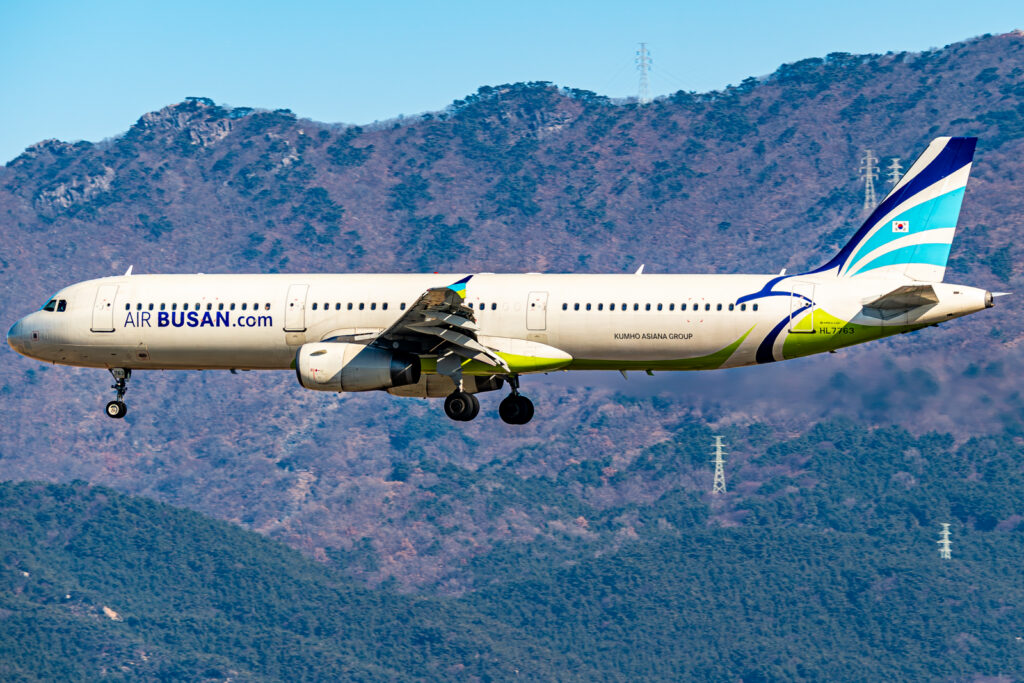
On the evening of 28 January 2025, smoke and flames appeared from an overhead luggage bin near the rear of Air Busan Flight 391 as the Airbus A321 waited to leave Busan for Hong Kong. Within minutes all 176 people on board were evacuated down the slides. The fire then burned through the roof of the cabin and destroyed the aircraft. Nobody was killed, but the accident led airlines around the world to rethink how passengers carry lithium-ion power banks.
Air Busan Flight 391 at a glance
- Date: 28 January 2025, about 22:26 local time
- Aircraft: Airbus A321-231, registration HL7763, in service since 2008, first with Asiana Airlines and from 2017 with Air Busan
- Place: Gimhae International Airport, Busan, South Korea, on the ground before departure
- On board: 169 passengers, 6 crew and 1 engineer
- Injuries: a few minor injuries, mostly from smoke and the evacuation; no fatalities
- Investigator: Aviation and Railway Accident Investigation Board (ARAIB), with France’s BEA
The fire
The flight was full of passengers travelling for the Lunar New Year holiday and had been delayed. As it prepared to taxi, cabin crew saw smoke and fire coming from an overhead bin at the rear left of the cabin. The captain shut down the aircraft’s systems and an evacuation began about a minute after the fire was detected. Passengers left through the inflatable slides, one of which a passenger opened. Airport fire crews arrived within minutes, but the fire had already spread into the cabin ceiling and burned through the fuselage roof before it was put out about an hour later. It did not reach the fuel in the wings.
What investigators found
The ARAIB’s preliminary report confirmed that the fire started in the overhead bin while the aircraft was on the ground. In March 2025, investigators said burn marks on the remains of a portable battery pack found where the fire began suggested that its insulation had broken down, causing an internal short circuit. As of November 2026, the ARAIB has not published its final report. This entry will be updated when it does.
How it changed the rules
Within weeks, South Korea banned passengers from keeping power banks and e-cigarettes in overhead bins and from charging them through seat USB ports, and limited how many power banks each passenger may carry. Many airlines in Asia and beyond, including Singapore Airlines, Thai Airways and EVA Air, introduced similar rules: power banks must stay within reach, where a fire can be seen and dealt with quickly. Read how manufacturers handle the same risk in larger batteries in our article on how electric aircraft prevent battery fires, and see the type in our Airbus A321 profile.
Sources
- BEA: Accident to the Airbus A321 registered HL7763 operated by Air Busan on 28 January 2025
- ICAO APRAST/23, Republic of Korea working paper on lithium battery and e-cigarette cabin fire risks, 2025
- The Standard: South Korea says battery pack is possible cause of Air Busan fire, March 2025
- Korea JoongAng Daily: Was a power bank behind the Air Busan fire?
Related Historical Aviation Accidents Events
More significant events from aviation history
Assassination of Juvénal Habyarimana and Cyprien Ntaryamira: The 1994 Aircraft Shootdown in Rwanda
🗓 6 April, 1994 📍 Presidential Palace gardens, near Kigali International Airport, Kigali, Rwanda, 1°58′32″S 30°10′26″E / 1.9756°S 30.1739°E / -1.9756; 30.1739 ★★★★☆ Read full story →
1996 Charkhi Dadri Collision: The Deadliest Mid-Air Crash
🗓 12 November, 1996 📍 Charkhi Dadri, Haryana, India, 28°33′38″N 76°18′15″E / 28.56056°N 76.30417°E / 28.56056; 76.30417 ★★★★☆ Read full story →
United Airlines Flight 736: The Crash That Changed Aviation
🗓 21 April, 1958 📍 Clark County, Nevada, United States ★★★★☆ Read full story →
The Tragic Mystery of China Northern Airlines Flight 6136
🗓 7 May, 2002 📍 Bohai Bay, near Dalian Zhoushuizi International Airport, Dalian, Liaoning, China, 39°00′N 121°48′E / 39°N 121.8°E / 39; 121.8 ★★★☆☆ Read full story →
Start the discussion
Commenting on this event: Air Busan Flight 391: The Power Bank Fire That Changed Cabin Rules