








Last Updated: 4 months ago
A pitot tube is a small pressure-sensing probe used to measure fluid flow velocity. In aviation, it helps determine aircraft airspeed by measuring the pressure of the air moving into the probe during flight. Although it is a small component, it plays a major role in flight instruments and aircraft safety.
Pilots often rely on airspeed information during takeoff, climb, cruise, approach, and landing. Without accurate airspeed data, the aircraft may become harder to manage safely. That is why this simple-looking probe remains one of the most important sensors on many aircraft.
Origin and Early Development
The device takes its name from Henri Pitot, a French engineer who studied fluid flow in the eighteenth century. He introduced the basic concept in 1732 while working on water flow measurement. Later, Henry Darcy improved the design in the nineteenth century and helped shape the more modern form of the instrument.
The original idea came from hydraulic engineering, not aviation. Engineers first used the principle to measure the speed of water in rivers, canals, and aqueducts. As aircraft developed, the same pressure-measuring concept became useful for measuring airflow around an aircraft.
This history explains why the same principle appears in aviation, marine systems, and industrial flow measurement.
How a Pitot Probe Measures Airspeed
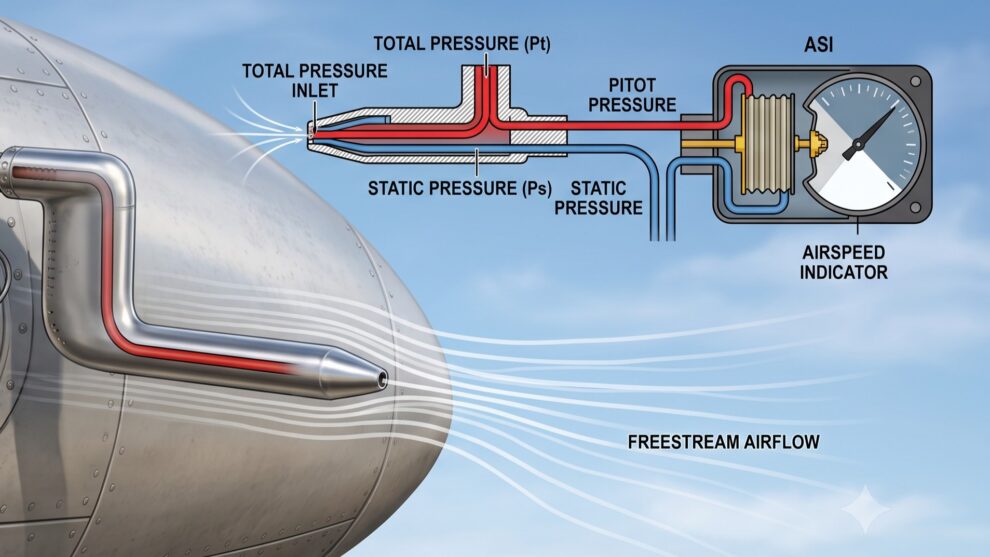
A pitot tube measures total pressure, also called stagnation pressure. When an aircraft moves through the air, airflow enters the forward-facing opening of the probe. The moving air slows down inside the tube, and this creates pressure.
Aircraft instruments compare this pressure with static pressure, which represents the pressure of the surrounding undisturbed air. The difference between total pressure and static pressure gives dynamic pressure. The airspeed indicator uses this pressure difference to show indicated airspeed.
In simple terms, faster airflow creates greater pressure difference. The instrument then converts that pressure difference into a speed reading for the pilot.
Pitot Tube and Pitot-Static System
The pitot tube usually works as part of the pitot-static system. This system supplies pressure data to key flight instruments.
| Component | Pressure Measured | Main Instrument Use |
|---|---|---|
| Pitot probe | Total pressure | Airspeed indicator |
| Static port | Static pressure | Altimeter, vertical speed indicator, airspeed indicator |
| Airspeed indicator | Pressure difference | Shows indicated airspeed |
| Altimeter | Static pressure | Shows altitude |
| Vertical speed indicator | Static pressure change | Shows climb or descent rate |
This table shows why the probe does not work alone. Accurate airspeed measurement depends on both pitot pressure and static pressure.
Why It Matters in Flight
Airspeed is one of the most important pieces of flight information. Pilots use it to maintain safe control margins and avoid flying too slowly or too fast.
During takeoff, airspeed confirms that the aircraft is accelerating correctly. During climb, it helps the pilot maintain the correct climb speed. In cruise, it supports efficient operation. During approach and landing, it helps the pilot manage energy and avoid stall risk.
Because of this, even a small pressure probe can have a large effect on flight safety.
Common Pitot Tube Problems and Protection
A pitot tube can give incorrect readings if something blocks the opening. Ice, insects, dirt, water, or protective covers can prevent air from entering the probe. If the system becomes blocked, the airspeed indicator may show unreliable information.
Many aircraft use pitot heat to reduce the risk of ice blockage. This heating system warms the probe in cold or moist conditions. Pilots may turn it on before flight or during operations where icing could occur, depending on aircraft procedures.
Preflight inspection is also important. Pilots and maintenance teams check that the probe is clean, uncovered, and undamaged before flight.
Location on Aircraft
Aircraft designers usually place the probe where it can sense clean airflow. Common locations include the nose, wing, or forward fuselage. The exact position depends on the aircraft design and air data system.
The probe should avoid disturbed airflow from the fuselage, propeller slipstream, or other structures. A poor location can reduce measurement accuracy and affect instrument readings.
On some modern aircraft, traditional probes may work together with advanced air data computers. These systems process pressure data and provide information to cockpit displays, flight control computers, and navigation systems.
Why the Term Matters
Understanding the pitot tube helps explain how aircraft measure airspeed. The component may look simple, but it supports one of the most essential flight parameters.
From small training airplanes to large commercial jets, airspeed data helps pilots and systems make safe decisions. This pressure probe connects basic fluid dynamics with real-world aviation safety. For anyone learning aviation terminology, it is a key term to understand.
For more information, visit the Wikipedia article on Pitot Tube.
Did you know AviationStream.com has a YouTube channel? Check out TheAeroGraphyOfficial and subscribe to watch fun, highly engaging aviation Shorts!