Tenerife Airport Disaster
Two Boeing 747s collided on a fog-covered runway at Los Rodeos on 27 March 1977. With 583 deaths it remains the deadliest accident in aviation history.
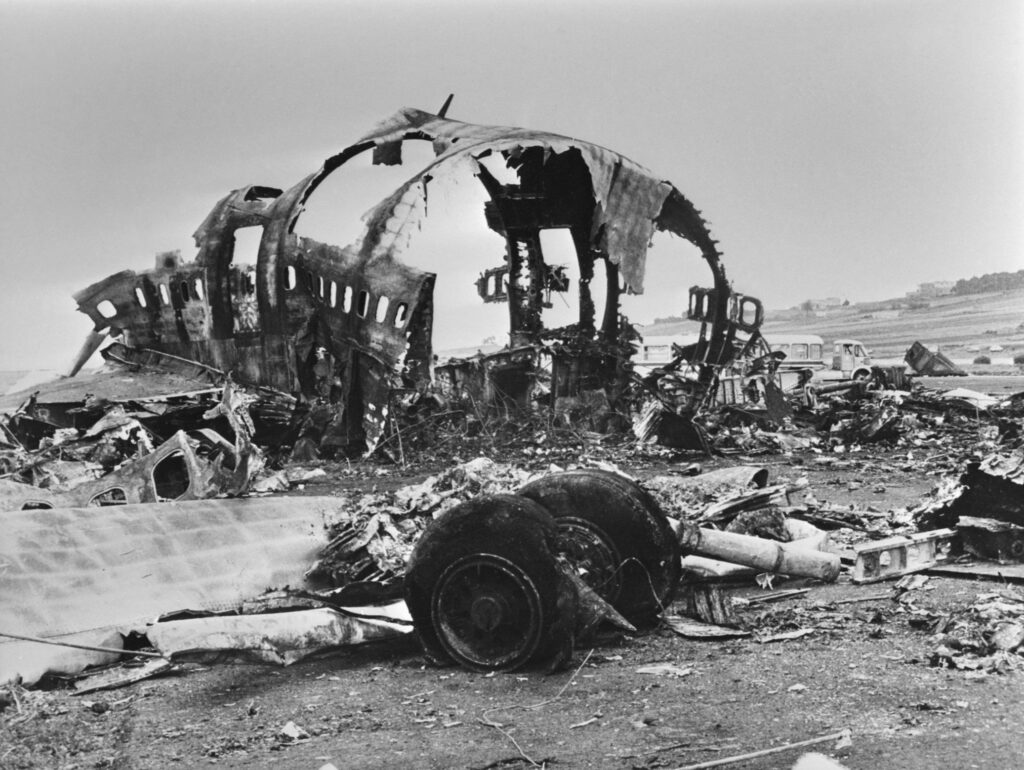
The Tenerife airport disaster happened on 27 March 1977, when a KLM Boeing 747 began its take-off run in thick fog and struck a Pan Am Boeing 747 that was still taxiing on the same runway at Los Rodeos Airport. 583 people died. No accident in the history of aviation has claimed more lives, and few have done more to change the way pilots and controllers talk to each other.
The Tenerife disaster at a glance
- Date: Sunday 27 March 1977, about 17:06 local time
- Place: Los Rodeos Airport (today Tenerife North), Canary Islands, Spain
- Aircraft: KLM Flight 4805, Boeing 747-206B; Pan Am Flight 1736, Boeing 747-121
- On board: 248 on the KLM aircraft, 396 on the Pan Am aircraft
- Fatalities: 583; all 61 survivors were on the Pan Am jet
- Investigation: Spanish civil aviation authorities, with Dutch and US participation
A small airport full of diverted jumbo jets
Neither aircraft was meant to be in Tenerife. A bomb planted by a separatist group had exploded in the terminal at Gran Canaria Airport, and the airport was closed. Flights heading there, including the KLM charter from Amsterdam and the Pan Am flight from Los Angeles and New York, were sent to Los Rodeos, a regional airport with one runway and one parallel taxiway.
By the afternoon the apron was so crowded that parked aircraft blocked the taxiway. When Gran Canaria reopened, departing jets had to taxi along the runway itself and turn around at the end, a procedure known as backtracking. At the same time, low cloud was rolling across the airfield. Visibility on the runway dropped to a few hundred metres, and the control tower had no ground radar to see where the aircraft were.
How the collision happened
The KLM 747 backtracked first and turned at the end of the runway to face the take-off direction. The Pan Am 747 followed it down the runway and was told to leave at the third exit. In the fog, the crew had trouble identifying the exits and continued past it.
KLM’s crew then received their route clearance, which describes the path to fly after departure but is not permission to take off. As the first officer read it back, the aircraft began to roll. He added a phrase that was later heard in two ways: “We are now at take-off.” The tower replied “OK” and then “stand by for take-off, I will call you”, while the Pan Am crew transmitted that they were still taxiing down the runway. The two transmissions overlapped, and the KLM cockpit heard mostly a squeal.
The KLM flight engineer asked whether the Pan Am aircraft was clear of the runway. The captain answered emphatically that it was. Seconds later the Pan Am crew saw landing lights coming at them through the fog and turned hard towards the grass. The KLM captain tried to lift off early, but the lower fuselage and engines struck the top of the Pan Am aircraft. Both aircraft were destroyed by the impact and fire.
Why it happened
The Spanish investigation concluded that the main cause was the KLM captain taking off without a take-off clearance. It also pointed to the use of non-standard phrases, the blocked radio calls, the fog, and the pressure the crew felt to leave before Dutch duty-time limits forced them to stay overnight. The Dutch report placed more weight on the misunderstanding between crew and tower, but KLM accepted responsibility and compensated the victims’ families.
The cockpit voice recorder showed something else that troubled investigators: the flight engineer had doubts, voiced them, and was overruled by a very senior captain.
What changed after Tenerife
- Standard phrases. The word “take-off” is now reserved for the actual take-off clearance or its cancellation. Everywhere else controllers and pilots say “departure”, and readbacks must be complete and exact.
- Crew resource management. Tenerife became one of the founding case studies of crew resource management, the training that teaches every crew member to speak up and every captain to listen.
- Airport capacity. Tenerife South Airport opened in 1978, and Los Rodeos later received ground radar.
The accident is a reminder that most of the rules found in today’s runway and taxiway procedures were written after someone paid a terrible price.
Remembering the victims
Memorials stand in Tenerife and in the Netherlands, and families from both countries have gathered on the island on major anniversaries. A 2007 monument on the Mesa Mota hill, a spiral staircase reaching towards the sky, was dedicated to all 583 victims.
Sources
Final report of the Spanish civil aviation authorities on the collision of KLM 4805 and Pan Am 1736 (1978); comments of the Dutch investigators on the Spanish report; cockpit voice recorder transcripts published with the reports.
Related Historical Aviation Accidents Events
More significant events from aviation history
Assassination of Juvénal Habyarimana and Cyprien Ntaryamira: The 1994 Aircraft Shootdown in Rwanda
🗓 6 April, 1994 📍 Presidential Palace gardens, near Kigali International Airport, Kigali, Rwanda, 1°58′32″S 30°10′26″E / 1.9756°S 30.1739°E / -1.9756; 30.1739 ★★★★☆ Read full story →
1996 Charkhi Dadri Collision: The Deadliest Mid-Air Crash
🗓 12 November, 1996 📍 Charkhi Dadri, Haryana, India, 28°33′38″N 76°18′15″E / 28.56056°N 76.30417°E / 28.56056; 76.30417 ★★★★☆ Read full story →
United Airlines Flight 736: The Crash That Changed Aviation
🗓 21 April, 1958 📍 Clark County, Nevada, United States ★★★★☆ Read full story →
The Tragedy of Lauda Air Flight 004
🗓 26 May, 1991 📍 Phu Toei National Park, Suphan Buri province, Thailand, 14°56′48″N 99°27′10″E / 14.94667°N 99.45278°E / 14.94667; 99.45278 ★★★☆☆ Read full story →