Elevator Explained: How Aircraft Control Pitch
The elevator is the hinged surface on the back of the horizontal tail. Moving it changes the tail's downforce, so the nose pitches up or down and the wing's angle of attack changes.
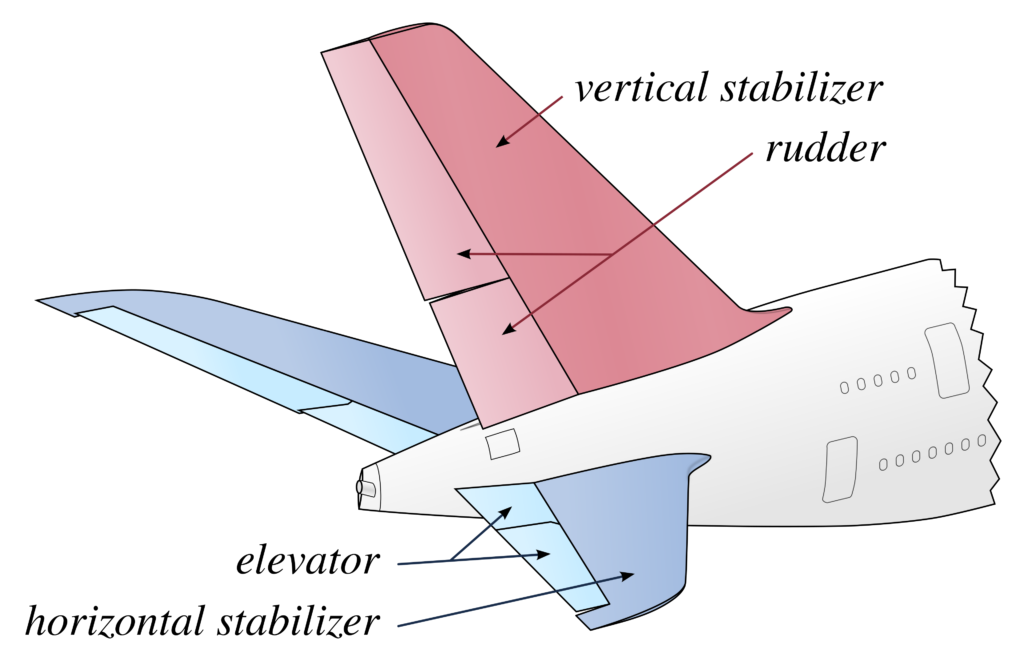
The elevator is the hinged flight control surface on the trailing edge of the horizontal stabilizer, the small wing at the tail. It controls pitch: moving it raises or lowers the nose of the aircraft around the lateral axis, the imaginary line from wingtip to wingtip. In a cockpit with a control wheel or stick, the pilot moves the elevator by pulling or pushing.
How the elevator works
When the pilot pulls back, the elevator moves up. This changes the camber of the tail so that it pushes down harder, the tail goes down and the nose comes up. Pushing forward does the opposite. Because the nose moves, the wing meets the air at a different angle of attack, so the elevator really controls the wing’s angle of attack and, through it, lift and speed. That is why instructors say the elevator controls airspeed as much as it controls climb or descent.
The elevator works together with the fixed horizontal stabilizer, which keeps the aircraft stable in pitch. On most aircraft the tail produces a small downward force in normal flight, balancing the nose-down tendency caused by the centre of gravity being ahead of the wing’s centre of lift.
Trim and the moving stabilizer
Holding the elevator in one position for a long time would be tiring, so aircraft have trim. Light aircraft such as the Cessna 172 use a small trim tab on the elevator, set with a wheel in the cockpit. Airliners like the Airbus A320 and Boeing 737 instead move the whole horizontal stabilizer slowly to trim, and use the elevator only for quick pitch changes. This design is called a trimmable horizontal stabilizer.
Where you find elevators
Elevators are found on almost all conventional aircraft. On a T-tail, as on the Bombardier CRJ series or the Embraer ERJ 145, the elevator sits on top of the fin. Some aircraft replace the elevator with an all-moving tail called a stabilator, and tailless delta-wing aircraft such as Concorde use elevons, which combine elevator and aileron.
Why the term matters
Pitch control is the most frequently used control in flying, from rotation on take-off to the flare before landing. Understanding the elevator explains how pilots change speed and altitude and why an aircraft’s balance, its centre of gravity, matters so much.
Frequently asked questions
What does the elevator do on an aircraft? It controls pitch, raising or lowering the nose.
Why is it called an elevator? Because moving it makes the aircraft climb or descend, but it actually changes the angle of attack and speed as well.
Is the elevator the same as the horizontal stabilizer? No. The stabilizer is the fixed part of the tail; the elevator is the hinged part behind it.
References
- FAA Pilot’s Handbook of Aeronautical Knowledge (FAA-H-8083-25), chapter 6: Flight Controls
- NASA Glenn Research Center, Beginner’s Guide to Aeronautics: Elevator
- FAA Aviation Maintenance Technician Handbook – Airframe (FAA-H-8083-31), chapter 2: Aerodynamics, Aircraft Assembly and Rigging
Start the discussion
Commenting on this term: Elevator Explained: How Aircraft Control Pitch