Aileron Explained: Meaning, Function and How It Rolls an Aircraft
Ailerons are the hinged surfaces near the wingtips that roll an aircraft. When one goes up, the other goes down, changing the lift on each wing so that the aircraft banks into a turn.
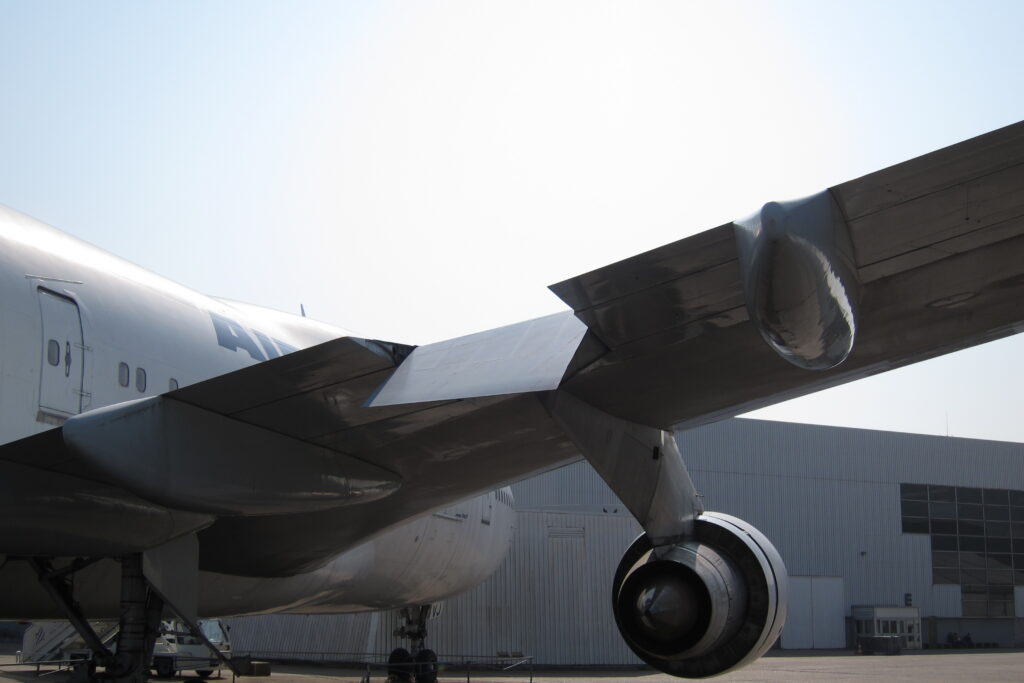
An aileron is a hinged flight control surface on the trailing edge of each wing, usually near the wingtip. The two ailerons move in opposite directions: one rises while the other goes down. This gives one wing more lift and the other less, so the aircraft rolls around its longitudinal axis and banks into a turn.
How an aileron works
When the pilot turns the control wheel or moves the stick to the left, the left aileron moves up and the right aileron moves down. The down-going aileron increases the camber of the right wing and therefore its lift; the up-going aileron reduces the lift of the left wing. The difference rolls the aircraft to the left. Once the desired bank angle is reached, the pilot returns the controls towards neutral and the bank stays roughly constant.
The ailerons do not turn the aircraft by themselves. Banking tilts the wing’s lift sideways, and that sideways component is what curves the flight path. The rudder is used at the same time to keep the turn coordinated.
Adverse yaw
The wing with the down-going aileron makes more lift, but also more induced drag. That extra drag pulls the nose briefly away from the turn, an effect called adverse yaw. Designers reduce it in two main ways. Differential ailerons move further up than down, and Frise ailerons have a nose that protrudes below the wing when raised, adding drag on the down-going wing. Pilots correct what remains with rudder.
Where you find ailerons
Almost every fixed-wing aircraft has them, from a Cessna 172 to a Boeing 747. Large jets often have two pairs. The Boeing 747, for example, has outboard ailerons that work only at low speed, when the flaps are out, and inboard ailerons that work at all speeds. At high speed an outboard aileron could twist the flexible wing so much that the roll goes the wrong way, a problem known as aileron reversal. Many airliners also raise some spoiler panels on the up-going wing to help the ailerons, and some combine flap and aileron in one surface called a flaperon.
Why the term matters
Roll control is one of the three basic controls of an aircraft, together with pitch from the elevator and yaw from the rudder. Understanding the aileron explains how every turn begins and why pilots learn to use hands and feet together. Read how ailerons sit next to the flaps on the trailing edge of the wing.
Frequently asked questions
What does an aileron do? It controls roll. Moving the ailerons banks the aircraft to the left or right.
Do both ailerons move the same way? No. One goes up and the other goes down at the same time.
What is the difference between an aileron and a flap? Ailerons move in opposite directions to control roll; flaps on both wings move down together to increase lift and drag for take-off and landing.
References
- FAA Pilot’s Handbook of Aeronautical Knowledge (FAA-H-8083-25), chapter 6: Flight Controls
- NASA Glenn Research Center, Beginner’s Guide to Aeronautics: Ailerons
- FAA Aviation Maintenance Technician Handbook – Airframe (FAA-H-8083-31), chapter 2: Aerodynamics, Aircraft Assembly and Rigging
Start the discussion
Commenting on this term: Aileron Explained: Meaning, Function and How It Rolls an Aircraft