Air Data Computer and ADIRU: Where an Airliner’s Flight Data Comes From
An air data computer turns the raw pressures and temperature measured outside the aircraft into airspeed, altitude, Mach number and vertical speed. An ADIRU combines air data with an inertial reference unit that measures attitude, heading and position.
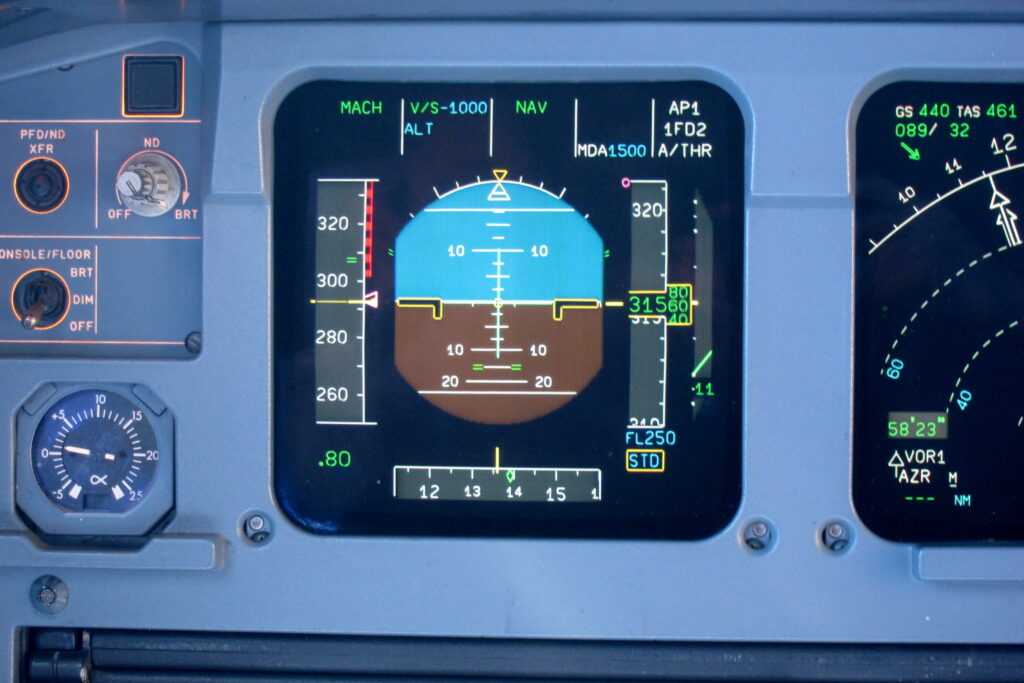
An air data computer (ADC) takes the raw measurements from an aircraft’s pitot tubes, static ports and temperature probes and calculates the values the crew and the aircraft’s systems need: airspeed, altitude, vertical speed, Mach number and air temperature. On many airliners, the air data function is combined with an inertial reference system in a single unit, the air data inertial reference unit (ADIRU).
What the air data computer does
The pitot-static system provides pressures, but turning them into accurate numbers takes calculation and correction. The ADC:
- computes pressure altitude from static pressure, and corrects it for the error caused by the position of the static ports;
- computes indicated and calibrated airspeed from the difference between total and static pressure, and true airspeed and Mach using air temperature;
- calculates vertical speed, static air temperature and, on some aircraft, angle of attack from vane sensors.
It sends these values digitally to the flight displays, the autopilot, the flight management system, the transponder (which reports altitude to air traffic control) and, on fly-by-wire aircraft, the flight control computers.
The inertial reference part
An inertial reference unit uses gyroscopes, usually ring laser or fibre-optic gyros, and accelerometers to measure the aircraft’s movement without any outside signal. From these it calculates attitude (pitch and roll), heading, ground speed and position. Before flight the unit must be aligned while the aircraft stands still, which takes several minutes as it senses the Earth’s rotation to find true north.
How ADIRUs are arranged
The Airbus A320 family, for example, has three ADIRUs. Two normally supply the captain’s and the first officer’s displays, and the third is a standby that can replace either. Computers compare the outputs of all three and reject one that disagrees. Separate standby instruments, with their own sensors, give the crew a last independent source.
Why it matters
Nearly everything an airliner does depends on good air data. Two well-known accidents show what happens when it goes wrong. On Air France Flight 447 in 2009, ice crystals blocked the pitot probes of an Airbus A330, the airspeed data became unreliable, the autopilot disconnected and the crew lost control. On Qantas Flight 72 in 2008, one ADIRU began sending occasional wrong angle-of-attack values, and the flight control computers commanded two sudden pitch-downs. Both led to changes in probes, software and training for unreliable airspeed.
Frequently Asked Questions
What does ADIRU stand for? Air data inertial reference unit: an air data computer and an inertial reference unit in one box.
Why does an IRU need alignment? It must know its starting position and find true north before it can track movement.
What happens if one ADIRU fails? The crew switches its display source to another unit; the aircraft carries spares in the system.
References
- FAA Aviation Maintenance Technician Handbook – Airframe (FAA-H-8083-31), chapter 10: Aircraft Instrument Systems
- ATSB Transport Safety Report AO-2008-070: In-flight upset, Airbus A330-303 VH-QPA, 7 October 2008
Start the discussion
Commenting on this term: Air Data Computer and ADIRU: Where an Airliner’s Flight Data Comes From