V-Speeds Explained: V1, VR, V2, Vref and the Airspeed Arcs
V-speeds are standard airspeeds, each named with a V and a suffix, that mark an aircraft's limits and the key moments of take-off and landing, such as V1, VR, V2 and Vref.
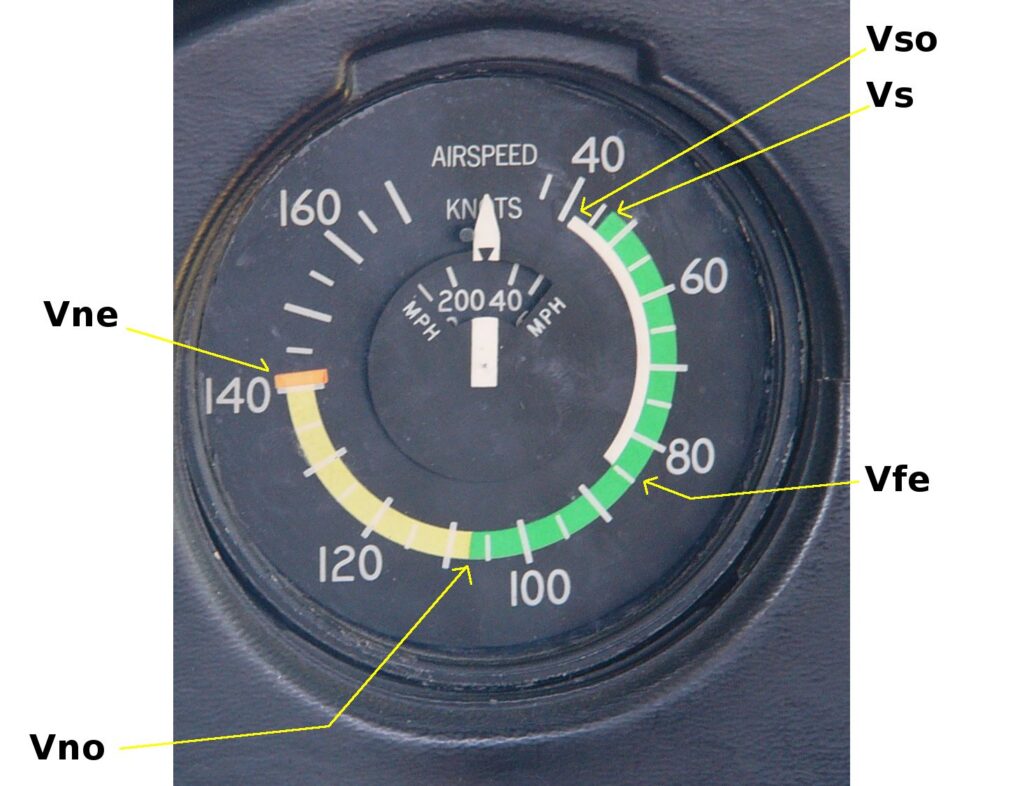
V-speeds are standard airspeeds, each written as a V (for velocity) with a short suffix, that define an aircraft’s operating limits and the key moments of a flight. Some are fixed at certification, such as the never-exceed speed; others, such as V1 and Vref, are calculated for every take-off and landing from the aircraft’s weight, the runway and the weather.
Take-off speeds
On a multi-engine aircraft, three speeds divide the take-off run:
- V1, the take-off decision speed. Below V1, the crew can reject the take-off and stop on the remaining runway. At V1 the decision has been made: if an engine fails after this point, the aircraft continues the take-off. The US definition in 14 CFR Part 1 ties V1 both to stopping within the accelerate-stop distance and to continuing safely on one engine.
- VR, rotation speed. The pilot raises the nose to lift off.
- V2, take-off safety speed. The speed the aircraft must reach by 35 ft above the runway with one engine failed. It gives a margin above the stall speed and above the minimum speed at which the aircraft can still be controlled with one engine out (VMC).
In an airliner, the pilot monitoring calls “V1” and “rotate” aloud, and the speeds are shown as bugs on the speed tape of the primary flight display.
Landing and limit speeds
Vref, the reference landing speed, is the speed flown across the runway threshold with landing flaps set. For large aeroplanes it is at least 1.23 times the reference stall speed in the landing configuration, and crews add a few knots for gusts. Other common limit speeds include:
- VNE: never-exceed speed, a structural limit marked by a red line.
- VNO: maximum structural cruising speed; above it the aircraft should only fly in smooth air.
- VA: design manoeuvring speed. Below it, a single full and abrupt movement of one flight control should not overstress the aircraft. The FAA stresses that VA gives no protection against repeated or alternating (back-and-forth) inputs, or full inputs on more than one axis at the same time. VA also falls as weight decreases, so the published figure applies only at the weight and configuration stated in the aircraft’s flight manual (AFM or POH).
- VFE: maximum speed with flaps extended.
- VLO and VLE: maximum speeds for operating the landing gear and for flying with it extended.
- VS, VS0 and VS1: VS is the stalling speed, or the minimum steady flight speed at which the aircraft is controllable. VS0 is that speed in the landing configuration, and VS1 in a specified configuration, for example with flaps up.
The airspeed indicator arcs
On a light aircraft’s airspeed indicator, the colour arcs show several V-speeds at a glance. The white arc runs from VSO to VFE, the flap operating range. The green arc runs from VS1 to VNO, the normal operating range. The yellow arc, from VNO to VNE, is the caution range for smooth air only, and the red line marks VNE.
Why it matters
V-speeds turn complex performance data into simple numbers a crew can act on in seconds. A rejected take-off started after V1, or a landing flown well above Vref, can easily run off the end of the runway. That is why the speeds are briefed before every take-off and approach and checked by both pilots.
Frequently Asked Questions
What does V1 mean? It is the take-off decision speed: the last moment to start a rejected take-off.
What is the difference between VR and V2? VR is when the pilot rotates; V2 is the safety speed to be reached by 35 ft with an engine failed.
What does the red line on an airspeed indicator mean? VNE, the never-exceed speed.
References
- 14 CFR 1.2, Abbreviations and symbols (V-speed definitions)
- FAA Advisory Circular 23-19A, Airframe Guide for Certification of Part 23 Airplanes (meaning and limits of the design manoeuvring speed)
- FAA Pilot’s Handbook of Aeronautical Knowledge (FAA-H-8083-25), chapter 8 (Flight Instruments)
- FAA Airplane Flying Handbook (FAA-H-8083-3), chapters on take-off and on transition to multi-engine aircraft


Start the discussion
Commenting on this term: V-Speeds Explained: V1, VR, V2, Vref and the Airspeed Arcs