Longeron and Frame: The Skeleton of an Aircraft Fuselage
A longeron is a strong member running the length of the fuselage, while frames are the rings that give the fuselage its cross-section. With stringers and skin they form the fuselage's load-carrying skeleton.
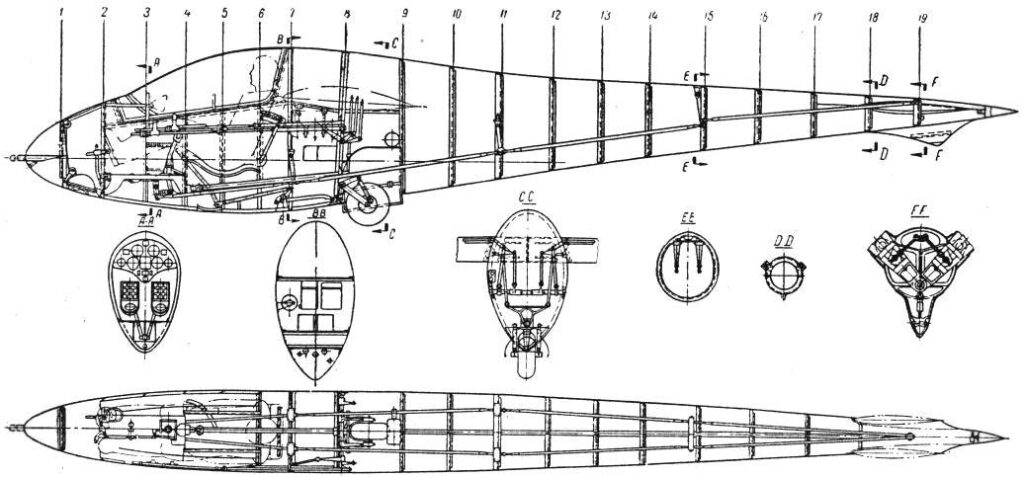
A longeron is a main structural member running along the length of an aircraft’s fuselage. Frames, also called formers, are the rings or partial rings that run around the fuselage and give it its cross-sectional shape. Longerons, frames, stringers and skin together form the fuselage structure, in the same way that spars and ribs form the wing.
Longerons and stringers
Both longerons and stringers run fore and aft, so the two words are often confused. The difference is size and job. Longerons are fewer and heavier, and they carry a large part of the fuselage’s bending load, the way the caps of a beam do. Stringers are lighter and more numerous, and their main job is to stiffen the skin against buckling. In practice many modern fuselages have no distinct longerons at all: dozens of evenly spaced stringers share the bending load with the skin.
In older truss-built aircraft, such as steel-tube light aircraft, the four corner tubes of the fuselage frame are also called longerons. They carry the loads directly, braced by diagonal members.
Frames
Frames keep the fuselage round, or whatever shape the designer chose, and they stop the skin and stringers from collapsing inwards under compression. They also collect concentrated loads and spread them into the skin. Heavier frames are placed where large loads enter the structure: at the wing attachment, the landing gear, the tail and the engine mounts. A frame that closes off a section completely is a bulkhead, and the rear pressure bulkhead of an airliner is one of its most important structural parts.
Cut-outs
Doors, windows and cargo hatches interrupt frames and stringers, so the structure around every cut-out must be reinforced. Heavier frames on each side of a door, short members called intercostals between frames, and thicker skin carry the loads around the hole. This is why windows on an airliner are spaced to fit between frames, and why passenger doors are among the most complex parts of a fuselage.
Where you find them
On an airliner such as the Boeing 737, frames are closely spaced along the whole cabin, and the floor beams that carry the cabin floor are attached to them. Composite fuselages such as those of the Boeing 787 and Airbus A350 still use frames, now made of carbon fibre or aluminium, inside a skin with co-cured stringers.
Why it matters
Frames and longerons are primary structure. Cracks often begin where they meet other parts, at fastener holes or around cut-outs, so they are a focus of structural inspections. Technicians must also know which members are load-carrying before they add a new antenna, window or cable run.
Frequently Asked Questions
What is a longeron on an aircraft? A main longitudinal member of the fuselage that carries bending loads.
What is the difference between a longeron and a stringer? Longerons are fewer and heavier; stringers are lighter and mainly stiffen the skin.
What does a fuselage frame do? It gives the fuselage its shape and spreads loads into the skin.
References
- FAA Aviation Maintenance Technician Handbook – Airframe (FAA-H-8083-31), chapter 1: Aircraft Structures
- FAA Advisory Circular 43.13-1B, Acceptable Methods, Techniques and Practices – Aircraft Inspection and Repair

Start the discussion
Commenting on this term: Longeron and Frame: The Skeleton of an Aircraft Fuselage