Mass Balance and Aerodynamic Balance of Control Surfaces
Control surfaces are balanced in two ways. A mass balance puts weight ahead of the hinge line to prevent flutter, and aerodynamic balance uses part of the surface ahead of the hinge to make it lighter to move.
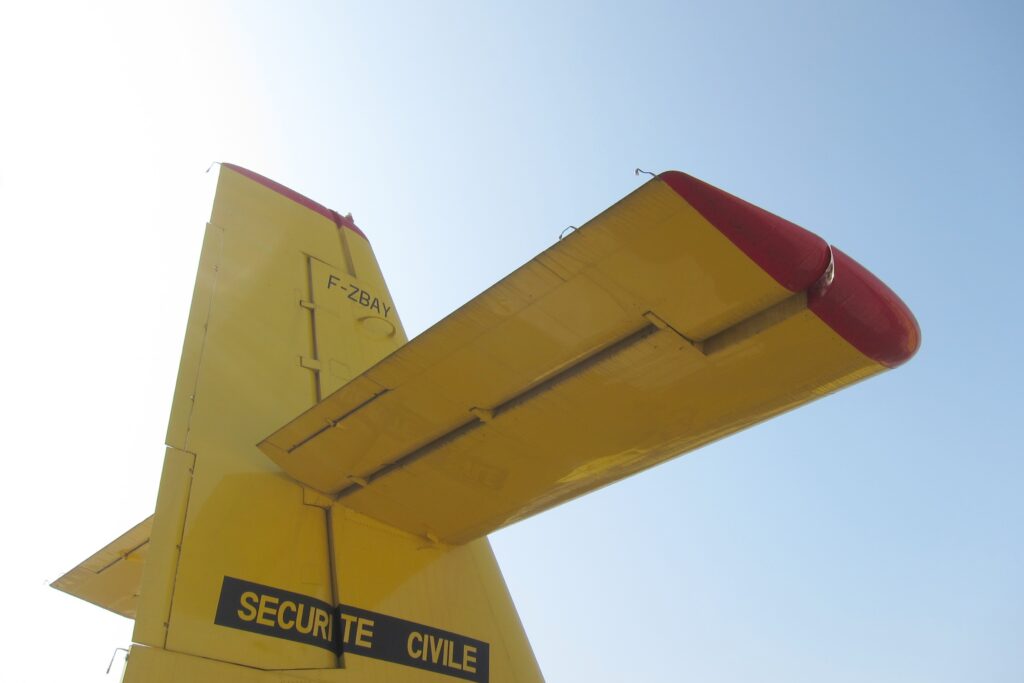
Mass balance is weight added to a control surface ahead of its hinge line so that the surface’s centre of gravity lies on or in front of the hinge. Its purpose is to prevent flutter, a dangerous vibration of the control surface and the wing or tail it is attached to. Aerodynamic balance is a different idea: part of the surface is placed ahead of the hinge so that air pressure helps the pilot move it.
How mass balance prevents flutter
If a control surface’s centre of gravity lies behind its hinge, the surface lags behind when the wing or tail bends or twists in turbulence. That lag can feed energy into the motion, so each oscillation grows larger. At a certain speed, the vibration can destroy the structure in seconds. By moving the centre of gravity forward with lead or steel weights, designers make the surface follow the structure instead of fighting it. Mass balance weights are often hidden inside the leading edge of the surface or carried on small arms that stick forward of the hinge.
Because the balance depends on the exact weight distribution, the surface must be rebalanced after painting or repair. Maintenance manuals give the allowed limits, and the FAA’s maintenance handbook explains how technicians check them.
How aerodynamic balance works
As aircraft became faster, control surfaces became too heavy to move by hand. Aerodynamic balance reduces the force needed. A horn balance is a part of the surface that extends forward of the hinge at the tip, where it meets the airflow. An inset hinge moves the hinge line back from the leading edge, so the air pushing on the part ahead of the hinge helps turn the surface. Balance tabs and servo tabs, which are a form of trim tab, do a similar job.
Where you find them
Horn balances are visible at the tips of the elevators and rudders of many propeller aircraft. Mass balance arms can be seen on the ailerons of gliders and older aircraft. Large jets use hydraulic actuators to move their surfaces, but their surfaces are still mass balanced or held by actuators that are designed to prevent flutter.
Why it matters
Flutter has caused fatal accidents, and certification rules require proof that an aircraft is free of flutter throughout its speed range. Correct balance is also why control surfaces must never be repainted or repaired without checking their balance afterwards.
Inspection and maintenance
Technicians check balance with the surface removed from the aircraft and supported at its hinge line. The amount it tips forward or backward is compared with the limits in the maintenance manual, and weights are added or removed as needed. Read more about the surfaces involved in our guides to the aileron and the elevator.
Frequently Asked Questions
What is control surface flutter? A self-feeding vibration of a control surface and its supporting structure that can destroy it.
Why are control surfaces rebalanced after painting? Paint adds weight behind the hinge and can upset the balance.
What is a horn balance? A part of the surface ahead of the hinge line that reduces control forces.
References
- FAA Aviation Maintenance Technician Handbook – Airframe (FAA-H-8083-31), chapter 2: Aerodynamics, Aircraft Assembly and Rigging
- FAA Pilot’s Handbook of Aeronautical Knowledge (FAA-H-8083-25), chapters 5 (Aerodynamics of Flight) and 6 (Flight Controls)
Start the discussion
Commenting on this term: Mass Balance and Aerodynamic Balance of Control Surfaces