Mach Tuck Explained: Why the Nose Drops Near Mach 1
Mach tuck is a nose-down tendency at high subsonic speed. Shock waves move the wing's centre of lift aft, so the nose drops and the aircraft speeds up further unless the crew or a Mach trim system corrects it.
Mach tuck is a nose-down pitching tendency that can occur when an aircraft flies faster than its critical Mach number. As shock waves form and move aft on the wing, the centre of lift moves back and the aircraft wants to pitch down. Because a nose-down attitude makes the aircraft accelerate, the effect can build on itself if it is not corrected.
Why Mach tuck happens
At normal speeds, the centre of pressure of a wing stays fairly still. When the aircraft passes its critical Mach number, a shock wave forms on the upper surface, and as speed increases it moves towards the trailing edge. The region of high lift moves with it, so the centre of pressure shifts aft. At the same time, the airflow behind the shock may separate and reduce the downwash on the tail, which also changes the balance in pitch. The net result on many aircraft is a nose-down moment.
History
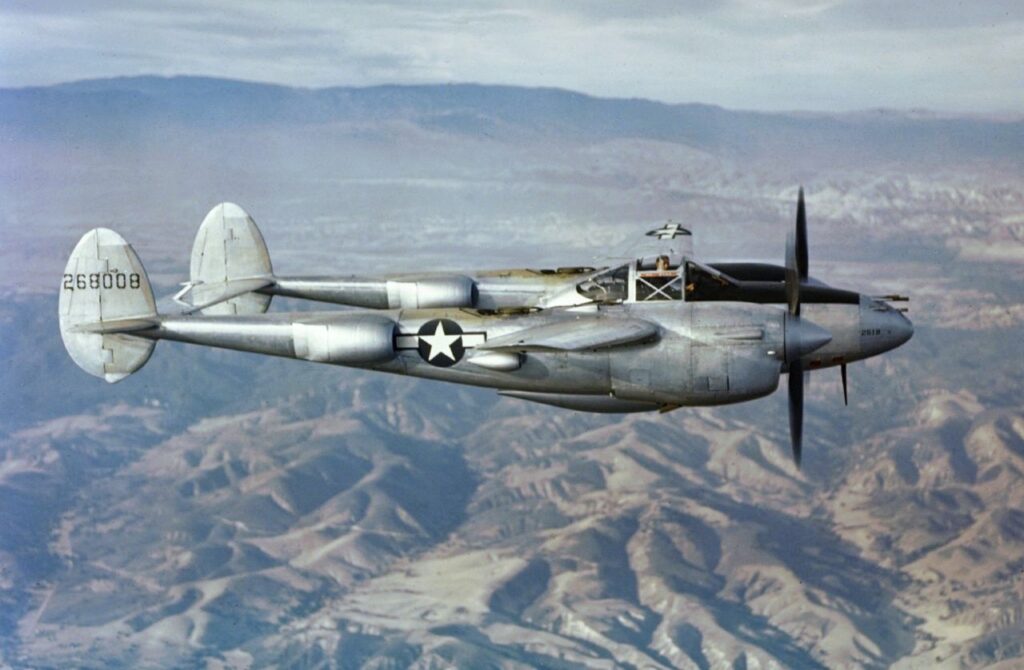
In the early 1940s, pilots of fast fighters such as the Lockheed P-38 Lightning found that in steep, high-speed dives the nose would tuck under and the controls would become too heavy to pull out. Some aircraft were lost before engineers understood the effects of compressibility. Lockheed later fitted the P-38 with dive flaps to reduce speed and restore control.
How jets are protected
Jet airliners and business jets are designed and certified with a maximum operating Mach number (MMO) and are fitted with overspeed warnings. Many also have a Mach trim system that automatically adjusts the horizontal stabilizer or elevator as speed increases, to counter the nose-down tendency. The FAA’s training material for pilots moving to jets explains Mach tuck and why the Mach trim must be working at high speed.
Why it matters
Mach tuck is one of the reasons jets have strict speed limits at high altitude, where the margin between the maximum speed and the stall speed can be small. Understanding it helps pilots recognise why an upset at high altitude must be handled smoothly and why speed must not be allowed to run away in a descent.
Mach tuck and swept wings
On swept wings, a stall or flow separation near the wingtips also moves the centre of lift forward or aft and can change the pitching tendency. Designers test these effects carefully during flight testing, and the results set the speed limits in the flight manual.
Frequently Asked Questions
What is Mach tuck? A nose-down pitching tendency at high subsonic speeds caused by shock waves moving the centre of lift aft.
What is a Mach trim system? An automatic system that adjusts pitch trim as Mach number increases to counter Mach tuck.
Which aircraft first met Mach tuck? Fast Second World War fighters such as the Lockheed P-38 Lightning in high-speed dives.
References
- FAA Airplane Flying Handbook (FAA-H-8083-3), chapter on transition to jet-powered airplanes
- FAA Pilot’s Handbook of Aeronautical Knowledge (FAA-H-8083-25), chapters 5 (Aerodynamics of Flight) and 6 (Flight Controls)

Start the discussion
Commenting on this term: Mach Tuck Explained: Why the Nose Drops Near Mach 1