Area Rule: Why Supersonic Jets Have a Wasp Waist
The area rule, discovered by NACA engineer Richard Whitcomb in 1952, shows that wave drag near Mach 1 depends on how the total cross-sectional area changes along the aircraft. It led to the "wasp-waisted" fuselage.
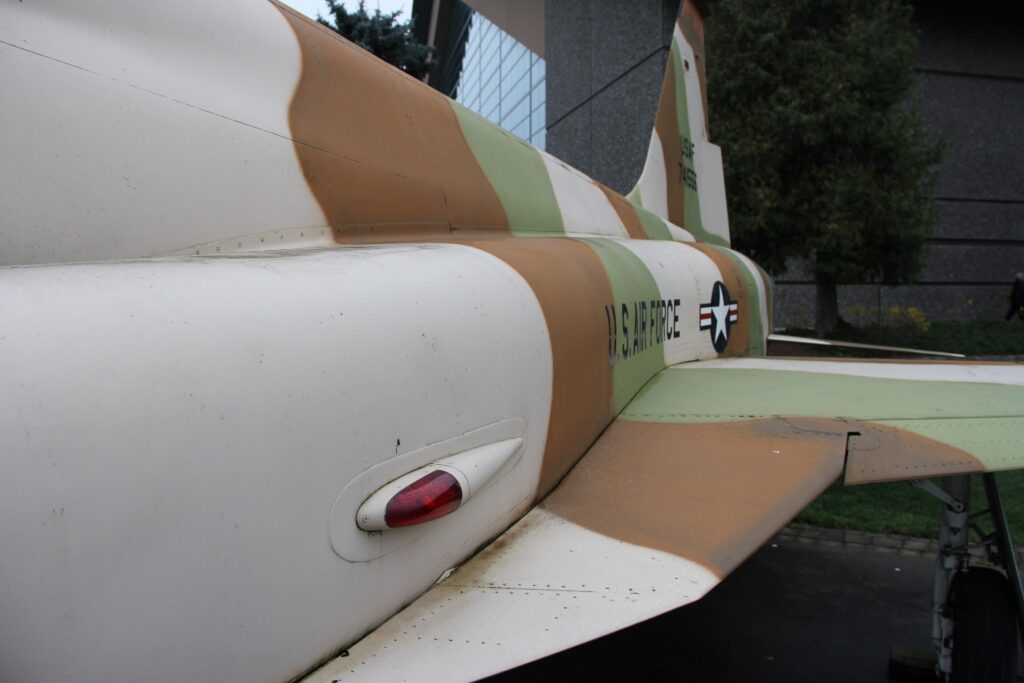
The area rule is a design principle for aircraft that fly close to or faster than the speed of sound. It says that wave drag is lowest when the total cross-sectional area of the aircraft, including the fuselage, wings and tail, changes smoothly along its length, like that of a smooth, streamlined body. Where the wings add area, the fuselage is narrowed to compensate.
How the area rule works
Near Mach 1, the air cannot tell the difference between the fuselage and the wings; it reacts to the overall shape. If you slice the aircraft at many points from nose to tail and plot the area of each slice, any sudden jump in that curve creates strong shock waves and high wave drag. A smooth curve gives much less drag. Because the wing adds a lot of area in the middle, the fuselage is pinched in at the wing root to keep the total area even. The result is the “wasp-waist” or “Coke-bottle” shape.
The story of the F-102
NACA engineer Richard Whitcomb developed the idea in 1952 through tests in the 8-Foot High-Speed Tunnel at Langley. At the same time, the Convair YF-102 interceptor was failing to reach supersonic speed in level flight because of its high transonic drag. Convair redesigned the fuselage according to the area rule, and the revised YF-102A passed Mach 1 easily. Whitcomb received the Collier Trophy for the discovery.
Where you see it
The narrow waist of the Convair F-102 and F-106, the Northrop F-5 and T-38, and many other supersonic fighters comes from the area rule. Some aircraft add bulges, such as the pods on the trailing edges of a Convair 990’s wings, for the same reason.
Why it matters
The area rule made routine supersonic flight practical and still guides the design of fighters and business jets that cruise near the speed of sound. It is one of the most important aerodynamic discoveries of the jet age. Read more about drag and the critical Mach number.
The area rule today
Computer design tools now apply the area rule automatically, together with other methods for reducing wave drag. It still shapes supersonic business jet designs and the latest research aircraft, such as NASA’s X-59, whose long, slender shape also spreads out the pressure changes that cause a sonic boom.
Frequently Asked Questions
Who discovered the area rule? NACA engineer Richard T. Whitcomb, in 1952.
Why do some jets have a narrow waist? To keep the total cross-sectional area smooth where the wings join the fuselage.
Does the area rule matter for slow aircraft? No; it reduces wave drag only near and above Mach 1.
References
- NASA History: The Whitcomb Area Rule, NACA Aerodynamics Research and Innovation (SP-4219, chapter 5)
- NASA Langley: Richard T. Whitcomb
- FAA Pilot’s Handbook of Aeronautical Knowledge (FAA-H-8083-25), chapters 5 (Aerodynamics of Flight) and 6 (Flight Controls)
Start the discussion
Commenting on this term: Area Rule: Why Supersonic Jets Have a Wasp Waist