Critical Mach Number: When Airflow Over the Wing Goes Supersonic
The critical Mach number is the speed at which the air flowing over the wing first reaches Mach 1 somewhere, even though the aircraft itself is still subsonic. Above it, shock waves and drag rise build up.
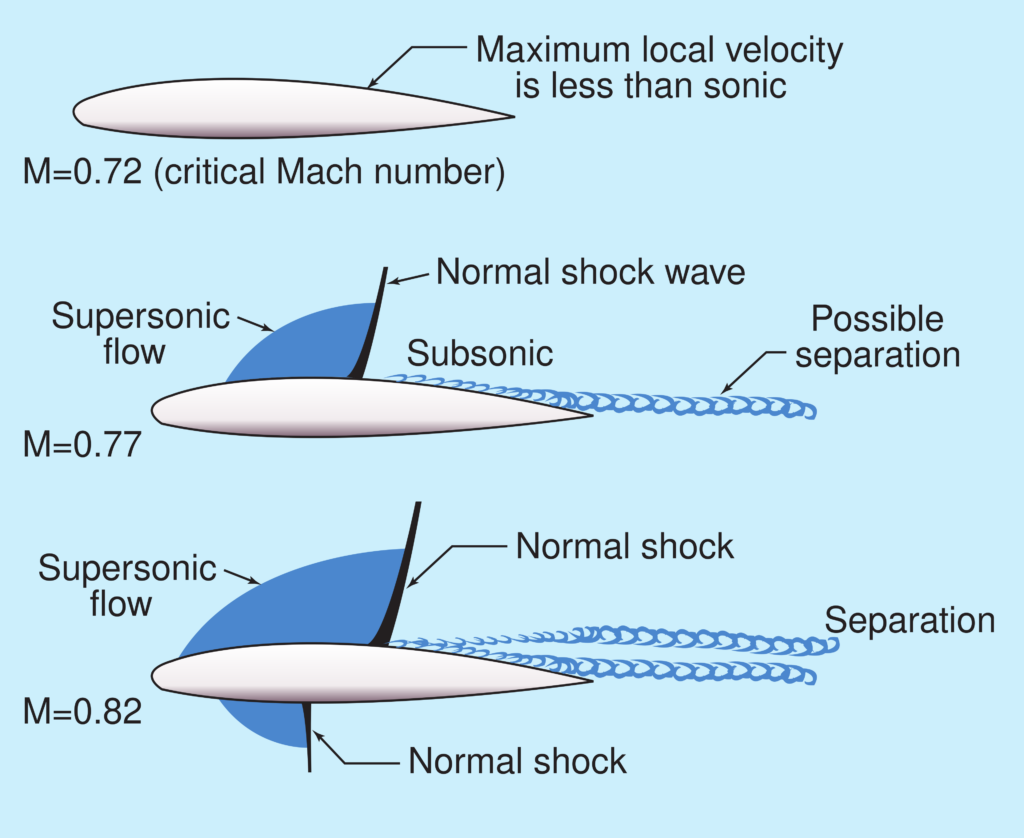
The critical Mach number is the lowest flight Mach number at which the airflow somewhere on the aircraft, usually over the top of the wing, first reaches the speed of sound. The aircraft as a whole is still flying below Mach 1, but locally the air is accelerating to sonic speed. For a typical straight wing it may be around Mach 0.7.
How it works
Air speeds up as it flows over the curved upper surface of a wing; that acceleration is part of how the wing makes lift. At low speed this does not matter. As the aircraft flies faster, the fastest air over the wing approaches Mach 1 before the aircraft does. When the aircraft reaches its critical Mach number, that local flow becomes sonic.
Above the critical Mach number, a small region of supersonic flow forms on the wing and ends in a shock wave. As speed increases further, the shock grows stronger and moves aft. The sudden pressure rise through the shock can make the boundary layer separate, which causes a steep increase in drag known as drag divergence, buffeting and changes in pitch trim.
How designers raise it
Several design choices push the critical Mach number higher. Thinner wings accelerate the air less. A swept wing reduces the speed component across the wing. Supercritical aerofoils, developed by NASA’s Richard Whitcomb, have a flatter upper surface that keeps the supersonic region weaker. Modern airliners combine all three, which is why they can cruise at about Mach 0.78 to 0.85.
Where you see it
Every jet airliner has a maximum operating Mach number (MMO) set below the speed at which buffeting or control problems would start. Pilots watch their Mach number at high altitude for this reason, and overspeed warnings protect the aircraft.
Why it matters
The critical Mach number explains why subsonic airliners do not simply fly faster: above it, fuel burn rises sharply because of wave drag. It also explains phenomena such as Mach tuck and why high-speed aircraft have swept, thin wings.
Drag divergence
A few hundredths of a Mach number above the critical Mach number, drag starts to climb steeply. Engineers call this point the drag-divergence Mach number, and airliners are designed to cruise just below it, where the extra speed is still worth the extra fuel.
Frequently Asked Questions
Is the critical Mach number the same as Mach 1? No. It is the aircraft speed at which local airflow first reaches Mach 1, so it is always below Mach 1.
What happens above the critical Mach number? Shock waves form on the wing and drag rises steeply.
How do airliners fly close to it? Swept, thin and supercritical wings raise the critical Mach number.
References
- FAA Pilot’s Handbook of Aeronautical Knowledge (FAA-H-8083-25), chapters 5 (Aerodynamics of Flight) and 6 (Flight Controls)
- FAA Airplane Flying Handbook (FAA-H-8083-3), chapter on transition to jet-powered airplanes
- NASA Glenn Research Center, Beginner’s Guide to Aeronautics: Mach number
Start the discussion
Commenting on this term: Critical Mach Number: When Airflow Over the Wing Goes Supersonic