








Last Updated: 4 months ago
A tiny rotor is a very small rotating aerodynamic component used to create lift, thrust, or airflow control in miniature flying systems. In aviation, the term usually refers to the small propeller-like rotors found on micro aerial vehicles, nano drones, and small unmanned aircraft systems.
Although the phrase sounds simple, the engineering behind these parts is surprisingly complex. A large helicopter rotor and a miniature drone rotor both move air to produce useful force. However, they do not behave in exactly the same way. At very small sizes, air acts differently around the blades, and designers must deal with unique aerodynamic challenges.
The term can also appear in broader mechanical engineering. In that context, it may describe a small rotating part inside a miniature turbine, electric motor, or MEMS device. In aviation and UAV technology, however, it most often describes a compact rotor that helps a very small aircraft fly.
Meaning in Aviation
In aviation terminology, a tiny rotor is not usually a formal regulatory category. It is a descriptive term. Engineers, drone designers, and aviation writers may use it when discussing ultra-small lift or propulsion systems.
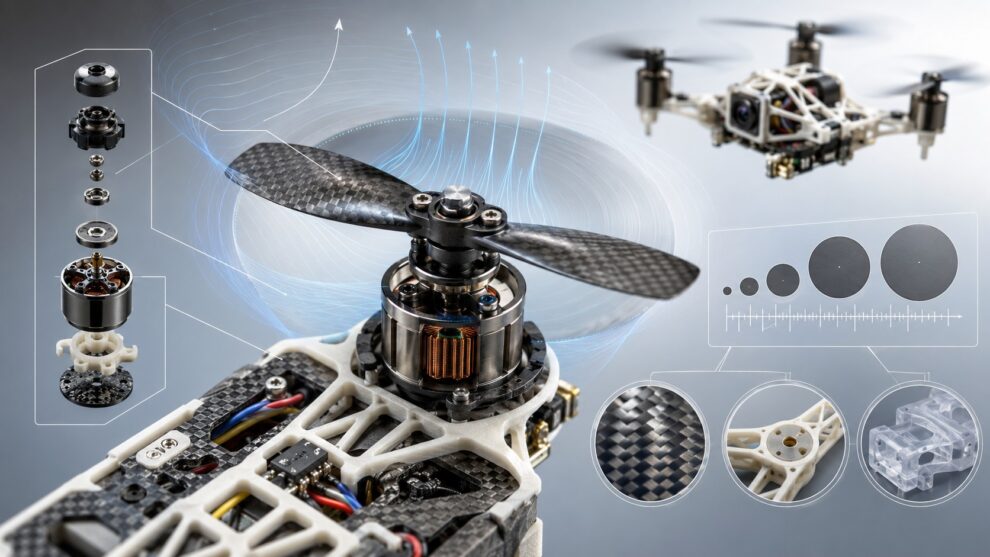
These rotors often appear on aircraft that weigh less than one hundred grams. Many nano quadcopters, indoor drones, and experimental micro aerial vehicles use rotors with diameters between twenty and sixty millimeters. Some research platforms may use even smaller designs.
The main job of the rotor is to accelerate air. When the blades spin, they push air downward or backward. This action creates lift or thrust, depending on the aircraft layout. In a quadcopter, four small rotors usually work together to lift, stabilize, and steer the aircraft.
Why Small Rotors Are Difficult to Design
Tiny rotors operate in a challenging aerodynamic environment. Their small size causes them to work at very low Reynolds numbers. This means air viscosity has a stronger effect on the flow around the blades.
At this scale, airflow can separate more easily from the blade surface. The rotor may lose efficiency faster than a larger propeller. Designers must also manage vibration, blade flexibility, motor response, and high rotational speed.
A small drone rotor can spin at very high RPM. This helps generate enough lift from a small blade area. However, high speed also creates noise, stress, and control challenges. If the rotor is too heavy, the motor wastes energy accelerating it. If the blade is too flexible, it may deform and reduce performance.
For this reason, material selection matters. Many tiny rotors use lightweight plastics, polymer blends, or carbon-fiber-reinforced materials. The goal is to keep the blade light, strong, and balanced.
Common Features of Tiny Rotors
| Feature | Typical Characteristic | Why It Matters |
|---|---|---|
| Size | Often around 20–60 mm in diameter | Allows use on nano drones and indoor UAVs |
| Weight | Extremely light construction | Reduces motor load and improves response |
| Material | Plastic, polymer, or carbon-fiber composite | Balances strength, flexibility, and low mass |
| Speed | High RPM operation | Helps produce lift from a small blade area |
| Aerodynamics | Designed for low Reynolds number flow | Improves efficiency at miniature scale |
| Application | Nano quadcopters, MAVs, research drones | Supports compact flight systems |
This comparison shows why a tiny rotor is not just a smaller version of a normal aircraft propeller. The physics, materials, and design priorities change as the scale becomes smaller.
Applications in UAV Technology
Tiny rotors are common in consumer nano drones. These small aircraft often fly indoors, where light weight and quick response matter more than long range. Their rotors allow them to hover, turn, climb, and descend in tight spaces.
Research teams also use micro rotors in experimental micro aerial vehicles. Some projects study insect-scale flight and bio-inspired design. Others explore search, inspection, mapping, or reconnaissance in confined environments.
In industrial use, small UAVs can inspect spaces that larger aircraft cannot enter. A compact drone with tiny rotors may fly inside buildings, warehouses, tanks, ducts, or other restricted areas. These aircraft can carry small cameras or sensors while keeping the overall system lightweight.
Tiny Rotor vs Standard Propeller
A standard aircraft propeller usually works at a larger scale and in a more predictable flow environment. It can use longer blades, lower rotational speeds, and more efficient airfoil sections.
A tiny rotor has less room to work with. The blade chord is small, the Reynolds number is low, and the motor must respond quickly. Efficiency can become harder to achieve. Designers often trade maximum efficiency for stability, durability, and compactness.
This is why nano drones usually have short flight times. Their batteries are small, and their rotors must spin fast to generate enough lift. Even small improvements in blade shape can make a noticeable difference.
Why the Term Matters
Understanding the term tiny rotor helps explain the engineering behind small drones and micro aerial vehicles. These parts may look simple, but they represent a careful balance between aerodynamics, material science, electronics, and flight control.
As drone technology continues to shrink, miniature rotors will remain important. They make indoor flight, compact inspection drones, and bio-inspired aerial research possible. In modern UAV design, small components can have a big effect on performance.
Did you know AviationStream.com has a YouTube channel? Check out TheAeroGraphyOfficial and subscribe to watch fun, highly engaging aviation Shorts!