Shock Wave and Wave Drag Explained for Aircraft
A shock wave forms when an aircraft or part of its airflow moves faster than sound. Across the shock, pressure and temperature jump abruptly, and the energy this costs appears as wave drag.
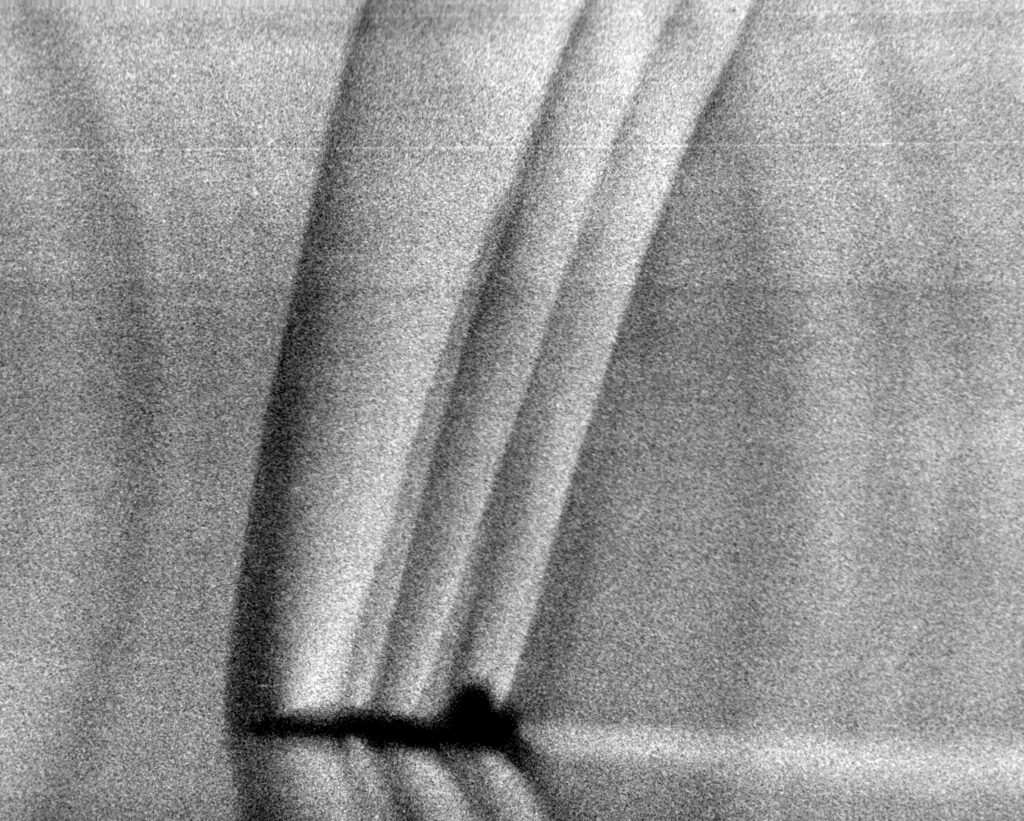
A shock wave is an extremely thin region in which the pressure, density and temperature of the air rise suddenly. Shock waves form when an aircraft, or the air flowing over part of it, moves faster than the speed of sound, so that pressure disturbances can no longer travel ahead and warn the air of what is coming. The energy lost in shock waves is felt as wave drag.
How shock waves form
At subsonic speed, the pressure changes created by an aircraft travel ahead of it at the speed of sound, and the air begins to move aside smoothly. At supersonic speed, the aircraft outruns these signals. The air is forced to change direction and pressure almost instantly, and these changes pile up into a shock wave.
There are two main types. A normal shock stands at right angles to the flow; behind it, the air is always subsonic. An oblique shock is angled to the flow, for example at the nose of a supersonic aircraft or the leading edge of a thin wing, and the air behind it can stay supersonic. When the aircraft is just above its critical Mach number, a small normal shock forms on top of the wing.
Wave drag
Every shock wave turns some of the aircraft’s energy into heat in the air, and that loss appears as an extra form of drag called wave drag. It rises steeply as an aircraft approaches Mach 1 and is the main reason the “sound barrier” was once thought impassable. Designers reduce it with thin, swept wings, sharp noses and the area rule.
Where you see them
Shock waves are invisible to the eye, but they can be photographed using the schlieren method, which shows changes in air density. NASA has photographed the shock waves of supersonic aircraft such as the T-38 in flight. On the ground, the shock waves of a supersonic aircraft are heard as a sonic boom. On airliners, a faint line sometimes visible on the wing in sunlight at cruise can be the shadow of a shock.
Why it matters
Shock waves set the limits of high-speed flight: they cause drag rise, buffeting, control problems and sonic booms. NASA’s X-59 research aircraft was built to shape its shock waves so that they reach the ground as a quiet “thump” instead of a boom.
Frequently Asked Questions
What causes a sonic boom? The shock waves of a supersonic aircraft reaching the ground.
What is wave drag? The drag caused by energy lost in shock waves at transonic and supersonic speeds.
What is the difference between a normal and an oblique shock? A normal shock is perpendicular to the flow; an oblique shock is angled.
References
- NASA Glenn Research Center, Beginner’s Guide to Aeronautics: Normal shock wave
- NASA Glenn Research Center, Beginner’s Guide to Aeronautics: Oblique shock waves
- FAA Pilot’s Handbook of Aeronautical Knowledge (FAA-H-8083-25), chapters 5 (Aerodynamics of Flight) and 6 (Flight Controls)
Start the discussion
Commenting on this term: Shock Wave and Wave Drag Explained for Aircraft