Dutch Roll and the Yaw Damper Explained
Dutch roll is a combined wagging and rocking motion in which an aircraft yaws and rolls from side to side. Swept-wing jets are prone to it, so they are fitted with a yaw damper that moves the rudder automatically.
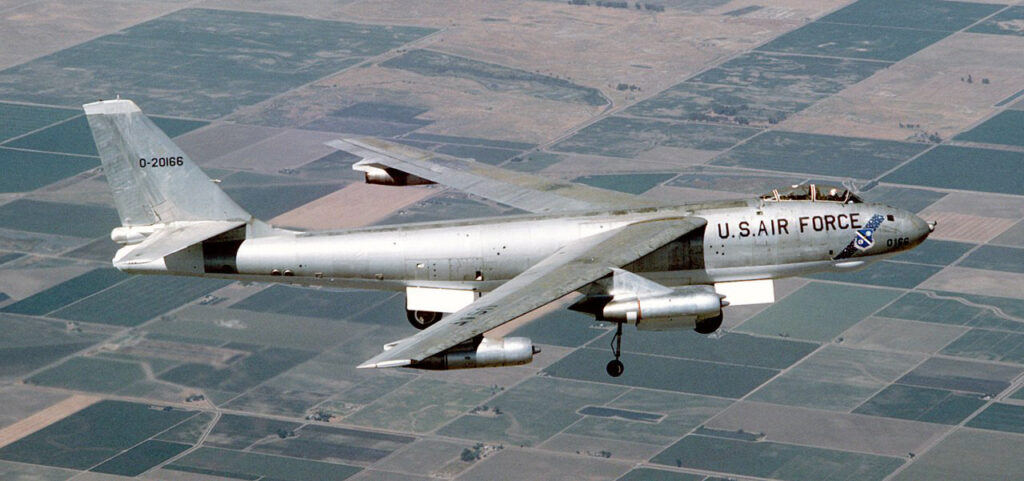
Dutch roll is an oscillation in which an aircraft yaws and rolls at the same time, so that the nose traces a figure-of-eight or a flattened circle while the wings rock from side to side. It happens when an aircraft’s lateral (roll) stability is strong compared with its directional (yaw) stability. Swept-wing jet aircraft are especially prone to it, and most of them have a yaw damper to suppress it.
Why Dutch roll happens
Imagine a gust yaws the nose to the right. On a swept-wing aircraft, the left wing now meets the air more squarely and produces more lift, so the aircraft also rolls to the right. The vertical fin then pushes the nose back to the left, but it overshoots; now the right wing gains lift and the aircraft rolls the other way. If the fin’s damping is weak compared with the rolling effect, this cycle repeats every few seconds. The name is often linked to the rhythmic motion of a skater on Dutch canals.
The yaw damper
Pilots can stop Dutch roll with careful aileron inputs, but the motion is tiring and can be made worse by inputs at the wrong moment. The solution is a yaw damper, an automatic system that senses the yaw rate with a gyro or the flight control computers and moves the rudder to oppose it. The system was developed for the Boeing B-47 Stratojet in the late 1940s, one of the first swept-wing jet bombers, and it has been standard on jet airliners ever since. On many types, the yaw damper must be working for flight at high altitude.
Where you see it
Passengers rarely notice Dutch roll because the yaw damper works continuously. If it fails, the crew may notice a slow wallowing motion and follow procedures that limit altitude or speed. On fly-by-wire aircraft such as the Airbus A320 and Boeing 777, yaw damping is part of the normal flight control laws.
Why it matters
Uncontrolled Dutch roll can be uncomfortable, can overstress the fin if the rudder is used wrongly, and makes precise flying difficult. Understanding the coupling between yaw and roll also explains why the vertical stabilizer of a jet is sized the way it is.
Dutch roll in certification
Aircraft must show acceptable Dutch roll damping during certification. If the natural damping is too weak, the yaw damper becomes a required system, and the aircraft flight manual lists what the crew must do if it fails, such as descending to a lower altitude.
Frequently Asked Questions
What is Dutch roll? A combined yawing and rolling oscillation of an aircraft.
Which aircraft are most prone to Dutch roll? Swept-wing aircraft with relatively weak directional stability.
What does a yaw damper do? It automatically moves the rudder to damp out yaw oscillations.
References
- FAA Pilot’s Handbook of Aeronautical Knowledge (FAA-H-8083-25), chapters 5 (Aerodynamics of Flight) and 6 (Flight Controls)
- FAA Airplane Flying Handbook (FAA-H-8083-3), chapter on transition to jet-powered airplanes
Start the discussion
Commenting on this term: Dutch Roll and the Yaw Damper Explained