Autopilot and Autothrottle Explained: How Airliners Fly Themselves
An autopilot is a system that moves an aircraft's flight controls to follow a path chosen by the pilots, while the autothrottle (autothrust on Airbus) controls engine power. Together they can fly almost the whole flight, including the landing.
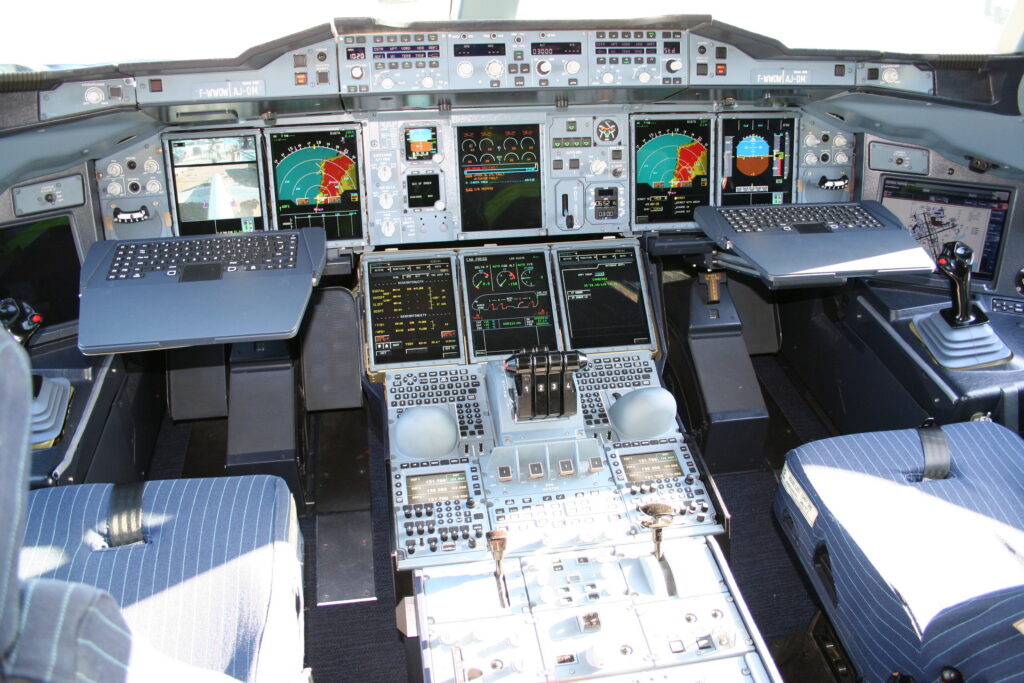
An autopilot is a system that flies an aircraft along a path chosen by the pilots by moving the flight controls automatically. Its partner, the autothrottle (called autothrust on Airbus aircraft), controls the engines’ power to hold a target speed or thrust. On an airliner the two systems can fly almost the entire flight, from shortly after take-off to the landing, but the pilots remain in command and must monitor them constantly.
How it works
The autopilot uses information from the air data computers, inertial reference units, navigation receivers and the flight management system. It compares where the aircraft is with where it should be and sends commands to the pitch, roll and sometimes yaw actuators. Pilots choose what the autopilot does through modes, selected on a glareshield panel called the mode control panel (Boeing) or flight control unit (Airbus):
- Lateral modes: heading select, or LNAV/NAV to follow the route in the flight management system.
- Vertical modes: altitude hold, vertical speed, flight level change, or VNAV to follow the planned climb and descent profile.
- Approach modes: following the localiser and glideslope of an instrument landing system.
The active modes are shown at the top of the primary flight display on the flight deck, and pilots call out every mode change.
The autothrottle
The autothrottle adjusts engine power to hold the selected speed, or sets climb or take-off thrust. On Boeing aircraft the thrust levers move physically as it works. On most Airbus types, including the A320 family, A330, A350 and A380, the levers stay in fixed detents and the autothrust changes power without moving them, which is one of the main differences pilots notice when they change type. The A220, designed by Bombardier, is an exception: its thrust levers move with the autothrust.
Autoland
Many airliners can land automatically in fog, flaring, touching down and tracking the runway centreline, typically with two or three autopilots engaged. This allows landings in Category II or III conditions with very low visibility, but only when the aircraft and all its required systems are serviceable, the runway and its instrument landing system are approved for the approach category, and the crew and airline hold the operational approval for it.
History
Lawrence Sperry demonstrated a gyroscopic stabiliser in France in 1914 by standing up in the cockpit with his hands off the controls while his mechanic walked out on the wing. Modern autopilots have grown from that idea into systems that are linked to every part of the aircraft.
Why it matters
Automation reduces workload and flies more precisely than a person can for hours at a time, which improves safety and saves fuel. But it can also lead to confusion about what mode is active. In the Asiana Airlines Flight 214 accident at San Francisco in 2013, the NTSB found that the crew did not realise the autothrottle was no longer controlling speed, and the aircraft became too slow and too low on approach. Modern training stresses monitoring, clear mode awareness and crew resource management.
Frequently Asked Questions
Can an autopilot land a plane? Yes. Many airliners can land automatically using autoland, mainly in low visibility.
Does the autopilot take off? No. Pilots fly the take-off by hand and engage the autopilot shortly afterwards.
What is the difference between autothrottle and autothrust? They do the same job; autothrust is Airbus’s name, and on most Airbus types the thrust levers do not move.
References
- 14 CFR 25.1329, Flight guidance system
- FAA Aviation Maintenance Technician Handbook – Airframe (FAA-H-8083-31), chapter on aircraft instrument systems (autopilot systems)
- NTSB Aircraft Accident Report AAR-14/01: Asiana Airlines Flight 214
Start the discussion
Commenting on this term: Autopilot and Autothrottle Explained: How Airliners Fly Themselves