TCAS Explained: How Airliners Avoid Mid-Air Collisions
TCAS (Traffic Alert and Collision Avoidance System) is an airborne system that tracks nearby aircraft through their transponders. It gives traffic advisories and, in TCAS II, resolution advisories telling pilots to climb or descend to avoid a collision.
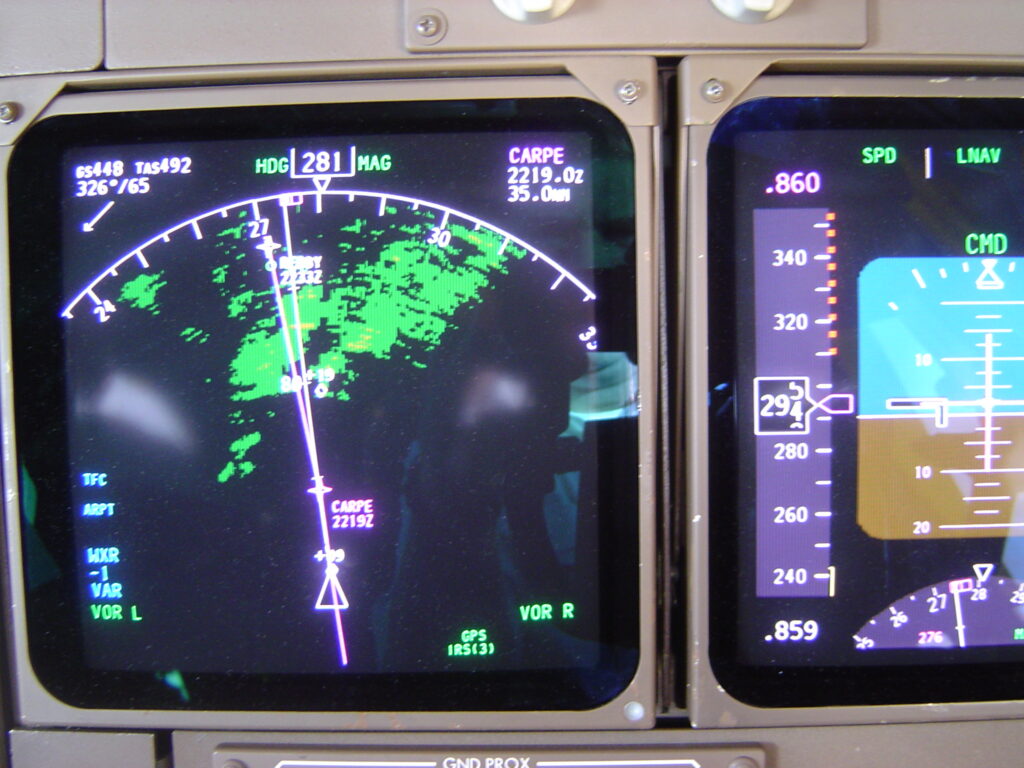
TCAS, the Traffic Alert and Collision Avoidance System, is an airborne system that warns pilots of other aircraft nearby and, in its most capable form, tells them how to avoid a collision. It works independently of air traffic control: the aircraft interrogates the transponders of other aircraft around it, calculates whether any are on a collision course, and alerts the crew. The international name for the same type of system is ACAS (airborne collision avoidance system).
How it works
TCAS sends interrogation signals on the same frequency used by ground secondary radar. Transponders on other aircraft reply, and from each reply TCAS works out the other aircraft’s range from the time the signal took, its bearing from a directional antenna, and its altitude from the altitude reported by its transponder. Tracking these values over time gives each intruder’s closing rate. TCAS does not see aircraft without a working transponder.
Alerts are based on time to the closest point of approach rather than distance alone:
- Traffic advisory (TA): the voice “Traffic, traffic” and a symbol on the display warn that an aircraft may become a threat, typically 20 to 48 seconds before the closest approach.
- Resolution advisory (RA): if the threat continues, TCAS II commands a vertical manoeuvre, such as “Climb, climb” or “Descend, descend”, or tells the crew to adjust vertical speed. The required vertical speed is shown on the primary flight display of the EFIS.
When both aircraft have TCAS II, they coordinate their manoeuvres through their Mode S transponders, so that one climbs and the other descends.
TCAS I and TCAS II
TCAS I, used on some smaller aircraft, gives traffic advisories only. TCAS II gives resolution advisories in the vertical plane and is required on airliners. The current standard is version 7.1. Since 2005, ICAO standards have called for ACAS II on turbine aeroplanes with a maximum take-off mass above 5,700 kg or more than 19 passenger seats, and in the United States 14 CFR 121.356 requires TCAS II on airline aircraft with more than 30 seats.
Why pilots must follow an RA
On 1 July 2002, a Tupolev Tu-154 and a Boeing 757 collided over Überlingen, Germany. TCAS told the Tu-154 crew to climb, but an air traffic controller, unaware of the RA, instructed them to descend, and they followed the controller; the 757 was descending in response to its own RA. After the accident, the rules were made clear: pilots must follow a resolution advisory promptly, even if it conflicts with an ATC instruction, and report it to ATC as soon as possible. Responding to an RA is now a standard part of crew resource management and simulator training.
Frequently Asked Questions
Does TCAS see every aircraft? No. It detects only aircraft with an operating transponder.
Can TCAS tell pilots to turn? No. TCAS II resolution advisories are vertical only: climb, descend or adjust vertical speed.
Is TCAS the same as ADS-B? No, but they work together; ADS-B broadcasts position data that can improve traffic displays.
References
- FAA Aeronautical Information Manual, chapter 4, section 4: ATC Clearances and Aircraft Separation (TCAS)
- 14 CFR 121.356, Collision avoidance system
- SKYbrary (EUROCONTROL): T154 / B752, en-route, Überlingen, Germany, 2002, summary of BFU investigation report AX001-1-2/02
Start the discussion
Commenting on this term: TCAS Explained: How Airliners Avoid Mid-Air Collisions