Spar, Rib and Stringer: How an Aircraft Wing Is Built
An aircraft wing is built around spars, the main spanwise beams. Ribs give the wing its aerofoil shape and stringers stiffen the skin, and together they form a strong, light wing box.
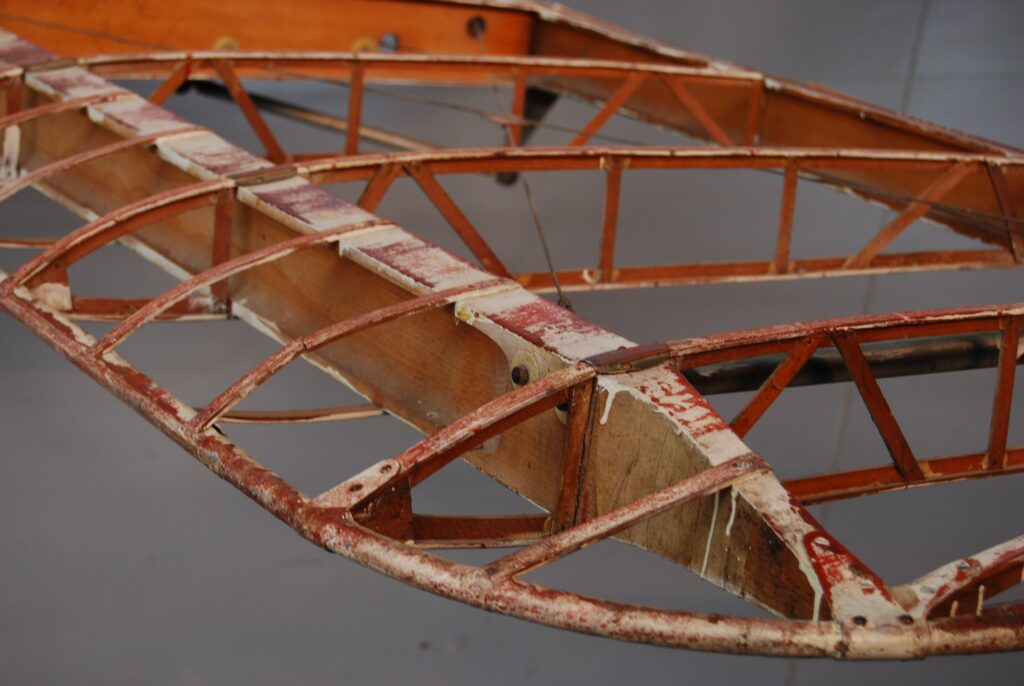
A wing spar is the main structural beam of a wing, running from the root to the tip and carrying most of the bending load. Ribs run across the wing from the leading edge to the trailing edge and give it its aerofoil shape. Stringers are light members running along the span that stiffen the skin. Together with the skin, these parts form the wing’s load-carrying structure.
The spar
In flight, the wing bends upwards under lift, a little like a diving board under a jumper. The spar resists this bending. A typical metal spar is an I-beam or C-beam: the top and bottom flanges, called spar caps, carry the bending as compression and tension, while the thin vertical web between them carries the shear force.
Small aircraft may have a single main spar, sometimes with a lighter rear spar to carry the aileron and flap hinges. Airliners have a front spar and a rear spar, and very large wings may add a centre spar near the root. On the Boeing 787 and Airbus A350, the spars and wing skins are made of carbon fibre composite instead of aluminium.
The rib
Ribs are the wing’s cross-sections. They hold the skin in the right aerofoil shape, pass the air loads from the skin to the spars, and stop the skin and stringers from buckling. Ribs can be solid plates with lightening holes, built-up trusses or, in older aircraft, frameworks of wood strips. In an airliner, some ribs also act as walls of the integral fuel tanks, with baffles that stop fuel from surging.
The stringer
Stringers run along the span between the ribs and are riveted or bonded to the inner surface of the skin. They turn thin skin panels into stiff panels that can carry compression without wrinkling, especially on the upper surface, which is squeezed as the wing bends upwards.
The wing box
On modern aircraft, the front spar, rear spar, upper skin and lower skin form a closed box called the torsion box or wing box. A closed box is very good at resisting twisting as well as bending. It also makes a convenient fuel tank. The leading edge, with its slats, and the trailing edge, with its flaps and ailerons, are attached to the front and rear of this box.
Where you see it
On a fabric-covered biplane such as the de Havilland DH.60 Moth, the wooden spars and ribs can be seen clearly whenever the covering is removed for restoration. On an airliner the structure is hidden, but the spar positions can often be traced by the lines of fasteners on the wing’s upper surface.
Why it matters
The spars are primary structure: damage to them can endanger the aircraft, so they are inspected carefully for cracks and corrosion, and repairs need approved data. Knowing how loads flow from skin to stringer, rib and spar is the basis of every structural repair.
Frequently Asked Questions
What does a wing spar do? It carries the wing’s bending load from tip to root.
What is the purpose of wing ribs? They give the wing its aerofoil shape and pass loads to the spars.
What is a wing box? The closed box formed by the spars and skins, which resists bending and twisting.
References
- FAA Aviation Maintenance Technician Handbook – Airframe (FAA-H-8083-31), chapter 1: Aircraft Structures
- FAA Advisory Circular 43.13-1B, Acceptable Methods, Techniques and Practices – Aircraft Inspection and Repair



Start the discussion
Commenting on this term: Spar, Rib and Stringer: How an Aircraft Wing Is Built